Biomedical Imaging Institute, The University of Manchester, Oxford Road, Manchester M13 9PT, UK.
Arthritis Res Ther. 2010;12(5):R202. doi: 10.1186/ar3174. Epub 2010 Oct 28.
Cartilage thickness from MR images has been identified as a possible biomarker in knee osteoarthritis (OA) research. The ability to acquire MR data at multiple centers by using different vendors' scanners would facilitate patient recruitment and shorten the duration of OA trials. Several vendors manufacture 3T MR scanners, including Siemens, Philips Medical Systems, and GE Healthcare. This study investigates whether quantitative MR assessments of cartilage morphology are comparable between scanners of three different vendors.
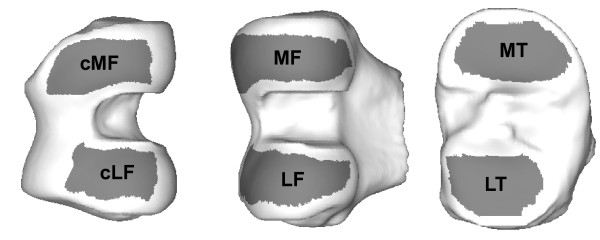
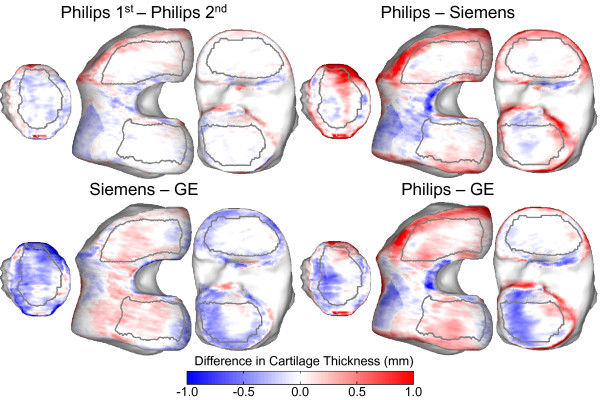
Twelve subjects with symptoms of knee OA and one or more risk factors had their symptomatic knee scanned on each of the three vendor's scanners located in three sites in the UK: Manchester (Philips), York (GE), and Liverpool (Siemens). The NIH OAI study protocol was used for the Siemens scanner, and equivalent protocols were developed for the Philips and GE scanners with vendors' advice. Cartilage was segmented manually from sagittal 3D images. By using recently described techniques for Anatomically Corresponded Regional Analysis of Cartilage (ACRAC), a statistical model was used anatomically to align all the images and to produce detailed maps of mean differences in cartilage-thickness measures between scanners. Measures of cartilage mean thickness were computed in anatomically equivalent regions for each subject and scanner image.
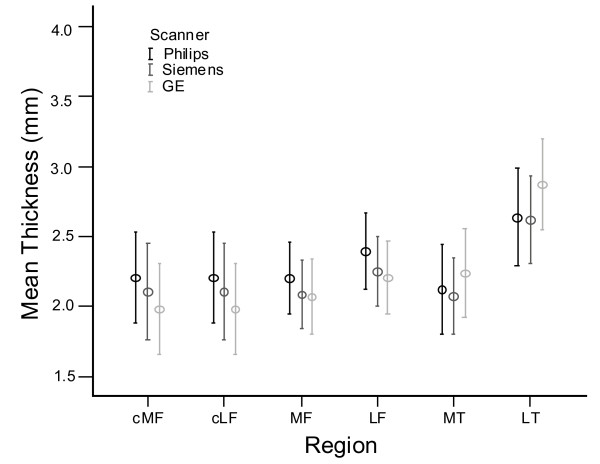
The ranges of mean cartilage-thickness measures for this cohort were similar for all regions and across all scanners. Philips intrascanner root-mean-square coefficients of variation were low in the range from 2.6% to 4.6%. No significant differences were found for thickness measures of the weight-bearing femorotibial regions from the Philips and Siemens images except for the central medial femur compartment (P = 0.04). Compared with the other two scanners, the GE scanner provided consistently lower mean thickness measures in the central femoral regions (mean difference, -0.16 mm) and higher measures in the tibial compartments (mean difference, +0.19 mm).
The OAI knee-imaging protocol, developed on the Siemens platform, can be applied to research and trials by using other vendors' 3T scanners giving comparable morphologic results. Accurate sequence optimization, differences in image postprocessing, and extremity coil type are critical factors for interscanner precision of quantitative analysis of cartilage morphology. It is still recommended that longitudinal observations on individuals should be performed on the same scanner and that assessment of intra- and interscanner precision errors is undertaken before commencement of the main study.
磁共振成像(MRI)中的软骨厚度已被确定为膝关节骨关节炎(OA)研究中的一个潜在生物标志物。通过使用不同供应商的扫描仪在多个中心获取 MRI 数据,将有助于招募患者并缩短 OA 试验的持续时间。有几家供应商生产 3T 的 MRI 扫描仪,包括西门子、飞利浦医疗系统和通用电气医疗集团。本研究旨在调查来自三个不同供应商的扫描仪之间,软骨形态的定量 MRI 评估是否具有可比性。
12 名有膝关节 OA 症状且有一个或多个危险因素的患者,在英国三个地点的三台不同供应商的 MRI 扫描仪上进行了膝关节扫描:曼彻斯特(飞利浦)、约克(GE)和利物浦(西门子)。西门子扫描仪使用 NIH OAI 研究方案,根据供应商的建议,为飞利浦和 GE 扫描仪制定了等效方案。通过使用最近描述的解剖对应区域软骨分析(ACRAC)技术,使用统计学模型对所有图像进行解剖对齐,并生成扫描仪间软骨厚度测量值差异的详细图谱。为每个患者和扫描仪图像计算了解剖学上等效区域的软骨平均厚度测量值。
该队列的所有区域和所有扫描仪的平均软骨厚度测量值范围相似。飞利浦扫描仪的内部扫描均方根变异系数在 2.6%至 4.6%之间较低。除了中央内侧股骨间室(P=0.04),飞利浦和西门子图像的负重股骨胫骨区域的厚度测量值没有发现显著差异。与其他两台扫描仪相比,GE 扫描仪在中央股骨区域提供的平均厚度测量值始终较低(平均差异为-0.16 毫米),在胫骨区域的测量值较高(平均差异为+0.19 毫米)。
基于西门子平台开发的 OAI 膝关节成像方案,可应用于使用其他供应商 3T 扫描仪进行的研究和试验,提供可比的形态学结果。准确的序列优化、图像后处理差异和肢体线圈类型是定量分析软骨形态的扫描仪间精度的关键因素。仍然建议对个体进行纵向观察时,应在同一台扫描仪上进行,并且在进行主要研究之前,应进行扫描仪内和扫描仪间精度误差的评估。