An Heeyoung, Lee Hyowon, Yang Seulkee, Won Woojin, Lee C Justin, Nam Min-Ho
KU-KIST Graduate School of Converging Science and Technology, Korea University, Seoul 02841, Korea.
Brain Science Institute, Korea Institute of Science and Technology (KIST), Seoul 02792, Korea.
Exp Neurobiol. 2021 Jun 30;30(3):222-231. doi: 10.5607/en21013.
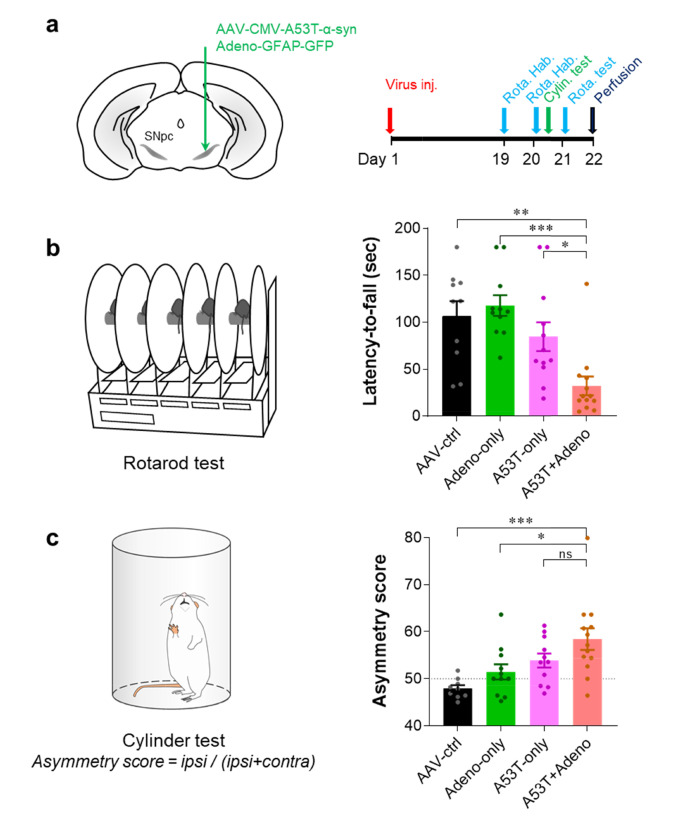
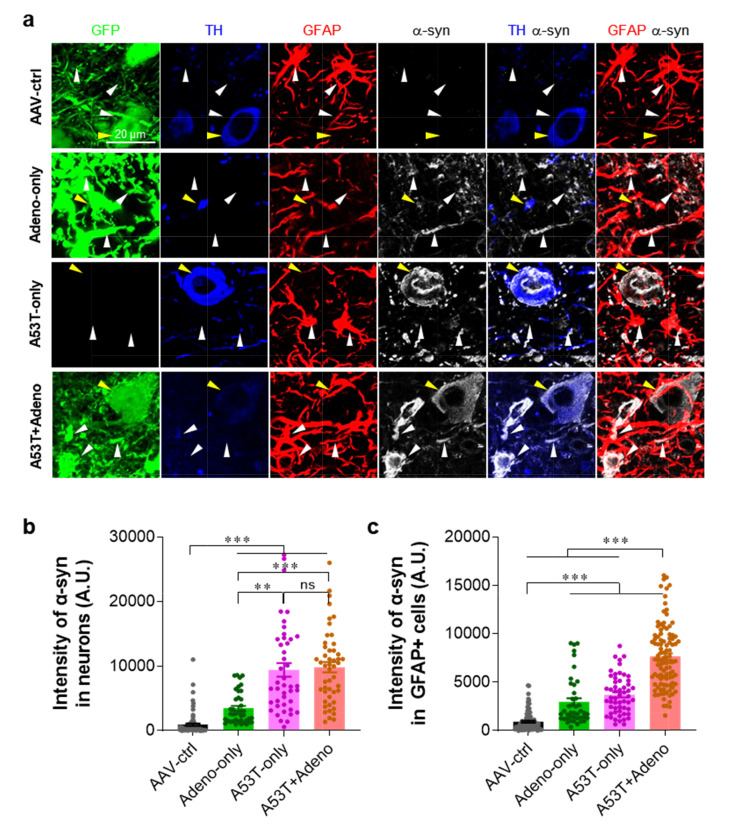
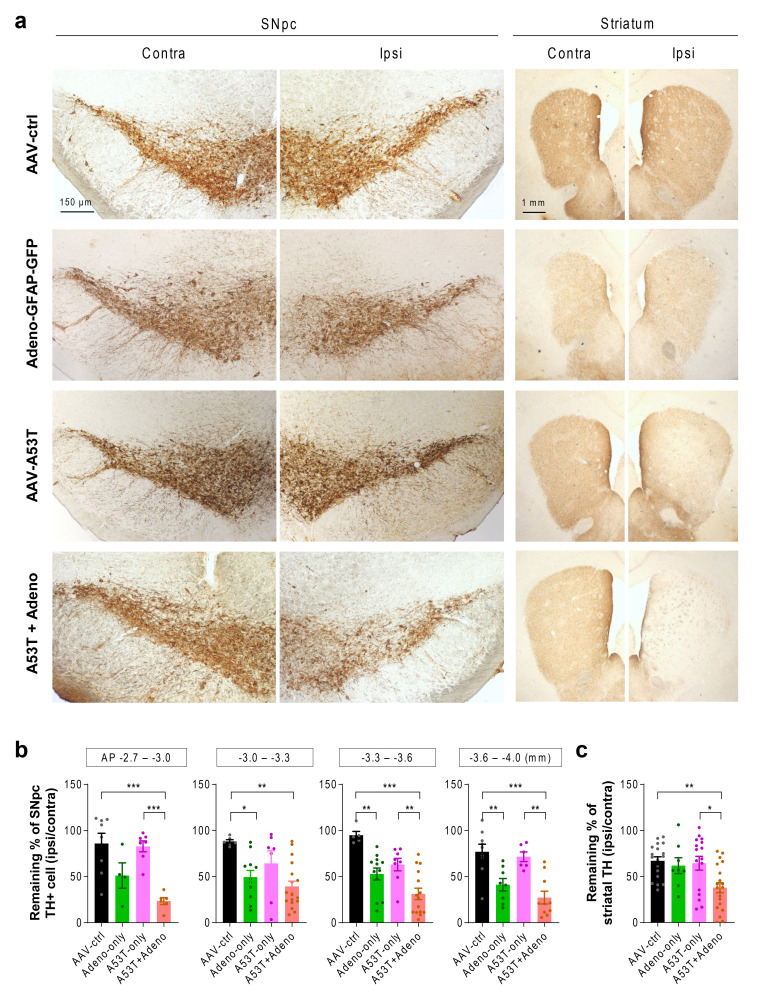
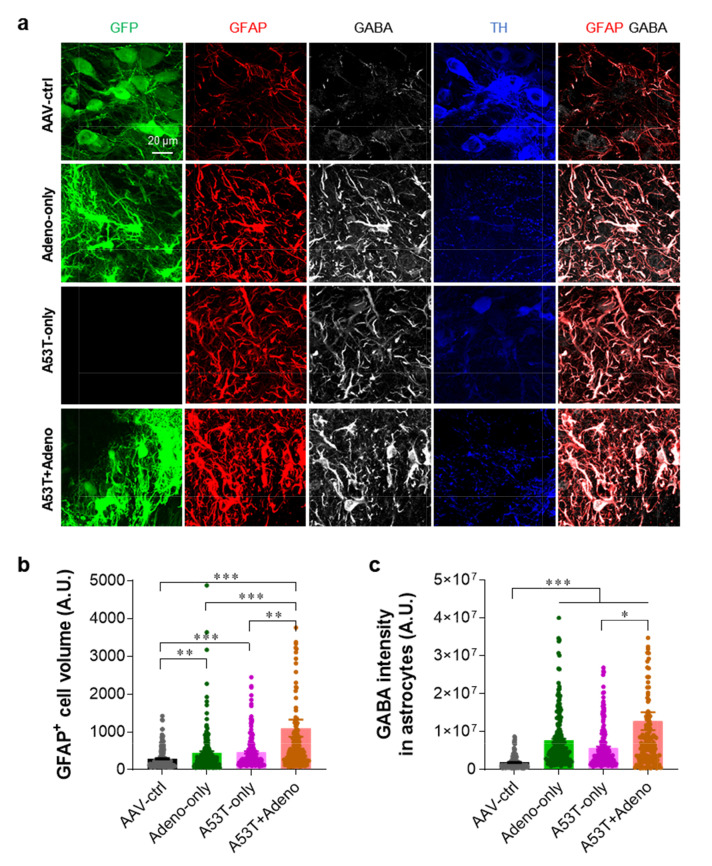
Parkinson's disease (PD) is the most prevalent neurodegenerative motor disorder. While PD has been attributed to dopaminergic neuronal death in substantia nigra pars compacta (SNpc), accumulating lines of evidence have suggested that reactive astrogliosis is critically involved in PD pathology. These pathological changes are associated with α-synuclein aggregation, which is more prone to be induced by an A53T mutation. Therefore, the overexpression of A53T-mutated α-synuclein (A53T-α-syn) has been utilized as a popular animal model of PD. However, this animal model only shows marginal-to-moderate extents of reactive astrogliosis and astrocytic α-synuclein accumulation, while these phenomena are prominent in human PD brains. Here we show that Adeno-GFAP-GFP virus injection into SNpc causes severe reactive astrogliosis and exacerbates the A53T-α-syn-mediated PD pathology. In particular, we demonstrate that AAV-CMV-A53T-α-syn injection, when combined with Adeno-GFAP-GFP, causes more significant loss of dopaminergic neuronal tyrosine hydroxylase level and gain of astrocytic GFAP and GABA levels. Moreover, the combination of AAV-CMV-A53T-α-syn and Adeno-GFAP-GFP causes an extensive astrocytic α-syn expression, just as in human PD brains. These results are in marked contrast to previous reports that AAV-CMV-A53T-α-syn alone causes α-syn expression mostly in neurons but rarely in astrocytes. Furthermore, the combination causes a severe PD-like motor dysfunction as assessed by rotarod and cylinder tests within three weeks from the virus injection, whereas Adeno-GFAP-GFP alone or AAV-CMV-A53T-α-syn alone does not. Our findings implicate that inducing reactive astrogliosis exacerbates PD-like pathologies and propose the virus combination as an advanced strategy for developing a new animal model of PD.
帕金森病(PD)是最常见的神经退行性运动障碍。虽然PD被认为是由于黑质致密部(SNpc)中多巴胺能神经元死亡所致,但越来越多的证据表明,反应性星形胶质细胞增生在PD病理过程中起关键作用。这些病理变化与α-突触核蛋白聚集有关,A53T突变更容易诱导这种聚集。因此,A53T突变的α-突触核蛋白(A53T-α-突触核蛋白)的过表达已被用作一种常用的PD动物模型。然而,这种动物模型仅表现出边缘到中度程度的反应性星形胶质细胞增生和星形细胞α-突触核蛋白积累,而这些现象在人类PD大脑中很突出。在这里,我们表明向SNpc注射腺病毒-GFAP-GFP病毒会导致严重的反应性星形胶质细胞增生,并加剧A53T-α-突触核蛋白介导的PD病理。特别是,我们证明,当腺相关病毒-CMV-A53T-α-突触核蛋白注射与腺病毒-GFAP-GFP联合使用时,会导致多巴胺能神经元酪氨酸羟化酶水平更显著的降低以及星形细胞GFAP和GABA水平的升高。此外,腺相关病毒-CMV-A53T-α-突触核蛋白和腺病毒-GFAP-GFP的联合使用会导致广泛的星形细胞α-突触核蛋白表达,就像在人类PD大脑中一样。这些结果与之前的报道形成了鲜明对比,之前的报道称单独的腺相关病毒-CMV-A53T-α-突触核蛋白主要在神经元中引起α-突触核蛋白表达,而在星形胶质细胞中很少见。此外,从病毒注射开始三周内,通过转棒试验和圆筒试验评估,这种联合使用会导致严重的类似PD的运动功能障碍,而单独使用腺病毒-GFAP-GFP或腺相关病毒-CMV-A53T-α-突触核蛋白则不会。我们的研究结果表明,诱导反应性星形胶质细胞增生会加剧类似PD的病理变化,并提出病毒联合使用作为开发新的PD动物模型的一种先进策略。