Dutch Institute for Healthcare Improvement, Utrecht, The Netherlands.
Implement Sci. 2010 Oct 28;5:84. doi: 10.1186/1748-5908-5-84.
To increase the effectiveness of quality-improvement collaboratives (QICs), it is important to explore factors that potentially influence their outcomes. For this purpose, we have developed and tested the psychometric properties of an instrument that aims to identify the features that may enhance the quality and impact of collaborative quality-improvement approaches. The instrument can be used as a measurement instrument to retrospectively collect information about perceived determinants of success. In addition, it can be prospectively applied as a checklist to guide initiators, facilitators, and participants of QICs, with information about how to perform or participate in a collaborative with theoretically optimal chances of success. Such information can be used to improve collaboratives.
We developed an instrument with content validity based on literature and the opinions of QIC experts. We collected data from 144 healthcare professionals in 44 multidisciplinary improvement teams participating in two QICs and used exploratory factor analysis to assess the construct validity. We used Cronbach's alpha to ascertain the internal consistency.
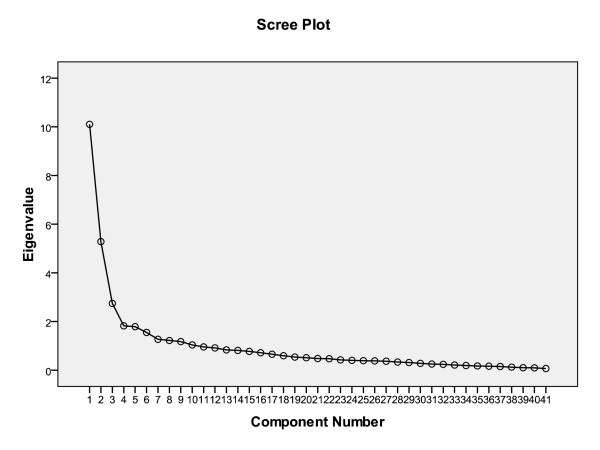
The 50-item instrument we developed reflected expert-opinion-based determinants of success in a QIC. We deleted nine items after item reduction. On the basis of the factor analysis results, one item was dropped, which resulted in a 40-item questionnaire. Exploratory factor analysis showed that a three-factor model provided the best fit. The components were labeled 'sufficient expert team support', 'effective multidisciplinary teamwork', and 'helpful collaborative processes'. Internal consistency reliability was excellent (alphas between .85 and .89).
This newly developed instrument seems a promising tool for providing healthcare workers and policy makers with useful information about determinants of success in QICs. The psychometric properties of the instrument are satisfactory and warrant application either as an objective measure or as a checklist.
为了提高质量改进合作(QIC)的效果,探索可能影响其结果的因素非常重要。为此,我们开发并测试了一种工具的心理测量特性,旨在确定可能提高合作质量和影响力的特征。该工具可用作回顾性收集关于成功决定因素的信息的测量工具。此外,它可以前瞻性地作为清单应用,为 QIC 的发起者、促进者和参与者提供有关如何以理论上最佳成功机会执行或参与合作的信息。这些信息可用于改进合作。
我们根据文献和 QIC 专家的意见开发了一种具有内容效度的工具。我们从参与两个 QIC 的 144 名医疗保健专业人员和 44 个多学科改进团队中收集数据,并使用探索性因素分析来评估结构有效性。我们使用 Cronbach's alpha 来确定内部一致性。
我们开发的 50 项工具反映了 QIC 中成功的专家意见决定因素。在项目减少后,我们删除了九个项目。基于因素分析结果,删除了一个项目,最终得到了一个 40 项的问卷。探索性因素分析表明,三因素模型提供了最佳拟合。组件被标记为“充足的专家团队支持”、“有效的多学科团队合作”和“有益的合作过程”。内部一致性可靠性非常好(alpha 值在.85 到.89 之间)。
这种新开发的工具似乎是为医疗保健工作者和决策者提供有关 QIC 成功决定因素的有用信息的有前途的工具。该工具的心理测量特性令人满意,值得作为客观衡量标准或清单应用。