National Institute of Plant Genome Research, New Delhi 110067, India.
J Exp Bot. 2011 Jan;62(2):571-82. doi: 10.1093/jxb/erq289. Epub 2010 Oct 28.
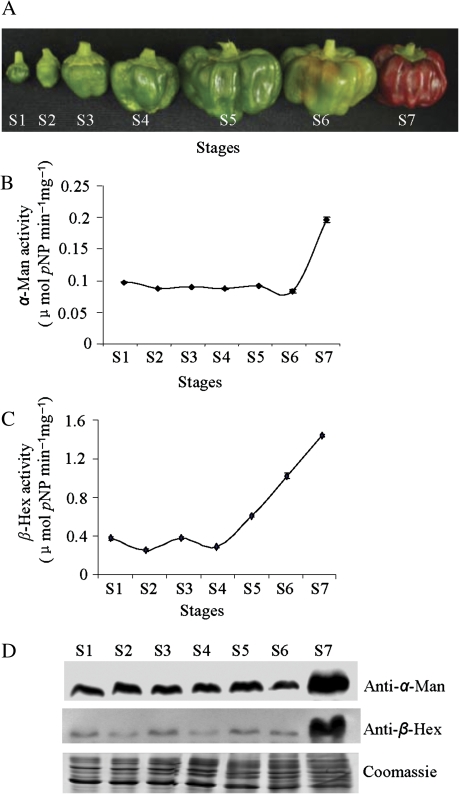
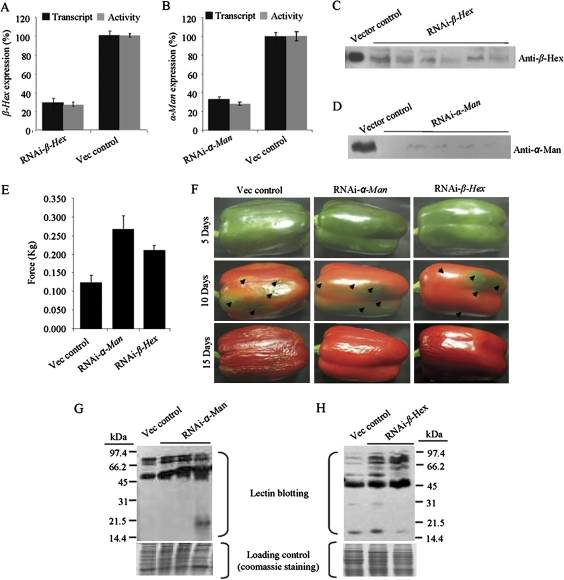
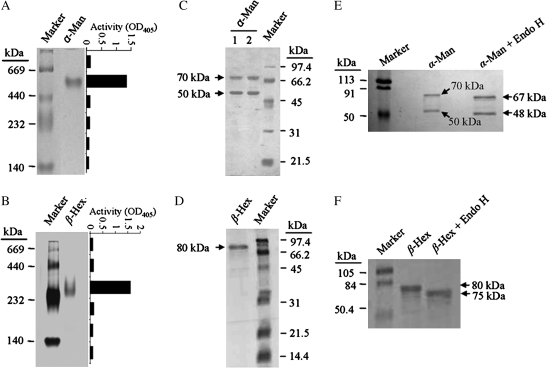
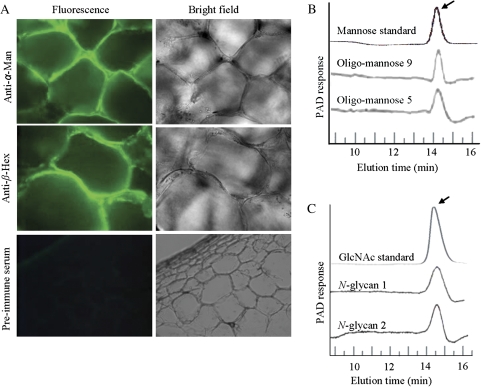
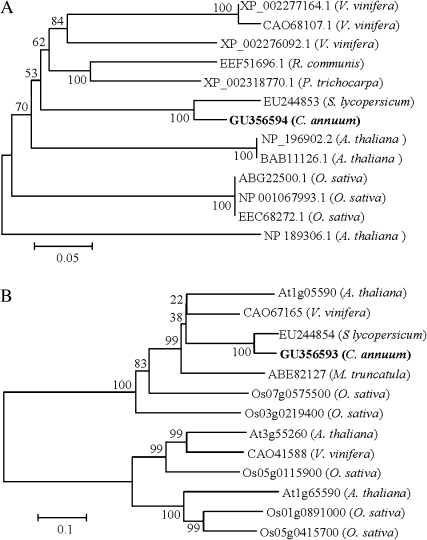
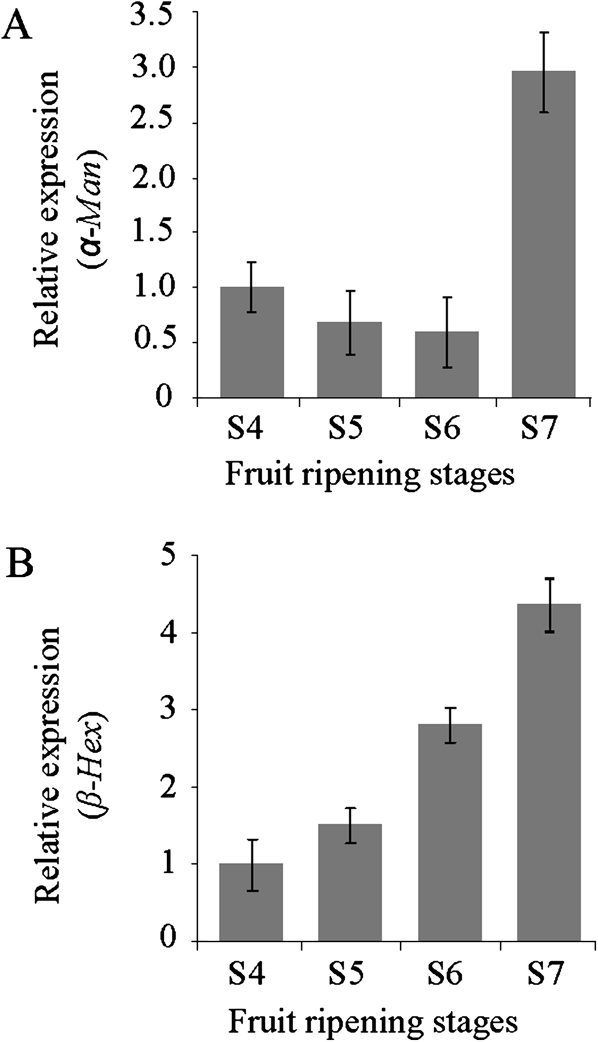
Excessive softening of fruits during the ripening process leads to deterioration. This is of significant global importance as softening-mediated deterioration leads to huge postharvest losses. N-glycan processing enzymes are reported to play an important role during climacteric fruit softening: however, to date these enzymes have not been characterized in non-climacteric fruit. Two ripening-specific N-glycan processing enzymes, α-mannosidase (α-Man) and β-D-N-acetylhexosaminidase (β-Hex), have been identified and targeted to enhance the shelf life in non-climacteric fruits such as capsicum (Capsicum annuum). The purification, cloning, and functional characterization of α-Man and β-Hex from capsicum, which belong to glycosyl hydrolase (GH) families 38 and 20, respectively, are described here. α-Man and β-Hex are cell wall glycoproteins that are able to cleave terminal α-mannose and β-D-N-acetylglucosamine residues of N-glycans, respectively. α-Man and β-Hex transcripts as well as enzyme activity increase with the ripening and/or softening of capsicum. The function of α-Man and β-Hex in capsicum softening is investigated through RNA interference (RNAi) in fruits. α-Man and β-Hex RNAi fruits were approximately two times firmer compared with the control and fruit deterioration was delayed by approximately 7 d. It is shown that silencing of α-Man and β-Hex enhances fruit shelf life due to the reduced degradation of N-glycoproteins which resulted in delayed softening. Altogether, the results provide evidence for the involvement of N-glycan processing in non-climacteric fruit softening. In conclusion, genetic engineering of N-glycan processing can be a common strategy in both climacteric and non-climacteric species to reduce the post-harvest crop losses.
果实成熟过程中过度软化会导致劣变。这在全球范围内都非常重要,因为软化介导的劣变会导致巨大的采后损失。已有报道称,N-聚糖加工酶在呼吸跃变型果实软化过程中发挥重要作用:然而,迄今为止,这些酶尚未在非呼吸跃变型果实中得到表征。已鉴定并靶向两种成熟特异性 N-聚糖加工酶,即α-甘露糖苷酶(α-Man)和β-D-N-乙酰己糖苷酶(β-Hex),以延长非呼吸跃变型果实(如辣椒)的货架期。本文描述了辣椒中 α-Man 和 β-Hex 的纯化、克隆和功能特征,它们分别属于糖苷水解酶(GH)家族 38 和 20。α-Man 和 β-Hex 是细胞壁糖蛋白,能够分别切割 N-聚糖末端的α-甘露糖和β-D-N-乙酰葡萄糖胺残基。α-Man 和 β-Hex 的转录本和酶活性随着辣椒的成熟和/或软化而增加。通过果实中的 RNA 干扰(RNAi)研究了 α-Man 和 β-Hex 在辣椒软化中的功能。与对照相比,α-Man 和 β-Hex RNAi 果实的硬度约增加两倍,果实劣变延迟约 7 天。结果表明,由于 N-糖蛋白降解减少导致软化延迟,α-Man 和 β-Hex 的沉默增强了果实的货架期。总之,这些结果为 N-聚糖加工参与非呼吸跃变型果实软化提供了证据。总之,N-聚糖加工的基因工程可以成为减少采后作物损失的呼吸跃变型和非呼吸跃变型物种的共同策略。