Department of Brain Rehabilitation and Repair, Institute of Neurology, University College London, Queen Square, London, United Kingdom.
Neurosci Biobehav Rev. 2011 Aug;35(8):1654-64. doi: 10.1016/j.neubiorev.2010.10.011. Epub 2010 Oct 29.
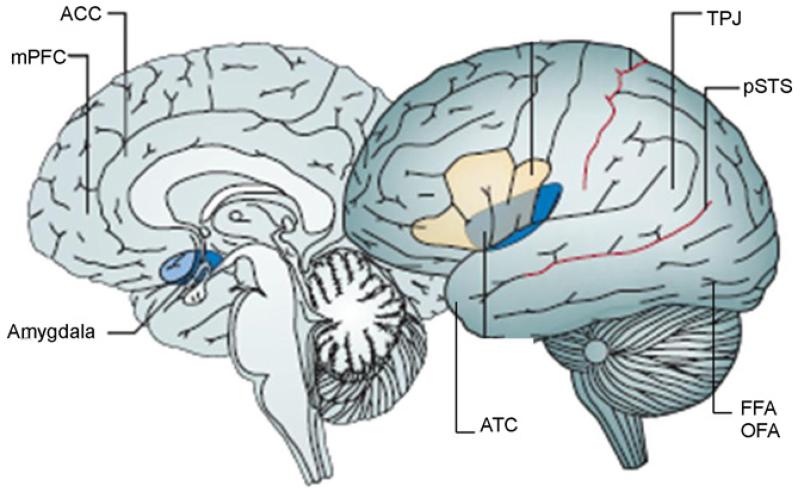
Social cognition is the collection of cognitive processes required to understand and interact with others. The term 'social brain' refers to the network of brain regions that underlies these processes. Recent evidence suggests that a number of social cognitive functions continue to develop during adolescence, resulting in age differences in tasks that assess cognitive domains including face processing, mental state inference and responding to peer influence and social evaluation. Concurrently, functional and structural magnetic resonance imaging (MRI) studies show differences between adolescent and adult groups within parts of the social brain. Understanding the relationship between these neural and behavioural observations is a challenge. This review discusses current research findings on adolescent social cognitive development and its functional MRI correlates, then integrates and interprets these findings in the context of hypothesised developmental neurocognitive and neurophysiological mechanisms.
社会认知是理解和与他人互动所需的一系列认知过程。“社会大脑”一词指的是支撑这些过程的大脑区域网络。最近的证据表明,许多社会认知功能在青少年时期仍在继续发展,这导致了在评估包括面部处理、心理状态推断以及对同伴影响和社会评价的反应等认知领域的任务中存在年龄差异。同时,功能和结构磁共振成像 (MRI) 研究显示,社会大脑的某些部分在青少年和成年组之间存在差异。了解这些神经和行为观察结果之间的关系是一项挑战。本综述讨论了青少年社会认知发展及其功能 MRI 相关性的当前研究结果,然后在假设的发育神经认知和神经生理机制的背景下整合和解释这些发现。