Department of Pharmacology and Physiology, University of Rochester, Rochester, NY 14642, USA.
J Immunol. 2010 Dec 1;185(11):7057-66. doi: 10.4049/jimmunol.1001638. Epub 2010 Oct 29.
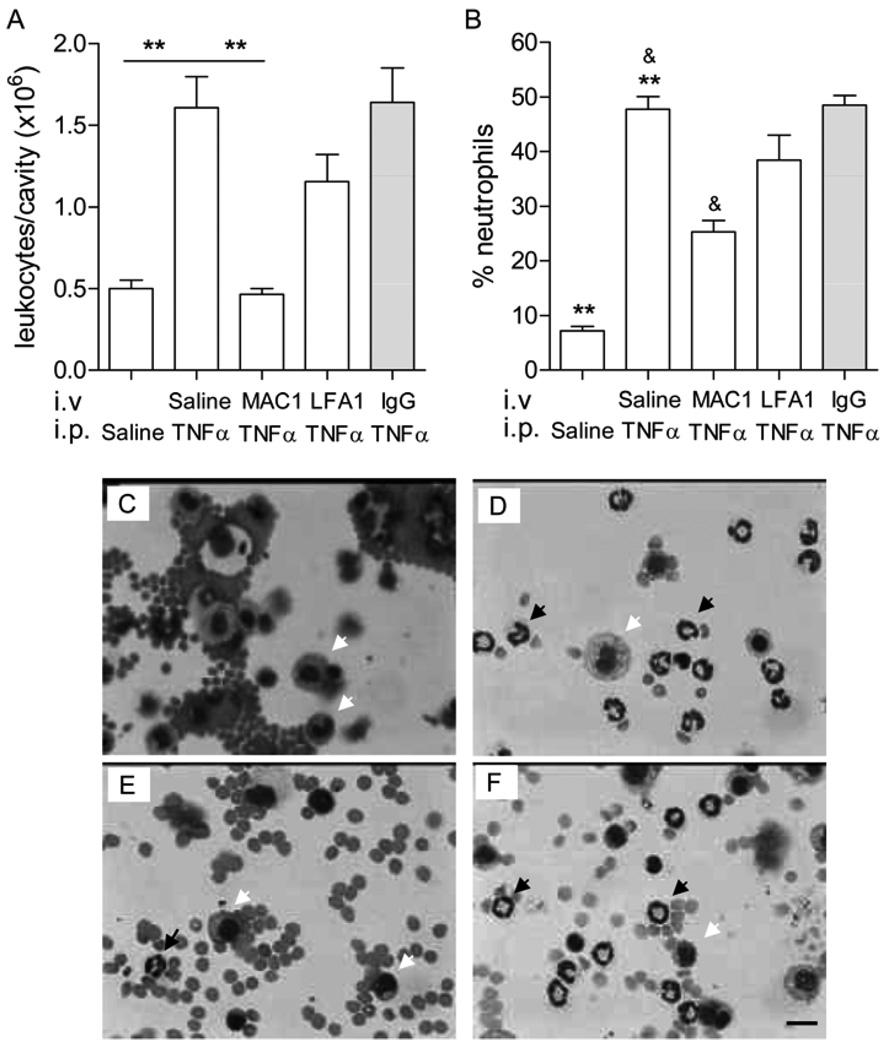
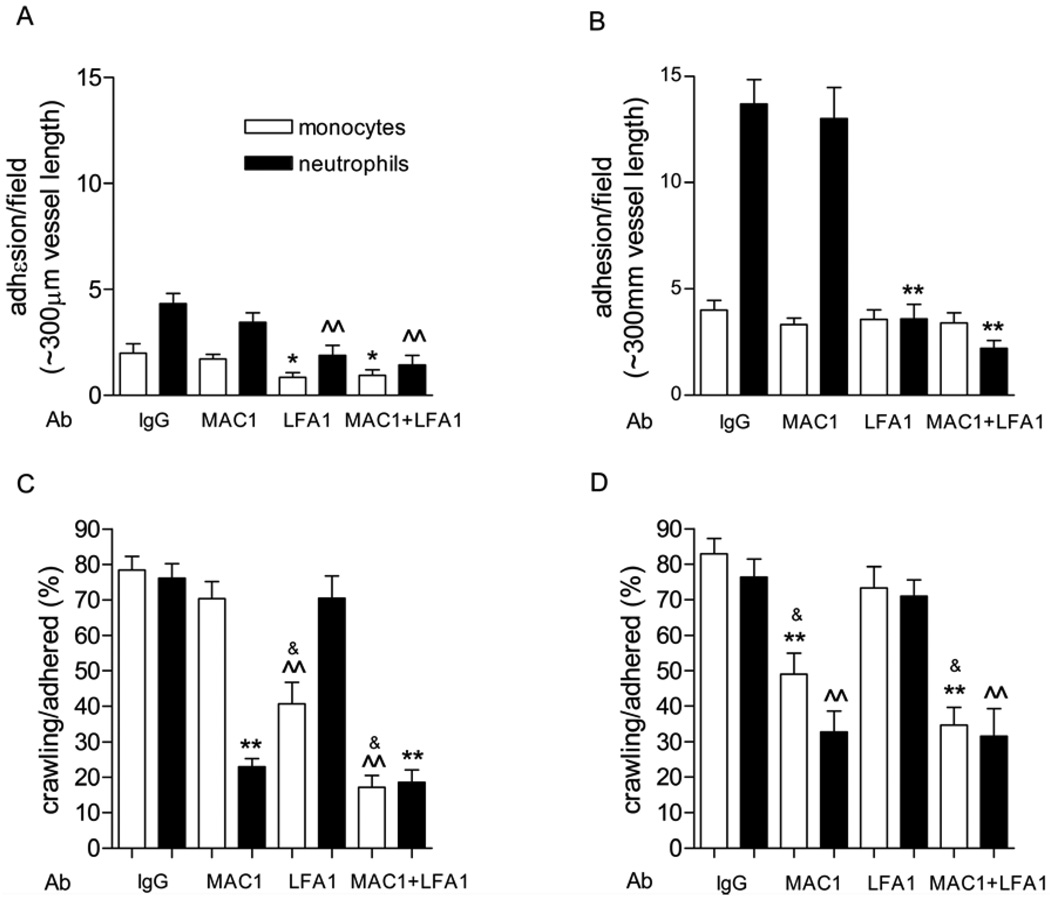
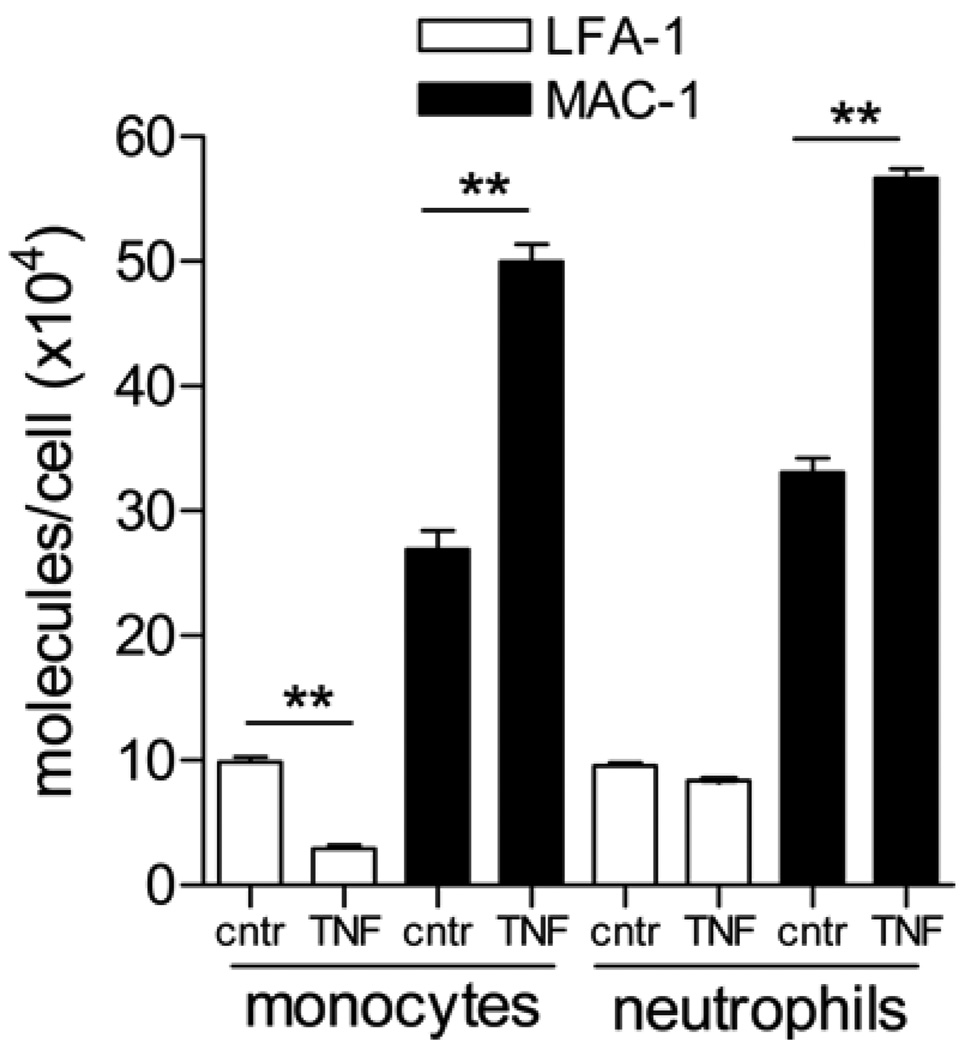
To exit blood vessels, most (∼80%) of the lumenally adhered monocytes and neutrophils crawl toward locations that support transmigration. Using intravital confocal microscopy of anesthetized mouse cremaster muscle, we separately examined the crawling and emigration patterns of monocytes and neutrophils in blood-perfused unstimulated or TNF-α-activated venules. Most of the interacting cells in microvessels are neutrophils; however, in unstimulated venules, a greater percentage of the total monocyte population is adherent compared with neutrophils (58.2 ± 6.1% versus 13.6 ± 0.9%, adhered/total interacting), and they crawl for significantly longer distances (147.3 ± 13.4 versus 61.8 ± 5.4 μm). Intriguingly, after TNF-α activation, monocytes crawled for significantly shorter distances (67.4 ± 9.6 μm), resembling neutrophil crawling. Using function-blocking Abs, we show that these different crawling patterns were due to CD11a/CD18 (LFA-1)- versus CD11b/CD18 (Mac-1)-mediated crawling. Blockade of either Mac-1 or LFA-1 revealed that both LFA-1 and Mac-1 contribute to monocyte crawling; however, the LFA-1-dependent crawling in unstimulated venules becomes Mac-1 dependent upon inflammation, likely due to increased expression of Mac-1. Mac-1 alone was responsible for neutrophil crawling in both unstimulated and TNF-α-activated venules. Consistent with the role of Mac-1 in crawling, Mac-1 block (compared with LFA-1) was also significantly more efficient in blocking TNF-α-induced extravasation of both monocytes and neutrophils in cremaster tissue and the peritoneal cavity. Thus, mechanisms underlying leukocyte crawling are important in regulating the inflammatory responses by regulating the numbers of leukocytes that transmigrate.
为了离开血管,大多数(约 80%)黏附于管腔的单核细胞和中性粒细胞向支持迁移的部位爬行。通过对麻醉小鼠提睾肌血液灌注的未刺激或 TNF-α 激活的小静脉进行共聚焦显微镜活体观察,我们分别检查了单核细胞和中性粒细胞在血液灌注的未刺激或 TNF-α 激活的小静脉中的爬行和迁移模式。大多数与微血管中的细胞相互作用的细胞是中性粒细胞;然而,在未刺激的小静脉中,与中性粒细胞相比,总单核细胞群体中黏附的比例更高(58.2 ± 6.1%比 13.6 ± 0.9%,黏附/总相互作用),并且它们爬行的距离显著更长(147.3 ± 13.4 比 61.8 ± 5.4 μm)。有趣的是,在 TNF-α 激活后,单核细胞爬行的距离显著缩短(67.4 ± 9.6 μm),类似于中性粒细胞的爬行。使用功能阻断抗体,我们表明这些不同的爬行模式是由于 CD11a/CD18(LFA-1)-与 CD11b/CD18(Mac-1)-介导的爬行。阻断 Mac-1 或 LFA-1 表明 LFA-1 和 Mac-1 都有助于单核细胞爬行;然而,在未刺激的小静脉中,LFA-1 依赖性爬行在炎症时变得依赖于 Mac-1,这可能是由于 Mac-1 的表达增加。Mac-1 单独负责未刺激和 TNF-α 激活的小静脉中的中性粒细胞爬行。与 Mac-1 在爬行中的作用一致,Mac-1 阻断(与 LFA-1 相比)在阻断 TNF-α 诱导的提睾肌组织和腹腔中单核细胞和中性粒细胞的渗出方面也明显更有效。因此,白细胞爬行的机制在调节白细胞迁移数量方面对于调节炎症反应非常重要。