Institute of Pharmacy and Molecular Biotechnology, Heidelberg University, Im Neuenheimer Feld 364, D-69120 Heidelberg, Germany.
Nucleic Acids Res. 2011 Mar;39(5):1943-52. doi: 10.1093/nar/gkq825. Epub 2010 Oct 30.
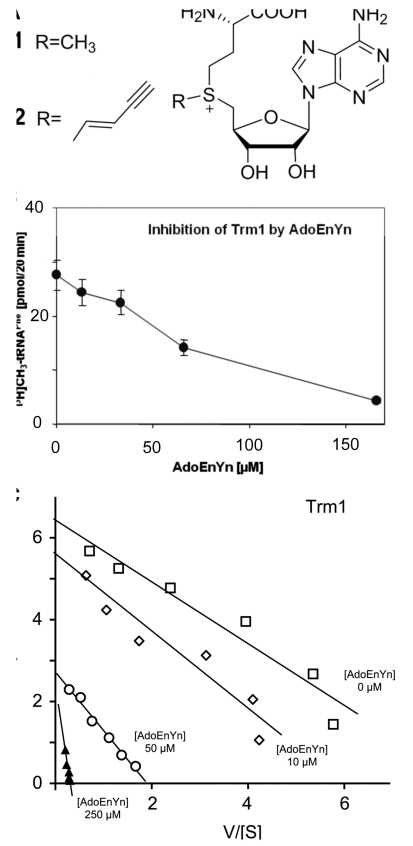
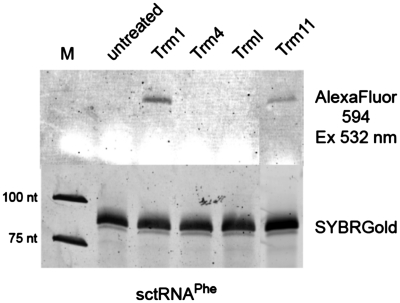
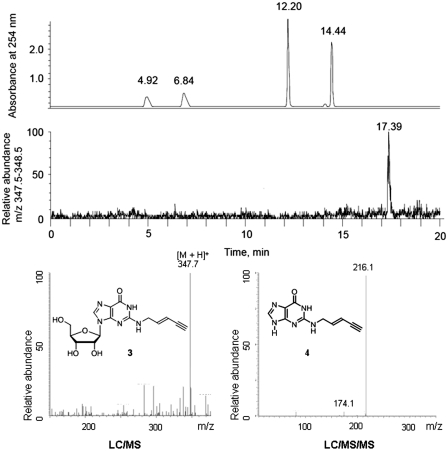
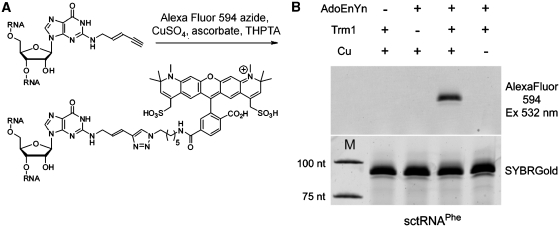
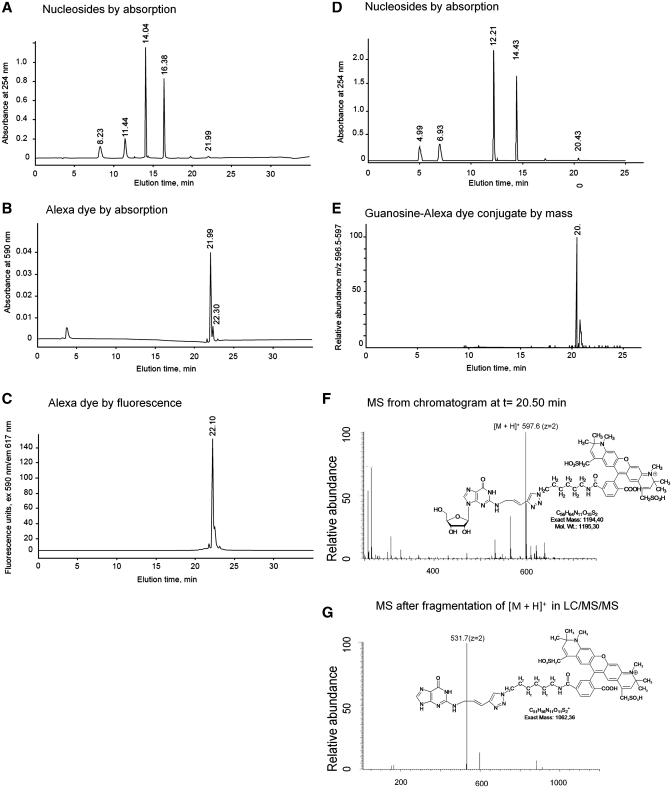
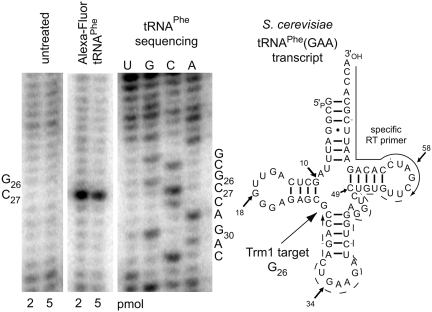
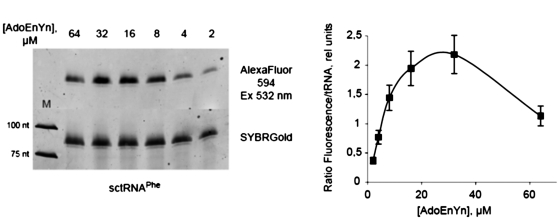
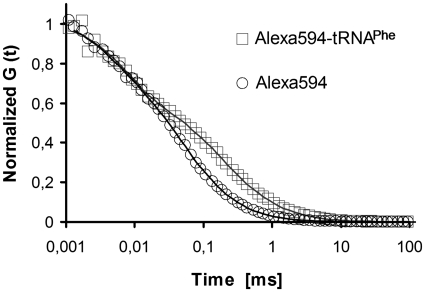
This work identifies the combination of enzymatic transfer and click labeling as an efficient method for the site-specific tagging of RNA molecules for biophysical studies. A double-activated analog of the ubiquitous co-substrate S-adenosyl-l-methionine was employed to enzymatically transfer a five carbon chain containing a terminal alkynyl moiety onto RNA. The tRNA:methyltransferase Trm1 transferred the extended alkynyl moiety to its natural target, the N2 of guanosine 26 in tRNA(Phe). LC/MS and LC/MS/MS techniques were used to detect and characterize the modified nucleoside as well as its cycloaddition product with a fluorescent azide. The latter resulted from a labeling reaction via Cu(I)-catalyzed azide-alkyne 1,3-cycloaddition click chemistry, producing site-specifically labeled RNA whose suitability for single molecule fluorescence experiments was verified in fluorescence correlation spectroscopy experiments.
这项工作确定了酶转移和点击标记的组合是一种有效的方法,用于对 RNA 分子进行生物物理研究的特异性标记。使用普遍存在的共底物 S-腺苷甲硫氨酸的双活化类似物,通过酶促反应将含有末端炔基部分的五碳链转移到 RNA 上。tRNA:甲基转移酶 Trm1 将扩展的炔基部分转移到其天然靶标 tRNA(Phe)中的鸟嘌呤 26 的 N2 上。LC/MS 和 LC/MS/MS 技术用于检测和表征修饰核苷及其与荧光叠氮化物的环加成产物。后者是通过 Cu(I) 催化的叠氮化物-炔烃 1,3-环加成点击化学反应进行标记反应的结果,产生了特异性标记的 RNA,其在荧光相关光谱实验中验证了用于单分子荧光实验的适用性。