Department of Chemistry, KU Leuven, Celestijnenlaan 200F, 3001 Heverlee, Belgium, Life Science Technologies, Imec, Kapeldreef 75, 3001 Heverlee, Belgium and Department of Chemistry, University of Copenhagen, Universitetsparken 5, 2100 Copenhagen, Denmark.
Nucleic Acids Res. 2014 Apr;42(7):e50. doi: 10.1093/nar/gkt1406. Epub 2014 Jan 21.
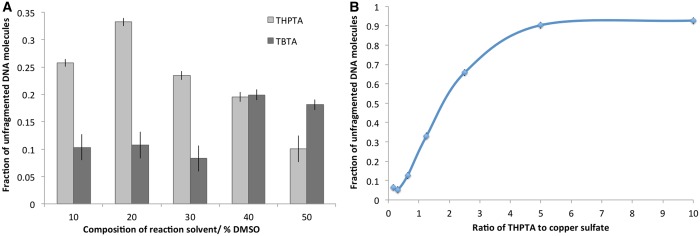
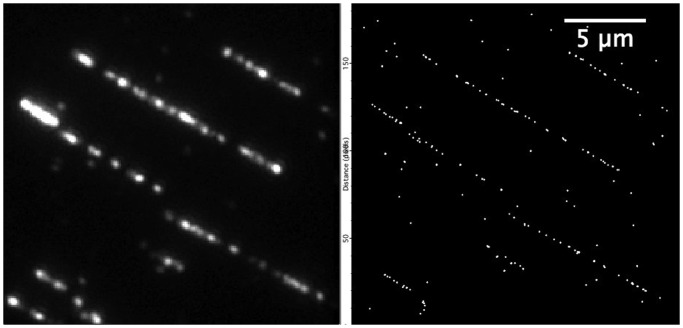
We demonstrate an approach to optical DNA mapping, which enables near single-molecule characterization of whole bacteriophage genomes. Our approach uses a DNA methyltransferase enzyme to target labelling to specific sites and copper-catalysed azide-alkyne cycloaddition to couple a fluorophore to the DNA. We achieve a labelling efficiency of ∼70% with an average labelling density approaching one site every 500 bp. Such labelling density bridges the gap between the output of a typical DNA sequencing experiment and the long-range information derived from traditional optical DNA mapping. We lay the foundations for a wider-scale adoption of DNA mapping by screening 11 methyltransferases for their ability to direct sequence-specific DNA transalkylation; the first step of the DNA labelling process and by optimizing reaction conditions for fluorophore coupling via a click reaction. Three of 11 enzymes transalkylate DNA with the cofactor we tested (a readily prepared s-adenosyl-l-methionine analogue).
我们展示了一种光学 DNA 作图方法,该方法能够实现对完整噬菌体基因组的近单分子特征分析。我们的方法使用 DNA 甲基转移酶将标记靶向特定位置,并使用铜催化的叠氮-炔环加成反应将荧光团与 DNA 偶联。我们实现了约 70%的标记效率,平均标记密度接近每 500bp 一个标记。这种标记密度缩小了典型 DNA 测序实验的输出与传统光学 DNA 作图衍生的长程信息之间的差距。我们通过筛选 11 种甲基转移酶来指导序列特异性 DNA 转烷基化的能力(DNA 标记过程的第一步),以及通过点击反应优化荧光团偶联的反应条件,为更广泛地采用 DNA 作图奠定了基础。在我们测试的辅助因子(一种易于制备的 s-腺苷甲硫氨酸类似物)中,有 11 种酶中的 3 种可以将 DNA 进行转烷基化。