Risk Anal. 2011 Apr;31(4):578-91. doi: 10.1111/j.1539-6924.2010.01523.x. Epub 2010 Oct 29.
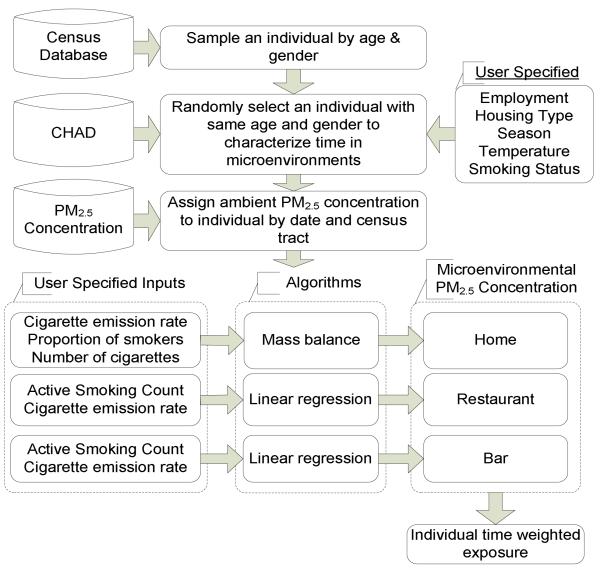
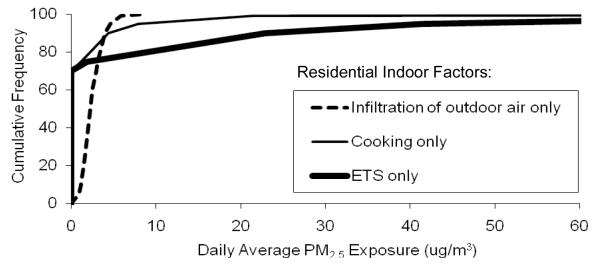
Environmental tobacco smoke (ETS) is a major contributor to indoor human exposures to fine particulate matter of 2.5 μm or smaller (PM(2.5) ). The Stochastic Human Exposure and Dose Simulation for Particulate Matter (SHEDS-PM) Model developed by the U.S. Environmental Protection Agency estimates distributions of outdoor and indoor PM(2.5) exposure for a specified population based on ambient concentrations and indoor emissions sources. A critical assessment was conducted of the methodology and data used in SHEDS-PM for estimation of indoor exposure to ETS. For the residential microenvironment, SHEDS uses a mass-balance approach, which is comparable to best practices. The default inputs in SHEDS-PM were reviewed and more recent and extensive data sources were identified. Sensitivity analysis was used to determine which inputs should be prioritized for updating. Data regarding the proportion of smokers and "other smokers" and cigarette emission rate were found to be important. SHEDS-PM does not currently account for in-vehicle ETS exposure; however, in-vehicle ETS-related PM(2.5) levels can exceed those in residential microenvironments by a factor of 10 or more. Therefore, a mass-balance-based methodology for estimating in-vehicle ETS PM(2.5) concentration is evaluated. Recommendations are made regarding updating of input data and algorithms related to ETS exposure in the SHEDS-PM model. Interindividual variability for ETS exposure was quantified. Geographic variability in ETS exposure was quantified based on the varying prevalence of smokers in five selected locations in the United States.
环境烟草烟雾(ETS)是导致人类室内细颗粒物(PM2.5)暴露的主要因素之一。美国环境保护署(U.S. Environmental Protection Agency)开发的随机人体暴露与剂量模拟(Stochastic Human Exposure and Dose Simulation for Particulate Matter,SHEDS-PM)模型根据环境浓度和室内排放源估算特定人群的室外和室内 PM2.5 暴露分布。本文对 SHEDS-PM 中用于估算 ETS 室内暴露的方法和数据进行了评估。对于居住微环境,SHEDS 使用质量平衡方法,这与最佳实践相当。审查了 SHEDS-PM 的默认输入,并确定了更新的更近期和更广泛的数据源。使用敏感性分析确定了哪些输入应优先更新。发现有关吸烟者和“其他吸烟者”的比例以及香烟排放率的数据很重要。SHEDS-PM 目前不考虑车内 ETS 暴露;然而,车内 ETS 相关的 PM2.5 水平可以超过居住微环境中的水平 10 倍以上。因此,评估了一种基于质量平衡的方法来估算车内 ETS PM2.5 浓度。就 SHEDS-PM 模型中与 ETS 暴露相关的输入数据和算法更新提出了建议。量化了 ETS 暴露的个体间变异性。基于美国五个选定地点的吸烟者比例的差异,量化了 ETS 暴露的地理变异性。