United States Environmental Protection Agency, National Health and Environmental Effects Research Laboratory, Research Triangle Park, North Carolina, USA.
Environ Health. 2010 Oct 31;9:66. doi: 10.1186/1476-069X-9-66.
In the United States and elsewhere, recreational water quality is monitored for fecal indicator bacteria to help prevent swimming-associated illnesses. Standard methods to measure these bacteria take at least 24 hours to obtain results. Molecular approaches such as quantitative polymerase chain reaction (qPCR) can estimate these bacteria faster, in under 3 hours. Previously, we demonstrated that measurements of the fecal indicator bacteria Enterococcus using qPCR were associated with gastrointestinal (GI) illness among swimmers at freshwater beaches. In this paper, we report on results from three marine beach sites.
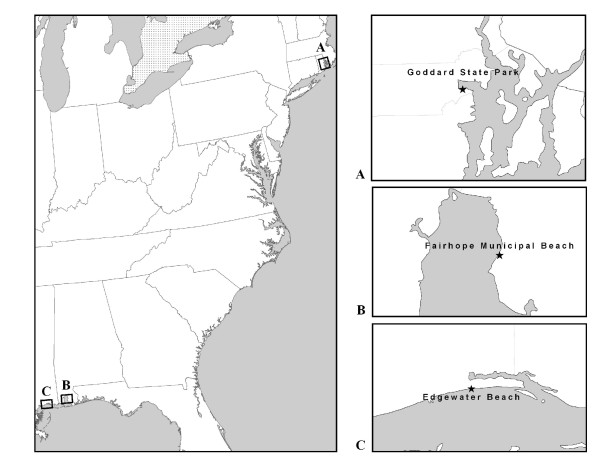
We interviewed beach-goers and collected water samples at marine beaches affected by treated sewage discharges in Mississippi in 2005, and Rhode Island and Alabama in 2007. Ten to twelve days later, we obtained information about gastrointestinal, respiratory, eye, ear and skin symptoms by telephone. We tested water samples for fecal indicator organisms using qPCR and other methods.
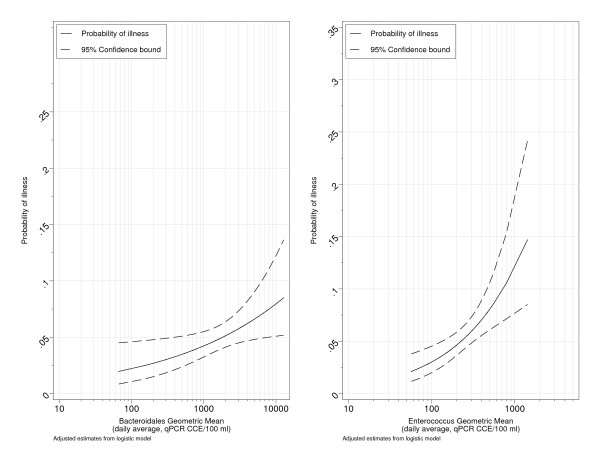
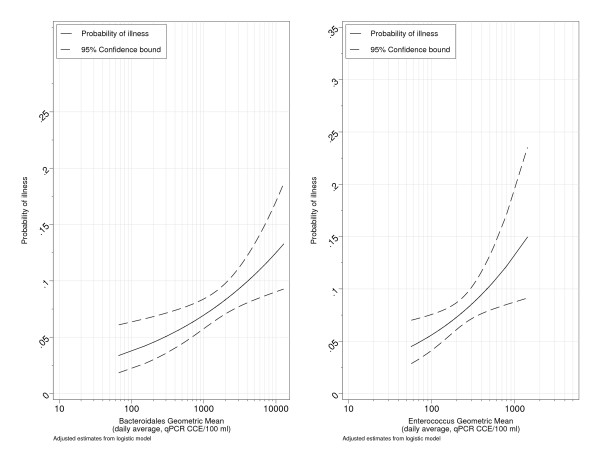
We enrolled 6,350 beach-goers. The occurrence of GI illness among swimmers was associated with a log10-increase in exposure to qPCR-determined estimates of fecal indicator organisms in the genus Enterococcus (AOR = 2.6, 95% CI 1.3-5.1) and order Bacteroidales (AOR = 1.9, 95% CI 1.3-2.9). Estimates of organisms related to Clostridium perfringens and a subgroup of organisms in the genus Bacteroides were also determined by qPCR in 2007, as was F+ coliphage, but relationships between these indicators and illness were not statistically significant.
This study provides the first evidence of a relationship between gastrointestinal illness and estimates of fecal indicator organisms determined by qPCR at marine beaches.
在美国和其他国家,通过监测粪便指示菌来监控娱乐用水水质,以帮助预防与游泳相关的疾病。测量这些细菌的标准方法至少需要 24 小时才能得出结果。而像定量聚合酶链反应(qPCR)这样的分子方法可以在不到 3 小时的时间内更快地估计这些细菌。之前,我们证明了使用 qPCR 测量粪便指示菌肠球菌与淡水海滩游泳者的胃肠道(GI)疾病有关。在本文中,我们报告了三个海洋海滩的结果。
我们在 2005 年对密西西比州、罗得岛州和阿拉巴马州受处理污水排放影响的海洋海滩进行了海滩游客访谈和水样采集。10 到 12 天后,我们通过电话获得了有关胃肠道、呼吸道、眼睛、耳朵和皮肤症状的信息。我们使用 qPCR 和其他方法测试水样中的粪便指示生物。
我们招募了 6350 名海滩游客。游泳者患胃肠道疾病的发生率与 qPCR 确定的粪便指示生物肠球菌(AOR = 2.6,95%CI 1.3-5.1)和拟杆菌目(AOR = 1.9,95%CI 1.3-2.9)的对数 10 增加暴露相关。2007 年还通过 qPCR 确定了与梭状芽胞杆菌和拟杆菌属中一个亚组相关的生物以及 F+噬菌体的估计值,但这些指标与疾病之间的关系没有统计学意义。
这项研究首次提供了证据,证明了在海洋海滩上使用 qPCR 确定的粪便指示生物与胃肠道疾病之间存在关系。