Department of Tropical Hygiene, Faculty of Tropical Medicine, Mahidol University, Bangkok, Thailand.
Malar J. 2010 Nov 1;9:308. doi: 10.1186/1475-2875-9-308.
Plasmodium vivax has a dormant hepatic stage, called the hypnozoite, which can cause relapse months after the initial attack. For 50 years, primaquine has been used as a hypnozoitocide to radically cure P. vivax infection, but major concerns remain regarding the side-effects of the drug and adherence to the 14-day regimen. This study examined the effectiveness of using the directly-observed therapy (DOT) method for the radical treatment of P. vivax malaria infection, to prevent reappearance of the parasite within the 90-day follow-up period. Other potential risk factors for the reappearance of P. vivax were also explored.
A randomized trial was conducted from May 2007 to January 2009 in a low malaria transmission area along the Thai-Myanmar border. Patients aged ≥ 3 years diagnosed with P. vivax by microscopy, were recruited. All patients were treated with the national standard regimen of chloroquine for three days followed by primaquine for 14 days. Patients were randomized to receive DOT or self-administered therapy (SAT). All patients were followed for three months to check for any reappearance of P. vivax.
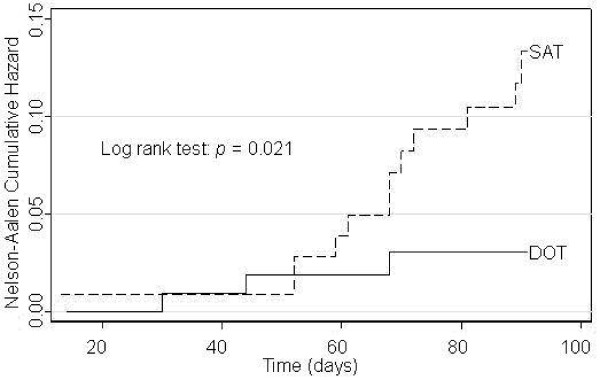
Of the 216 patients enrolled, 109 were randomized to DOT and 107 to SAT. All patients recovered without serious adverse effects. The vivax reappearance rate was significantly lower in the DOT group than the SAT group (3.4/10,000 person-days vs. 13.5/10,000 person-days, p = 0.021). Factors related to the reappearance of vivax malaria included inadequate total primaquine dosage received (< 2.75 mg/kg), duration of fever ≤ 2 days before initiation of treatment, parasite count on admission ≥ 10,000/µl, multiple P. vivax-genotype infection, and presence of P. falciparum infection during the follow-up period.
Adherence to the 14-day primaquine regimen is important for the radical cure of P. vivax malaria infection. Implementation of DOT reduces the reappearance rate of the parasite, and may subsequently decrease P. vivax transmission in the area.
间日疟原虫有一种休眠的肝脏阶段,称为休眠子,它可以在初次感染后数月引起复发。50 年来,伯氨喹一直被用作休眠子杀剂来根治间日疟原虫感染,但人们仍然对该药物的副作用和坚持 14 天疗程存在重大担忧。本研究通过直接观察治疗(DOT)方法来根治间日疟原虫感染,以防止寄生虫在 90 天随访期内再次出现,从而检验其有效性。还探讨了间日疟原虫再次出现的其他潜在危险因素。
2007 年 5 月至 2009 年 1 月,在泰国-缅甸边境的低疟疾传播地区进行了一项随机试验。招募了通过显微镜诊断为间日疟原虫感染的年龄≥3 岁的患者。所有患者均接受了氯喹 3 天的国家标准治疗方案,随后接受了 14 天的伯氨喹治疗。患者被随机分配接受 DOT 或自我管理治疗(SAT)。所有患者随访三个月以检查间日疟原虫是否再次出现。
216 名入组患者中,109 名被随机分配至 DOT 组,107 名被分配至 SAT 组。所有患者均康复,无严重不良反应。DOT 组的间日疟原虫再出现率明显低于 SAT 组(3.4/10000 人天比 13.5/10000 人天,p=0.021)。与间日疟原虫再次出现相关的因素包括接受的总伯氨喹剂量不足(<2.75mg/kg)、治疗前发热持续时间≤2 天、入院时寄生虫计数≥10000/µl、多种间日疟原虫基因型感染以及随访期间存在恶性疟原虫感染。
坚持 14 天伯氨喹疗程对于根治间日疟原虫感染至关重要。实施 DOT 可降低寄生虫的再出现率,从而减少该地区间日疟原虫的传播。