National Resource Centre for Rehabilitation in Rheumatology, Department of Rheumatology, Diakonhjemmet Hospital, Oslo, Norway.
BMC Musculoskelet Disord. 2010 Nov 1;11:253. doi: 10.1186/1471-2474-11-253.
Osteoarthritis (OA) is a prevalent joint disorder with a need for efficient and evidence-based management strategies.
The primary purpose of this study is to compare the effects of a multidisciplinary outpatient clinic, including a brief group-based educational programme, with a traditional individual outpatient clinic for patients with hip, knee, hand or generalized OA. A secondary purpose is to investigate the effects of a telephone follow-up call.
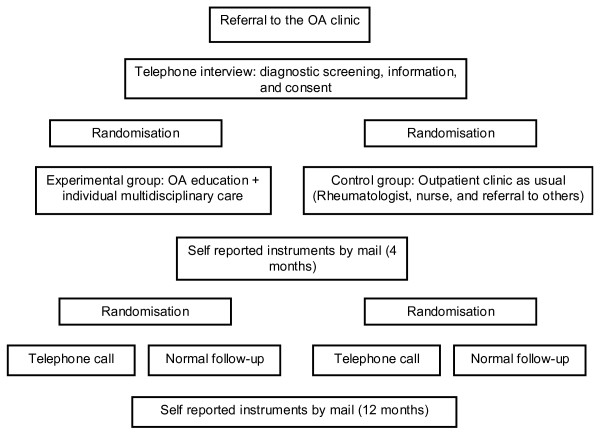
This is a pragmatic randomised single-blind controlled study with a total of 400 patients with hip, knee, hand or generalized OA between 40 and 80 years referred to an outpatient rheumatology hospital clinic. The randomisation is stratified according to the diagnostic subgroups. The experimental group is exposed to a multidisciplinary and multifaceted intervention, including a 3.5 hour group-based patient education programme about OA in addition to individual consultations with members of a multidisciplinary team. The control intervention is based on regular care with an individual outpatient consultation with a rheumatologist (treatment as usual). Primary outcomes are patient satisfaction measured at 4 months and cost-effectiveness measured at 12 months. Secondary outcomes are pain and global disease activity measured on a numeric rating scales (NRS), generic and disease specific functioning and disability using Short Form-36 (SF-36) health survey, the Western Ontario and McMaster Universities Osteoarthritis Index 3 (WOMAC), the Australian/Canadian Osteoarthritis Hand Index (AUSCAN), and a patient-generated measure of disability (Patient-Specific Functional scale, PSFS). Global perceived effect of change in health status during the study period is also reported. At 4-month follow-up, patients in both groups will be randomly allocated to a 10-minute telephone call or no follow-up ("treatment as usual"). After additional 8 months (12-month follow-up) the four groups will be compared in a secondary analysis with regard to health outcomes and health care costs.
This trial will provide results on how multidisciplinary and multifaceted management of patients with OA affects health outcomes and health care costs.
Current Controlled Trials ISRCTN25778426.
骨关节炎(OA)是一种普遍存在的关节疾病,需要有效的、基于证据的管理策略。
本研究的主要目的是比较多学科门诊诊所,包括一个简短的基于小组的教育计划,与传统的个体门诊诊所,治疗髋、膝、手或全身性 OA 患者的效果。次要目的是研究电话随访的效果。
这是一项实用的随机单盲对照研究,共有 400 名 40-80 岁的髋、膝、手或全身性 OA 患者被转诊到一家门诊风湿病医院诊所。随机分组根据诊断亚组进行分层。实验组接受多学科和多方面的干预,包括 3.5 小时的基于小组的 OA 患者教育计划,以及与多学科团队成员的个别咨询。对照组基于常规护理,即与风湿病学家进行个体门诊咨询(常规治疗)。主要结局是在 4 个月时测量的患者满意度,以及在 12 个月时测量的成本效益。次要结局是疼痛和整体疾病活动度,使用数字评定量表(NRS)测量,使用健康调查简表 36 项(SF-36)、西部安大略省和麦克马斯特大学骨关节炎指数 3 (WOMAC)、澳大利亚/加拿大骨关节炎手部指数(AUSCAN),以及患者生成的残疾测量(患者特定功能量表,PSFS)。还报告了研究期间健康状况变化的总体感知效果。在 4 个月随访时,两组患者将随机分配接受 10 分钟的电话或无随访(“常规治疗”)。在额外的 8 个月(12 个月随访)后,将对四组进行二次分析,比较健康结果和医疗保健成本。
本试验将提供关于多学科和多方面管理 OA 患者如何影响健康结果和医疗保健成本的结果。
当前对照试验 ISRCTN25778426。