Department of Neurology, Medical University of Białystok, 15-230 Białystok, Poland.
BMC Neurol. 2010 Nov 1;10:107. doi: 10.1186/1471-2377-10-107.
Extracellular gelsolin (GSN) and GC-globulin/Vitamin D-binding protein (DBP) appear to play an important role in clearing the actin from extracellular fluids and in modulating cellular responses to anionic bioactive lipids. In this study we hypothesized that cellular actin release and/or increase in bioactive lipids associated with multiple sclerosis (MS) development will translate into alteration of the actin scavenger system protein concentrations in blood and cerebrospinal fluid (CSF) of patients with MS.
We measured GSN and DBP concentrations in blood and CSF obtained from patients diagnosed with MS (n = 56) in comparison to a control group (n = 20) that includes patients diagnosed with conditions such as idiopathic cephalgia (n = 11), idiopathic (Bell's) facial nerve palsy (n = 7) and ischialgia due to discopathy (n = 2). GSN and DBP levels were measured by Western blot and ELISA, respectively.
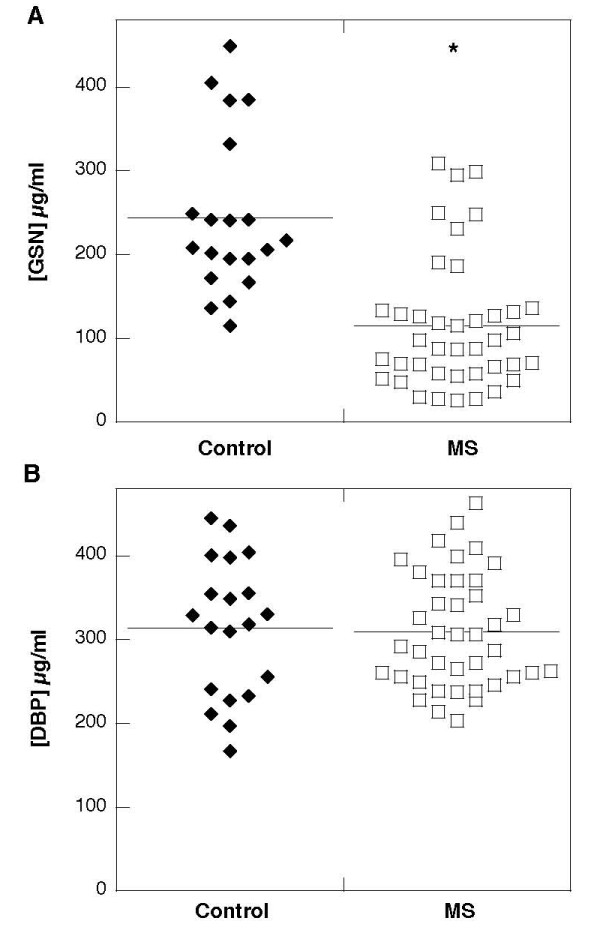
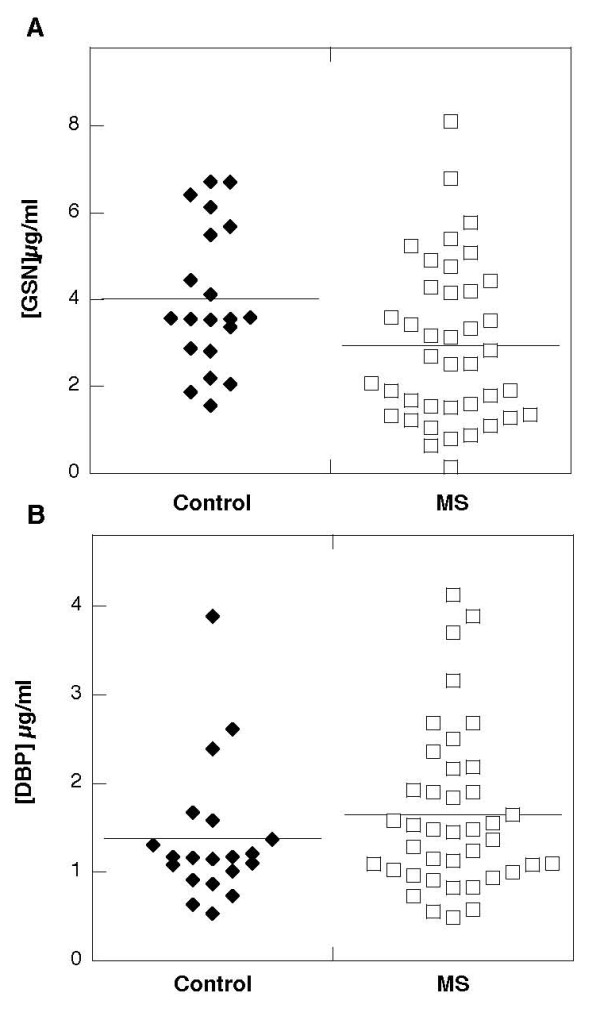
We found that the GSN concentration in the blood of the MS group (115 ± 78 μg/ml) was significantly lower (p < 0.001) compared to the control group (244 ± 96 μg/ml). In contrast, there was no statistically significant difference between blood DBP concentrations in patients with MS (310 ± 68 μg/ml) and the control group (314 ± 82 μg/ml). GSN and DBP concentrations in CSF also did not significantly differ between those two groups.
The decrease of GSN concentration in blood and CSF of MS subjects suggests that this protein may be involved in chronic inflammation associated with neurodegeneration. Additionally, the results presented here suggest the possible utility of GSN evaluation for diagnostic purposes. Reversing plasma GSN deficiency might represent a new strategy in MS treatment.
细胞外凝胶蛋白 (GSN) 和 GC-球蛋白/维生素 D 结合蛋白 (DBP) 似乎在清除细胞外液中的肌动蛋白和调节细胞对阴离子生物活性脂质的反应方面发挥着重要作用。在这项研究中,我们假设与多发性硬化症 (MS) 发展相关的细胞肌动蛋白释放和/或生物活性脂质增加,将转化为 MS 患者血液和脑脊液 (CSF) 中肌动蛋白清除系统蛋白浓度的改变。
我们测量了 56 名被诊断为 MS 的患者(MS 组)与包括特发性头痛(n=11)、特发性(贝尔氏)面神经麻痹(n=7)和椎间盘病引起的坐骨神经痛(n=2)在内的 20 名对照组患者血液和 CSF 中的 GSN 和 DBP 浓度。GSN 和 DBP 水平分别通过 Western blot 和 ELISA 测量。
我们发现 MS 组血液中的 GSN 浓度(115±78μg/ml)明显低于对照组(244±96μg/ml)(p<0.001)。相比之下,MS 患者血液中 DBP 浓度(310±68μg/ml)与对照组(314±82μg/ml)之间无统计学差异。两组 CSF 中 GSN 和 DBP 浓度也无显著差异。
MS 患者血液和 CSF 中 GSN 浓度降低表明该蛋白可能参与与神经退行性变相关的慢性炎症。此外,这里提出的结果表明 GSN 评估用于诊断目的的可能性。纠正血浆 GSN 缺乏可能是 MS 治疗的一种新策略。