Ogeng'o Julius Alexander, Olabu Beda O, Mburu Anne N, Sinkeet Simeon R
Department of Human Anatomy, University of Nairobi, PO Box 30197-00100, Nairobi, Kenya.
J Pediatr Neurosci. 2010 Jan;5(1):22-4. doi: 10.4103/1817-1745.66676.
The pattern of pediatric stroke displays ethnic and geographical variations. There are few reports from black Sub-Saharan Africa, although relevant data are important in prevention, clinical diagnosis, treatment and prognostication.
To describe subtypes, risk factors, localization, age and gender distribution of pediatric stroke in the black Kenyan population.
Retrospective cross-sectional study in a single regional referral and teaching hospital.
Data were analyzed by SPSS version 13.0 for Windows and presented in tables and bar and pie charts.
The study was performed at the Kenyatta National Hospital, a level-6 regional referral health facility with an annual pediatric in-patient turnover of about 40,000 patients. Files of patients aged 1 month to 18 years over a period of 5 years were analyzed for stroke subtypes, localization, risk factors, age and sex distribution. Only those files with complete information were included.
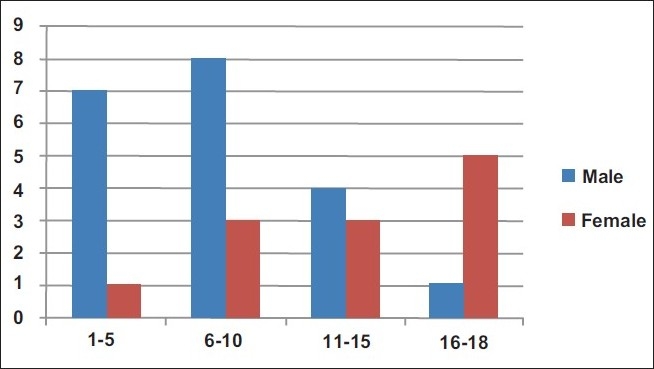
Thirty-two of the 712 stroke patients (4.5%) were pediatric. The male:female ratio was 1.7:1. Ischemic stroke comprised 56.3% (n = 18). Mean age was 7.7 years (range, 1.5-18 years). The most common sites were cortical (51%), lacunar (41%) and brain stem (8%). The most common risk factors were connective tissue disorders (28.1%), heart disease (25%), human immunodeficiency virus (9.4%) and infection (9.4%).
Pediatric stroke is not uncommon in the Kenyan population. The risk factor profile comprising connective tissue disorders and infection differs from that reported in other populations, inviting large community-based studies.
儿童卒中模式存在种族和地域差异。撒哈拉以南非洲黑人地区的相关报道较少,尽管相关数据对预防、临床诊断、治疗及预后判断很重要。
描述肯尼亚黑人人群中儿童卒中的亚型、危险因素、病变部位、年龄及性别分布。
在一家单一的地区转诊和教学医院进行回顾性横断面研究。
采用SPSS 13.0 for Windows软件对数据进行分析,并以表格、柱状图和饼图形式呈现。
研究在肯雅塔国家医院开展,这是一家6级地区转诊医疗机构,每年儿科住院患者周转量约40000例。分析了5年间年龄在1个月至18岁患者的病历,以确定卒中亚型、病变部位、危险因素、年龄及性别分布。仅纳入信息完整的病历。
712例卒中患者中有32例(4.5%)为儿童患者。男女比例为1.7:1。缺血性卒中占56.3%(n = 18)。平均年龄为7.7岁(范围1.5 - 18岁)。最常见的病变部位是皮质(51%)、腔隙性(41%)和脑干(8%)。最常见的危险因素是结缔组织病(28.1%)、心脏病(25%)、人类免疫缺陷病毒(9.4%)和感染(9.4%)。
儿童卒中在肯尼亚人群中并不罕见。由结缔组织病和感染构成的危险因素谱与其他人群报道的不同,需要开展大规模基于社区的研究。