Ominde Beryl Shitandi, Ogeng'o Julius Alexander, Misiani Musa Kerubuo, Kariuki Brain Ngure
Department of Human Anatomy, Kenya Methodist University, Meru, Kenya.
Department of Human Anatomy, University of Nairobi, Kenya.
Malawi Med J. 2019 Mar;31(1):50-55. doi: 10.4314/mmj.v31i1.9.
The pattern of stroke in rural population differs from that in urban ones. Although there are many studies on this condition in sub-Saharan Africa, few studies about stroke pattern in a Kenyan rural area exist.. This study therefore aims at describing the characteristics of stroke in a rural Kenyan hospital.
The study was conducted on 227 consecutive patients admitted with a World Health Organization (WHO) diagnosis of stroke in Kangundo Hospital, a level IV facility in Machakos, Eastern Kenya, between April 2015 and September 2016. The sub-type and anatomical distribution of stroke as well as the age, gender of the patients were recorded prospectively. Diagnosis was made through physical neurological examination and confirmed by Computerized Tomography (CT) scan imaging. Only those with complete bio-data, past medical and social history, clinical and physical findings of the patients and imaging results were included. The data were entered into a pre-formatted questionnaire, analysed for means, standard deviations and frequencies, and are presented in tables and bar charts.
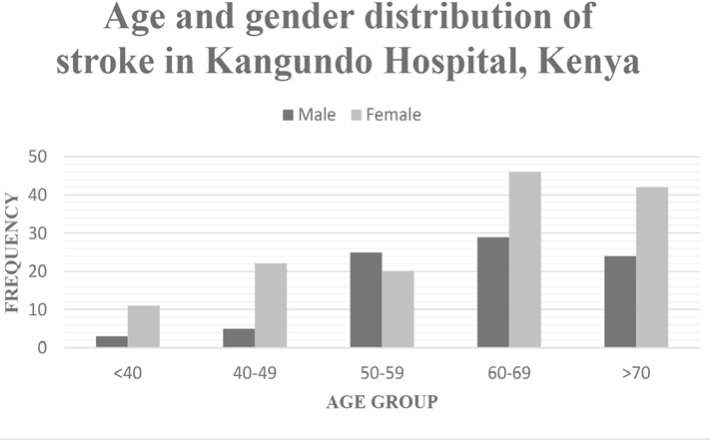
Out of 3200 medical admissions, 227 (7.09%) had a confirmed diagnosis of stroke. Ischaemic stroke was more common (67.4%) than haemorrhagic stroke (32.6%). It affected mainly the anterior circulation, especially the middle cerebral artery (39%). The mean age of patients was 68.8 years, (Range 32-96). It was more common in females (62%) than in males (38%). Hypertension was the most common (74%) risk factor followed by alcohol abuse (63%), tobacco smoking (48%) and diabetes mellitus (42%).
Ischaemic stroke was the more common major cause of morbidity in the rural hospital studied in Kenya. It occurred most commonly among elderly females, with the most frequent comorbidities being hypertension. In addition, modifiable lifestyle factors like alcohol abuse and cigarette smoking contributed to the prevalence; hence we recommend the control of blood pressure and glucose as well as lifestyle modification to reduce the scourge in our studied population.
农村人口的中风模式与城市人口不同。尽管在撒哈拉以南非洲有许多关于这种情况的研究,但关于肯尼亚农村地区中风模式的研究却很少。因此,本研究旨在描述肯尼亚一家农村医院中风的特征。
本研究对2015年4月至2016年9月期间在肯尼亚东部马查科斯的一家四级医疗机构坎贡多医院连续收治的227例经世界卫生组织(WHO)诊断为中风的患者进行。前瞻性记录中风的亚型和解剖分布以及患者的年龄、性别。通过体格神经学检查进行诊断,并通过计算机断层扫描(CT)扫描成像进行确认。仅纳入那些具有完整生物数据、既往病史和社会史、患者临床和体格检查结果以及影像学结果的患者。数据录入预先格式化的问卷,分析均值、标准差和频率,并以表格和柱状图呈现。
在3200例住院患者中,227例(7.09%)确诊为中风。缺血性中风比出血性中风更常见(67.4%)。它主要影响前循环,尤其是大脑中动脉(39%)。患者的平均年龄为68.8岁(范围32 - 96岁)。女性(62%)比男性(38%)更常见。高血压是最常见的(74%)危险因素,其次是酗酒(63%)、吸烟(48%)和糖尿病(42%)。
在肯尼亚研究的农村医院中,缺血性中风是更常见的主要发病原因。它最常发生在老年女性中,最常见的合并症是高血压。此外,酗酒和吸烟等可改变的生活方式因素导致了其患病率;因此,我们建议控制血压和血糖以及改变生活方式,以减少我们研究人群中的这种疾病。