Ibrahim Ahmed S, El-Shishtawy Mamdouh M, Peña Alejandro, Liou Gregory I
Department of Ophthalmology, Medical College of Georgia, Augusta, GA 30912, USA.
Mol Vis. 2010 Oct 8;16:2033-42.
Diabetic retinopathy (DR) is associated with microglial activation and increased levels of inflammatory cytokines. Genistein, a tyrosine kinase inhibitor, has been shown to possess anti-inflammatory potential that so far untested in animal models of diabetes. The aims of this study are to evaluate the efficacy of genistein for alleviation of diabetes-induced retinal inflammation and also to gain insight into the molecular mechanisms involved therein by analyzing the effect of genistein on concomitant microglia activation in the diabetic retina and in isolated cells.
Streptozotocin (STZ)-induced diabetic Sprague Dawley rats were used. After diabetes was established for two weeks a single intravitreal injection of genistein or vehicle was performed. Forty-eight hours later, rats were killed, their retinal and vitreal samples were processed for Quantitative Real Time-PCR (qRT-PCR) and Enzyme-linked immunosorbent assay (ELISA) analyses, respectively. For the in vitro study, isolated microglial cells from retinas of newborn rats were used.
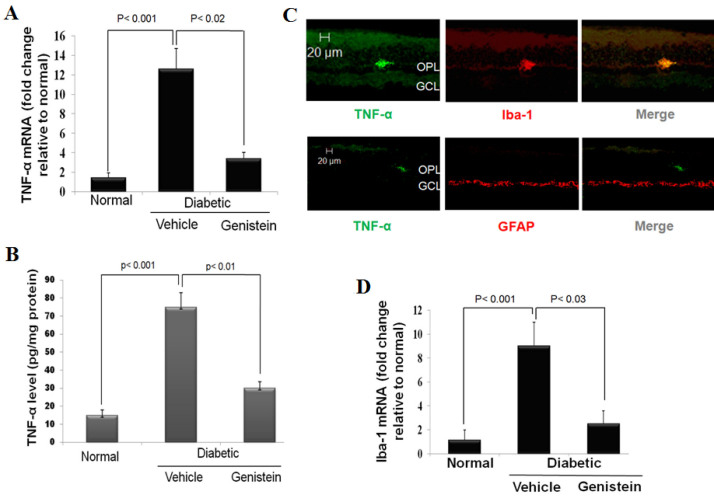
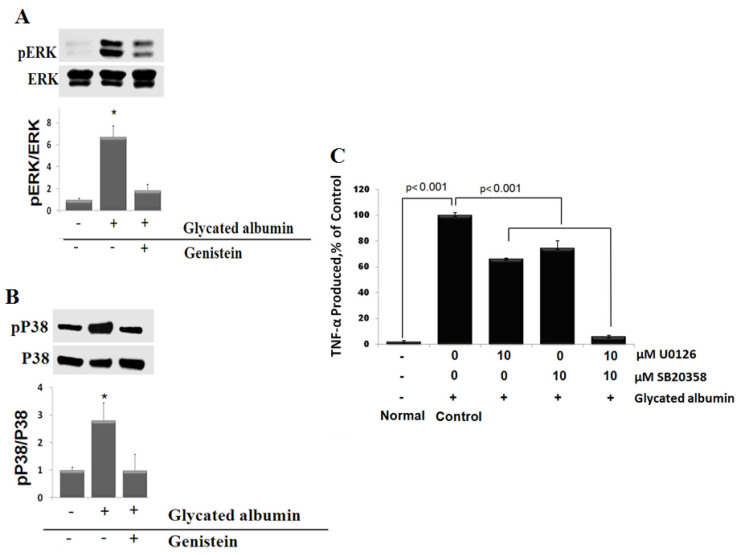
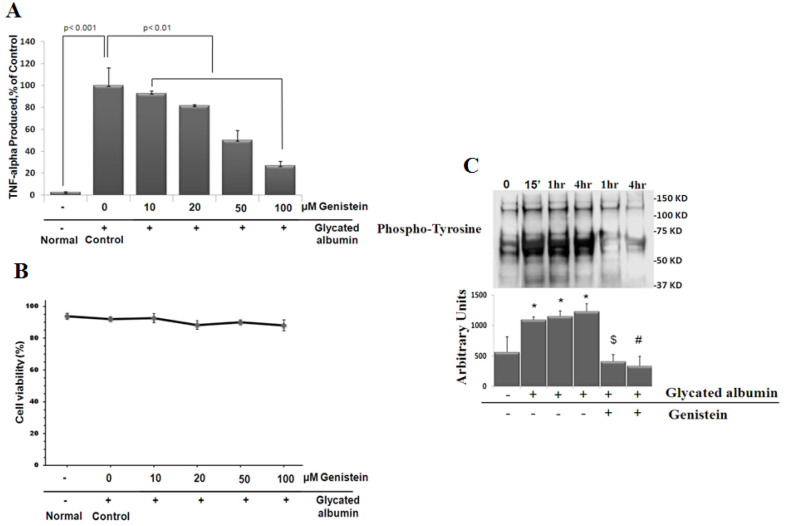
mRNA as well as protein levels for tumor necrosis factor α (TNF-α), a robust marker of inflammation, were increased in the retina early in the course of diabetes. Moreover, diabetes resulted in elevation of ionized calcium binding adaptor molecule-1 (Iba1) mRNA, known to be upregulated in activated microglia. These effects of diabetes in retina were all reduced by intervention treatment with genistein. Using an in vitro bioassay, we demonstrated the release of TNF-α from microglia activated by glycated albumin, a risk factor for diabetic disorders. This inflammatory signal involves the activation of tyrosine kinase and its subsequent events, ERK and P38 MAPKs. Genistein represses the release of TNF-α and significantly inhibits ERK and P38 phosphorylation in activated microglial cells by acting as a tyrosine kinase inhibitor.
These findings show genistein to be effective in dampening diabetes-induced retinal inflammation by interfering with inflammatory signaling (ERK and P38 MAPKs) that occurs in activated microglia. This beneficial effect of genistein may represent a new intervention therapy to modulate early pathological pathways long before the occurrence of vision loss among diabetics.
糖尿病视网膜病变(DR)与小胶质细胞活化及炎性细胞因子水平升高有关。染料木黄酮作为一种酪氨酸激酶抑制剂,已显示出具有抗炎潜力,但迄今为止尚未在糖尿病动物模型中进行测试。本研究的目的是评估染料木黄酮减轻糖尿病诱导的视网膜炎症的疗效,并通过分析染料木黄酮对糖尿病视网膜及分离细胞中伴随的小胶质细胞活化的影响,深入了解其中涉及的分子机制。
使用链脲佐菌素(STZ)诱导的糖尿病Sprague Dawley大鼠。糖尿病建立两周后,进行单次玻璃体内注射染料木黄酮或赋形剂。48小时后,处死大鼠,分别对其视网膜和玻璃体样本进行定量实时聚合酶链反应(qRT-PCR)和酶联免疫吸附测定(ELISA)分析。体外研究使用新生大鼠视网膜分离的小胶质细胞。
在糖尿病病程早期,视网膜中炎症的一个有力标志物肿瘤坏死因子α(TNF-α)的mRNA及蛋白水平升高。此外,糖尿病导致离子钙结合衔接分子1(Iba1)mRNA升高,已知其在活化的小胶质细胞中上调。染料木黄酮的干预治疗降低了糖尿病对视网膜的这些影响。通过体外生物测定,我们证明了糖化白蛋白(糖尿病疾病的一个危险因素)激活的小胶质细胞释放TNF-α。这种炎症信号涉及酪氨酸激酶的激活及其后续事件,即细胞外信号调节激酶(ERK)和p38丝裂原活化蛋白激酶(MAPKs)。染料木黄酮作为酪氨酸激酶抑制剂,可抑制TNF-α的释放,并显著抑制活化小胶质细胞中ERK和p38的磷酸化。
这些发现表明,染料木黄酮通过干扰活化小胶质细胞中发生的炎症信号(ERK和p38 MAPKs),有效减轻糖尿病诱导的视网膜炎症。染料木黄酮的这种有益作用可能代表一种新的干预疗法,可在糖尿病患者视力丧失发生之前很久就调节早期病理途径。