Early Life Nutrition Research Unit, Academic Child Health Respiratory Biomedical Research Unit, School of Clinical Sciences, Queen's Medical Centre, University Hospital, Nottingham, UK.
Reproduction. 2011 Jan;141(1):119-26. doi: 10.1530/REP-10-0325. Epub 2010 Nov 2.
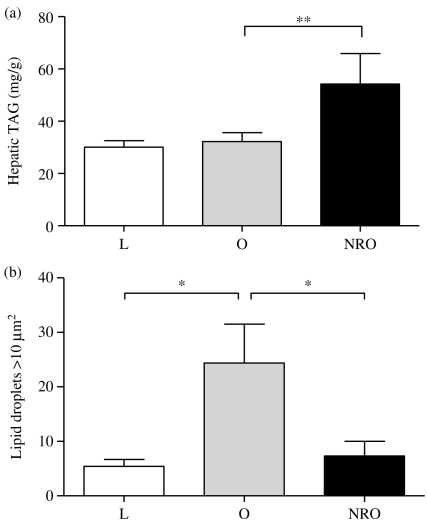
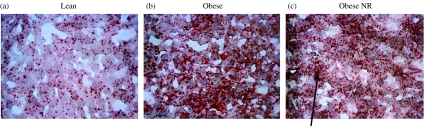
Maternal nutrition during the period of early organ development can modulate the offspring's ability to metabolise excess fat as young adults when exposed to an obesogenic environment. This study examined the hypothesis that exposing offspring to nutrient restriction coincident with early hepatogenesis would result in endocrine and metabolic adaptations that subsequently lead to increased ectopic lipid accumulation within the liver. Pregnant sheep were fed either 50 or 100% of total metabolisable energy requirements from 30 to 80 days gestation and 100% thereafter. At weaning, offspring were made obese, and at ~1 year of age livers were sampled. Lipid infiltration and molecular indices of gluconeogenesis, lipid metabolism and mitochondrial function were measured. Although hepatic triglyceride accumulation was not affected by obesity per se, it was nearly doubled in obese offspring born to nutrient-restricted mothers. This adaptation was accompanied by elevated gene expression for peroxisome proliferator-activated receptor γ (PPARG) and its co-activator PGC1α, which may be indicative of changes in the rate of hepatic fatty acid oxidation. In contrast, maternal diet had no influence on the stimulatory effect of obesity on gene expression for a range of proteins involved in glucose metabolism and energy balance including glucokinase, glucocorticoid receptors and uncoupling protein 2. Similarly, although gene expressions for the insulin and IGF1 receptors were suppressed by obesity they were not influenced by the prenatal nutritional environment. In conclusion, excess hepatic lipid accumulation with juvenile obesity is promoted by suboptimal nutrition coincident with early development of the fetal liver.
母体在胚胎器官早期发育阶段的营养供应可以调节后代在成年后暴露于肥胖环境时代谢多余脂肪的能力。本研究检验了这样一个假设,即让后代在早期肝发生时同时接受营养限制,会导致内分泌和代谢适应,从而导致肝脏内异位脂质积累增加。从妊娠 30 天到 80 天,给怀孕的绵羊喂食 50%或 100%的总可代谢能量需求,此后一直喂食 100%的能量。在断奶时,使后代肥胖,然后在大约 1 岁时采集肝脏样本。测量脂质浸润和糖异生、脂质代谢和线粒体功能的分子指标。尽管肥胖本身并没有影响肝脏甘油三酯的积累,但在营养受限母亲所生的肥胖后代中,肝脏甘油三酯的积累几乎增加了一倍。这种适应伴随着过氧化物酶体增殖物激活受体γ(PPARG)及其共激活因子 PGC1α的基因表达升高,这可能表明肝脏脂肪酸氧化率发生了变化。相比之下,母体饮食对肥胖对参与葡萄糖代谢和能量平衡的一系列蛋白质(包括葡萄糖激酶、糖皮质激素受体和解偶联蛋白 2)的基因表达的刺激作用没有影响。同样,尽管肥胖抑制了胰岛素和 IGF1 受体的基因表达,但它们不受产前营养环境的影响。总之,在胎儿肝脏早期发育时接受次优营养供应会促进与青少年肥胖相关的肝脏内过多脂质积累。