Department of Bioengineering, University of California, Berkeley, CA 94720-1762, USA.
Ann Biomed Eng. 2011 Apr;39(4):1163-73. doi: 10.1007/s10439-010-0195-z. Epub 2010 Oct 29.
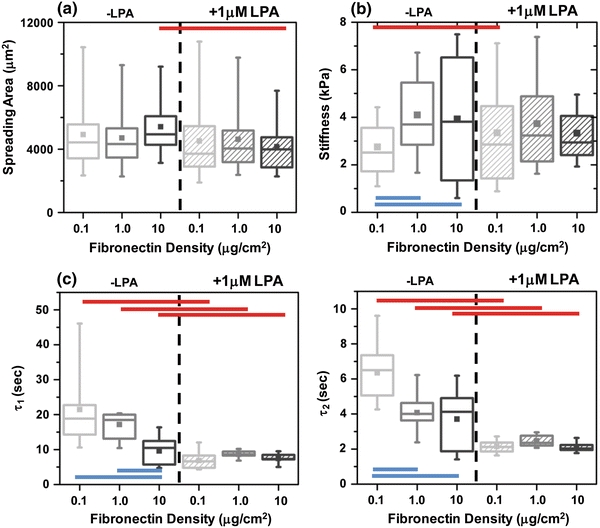
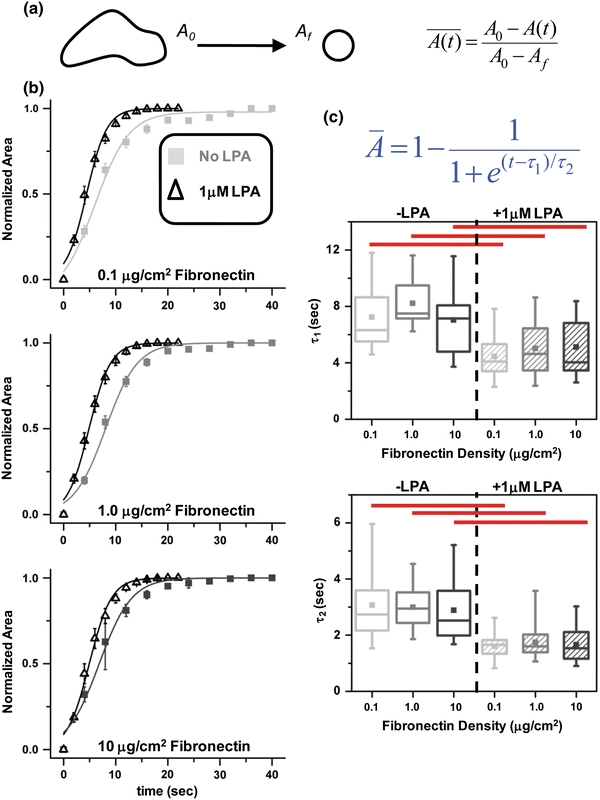
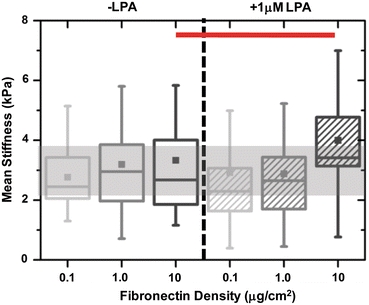
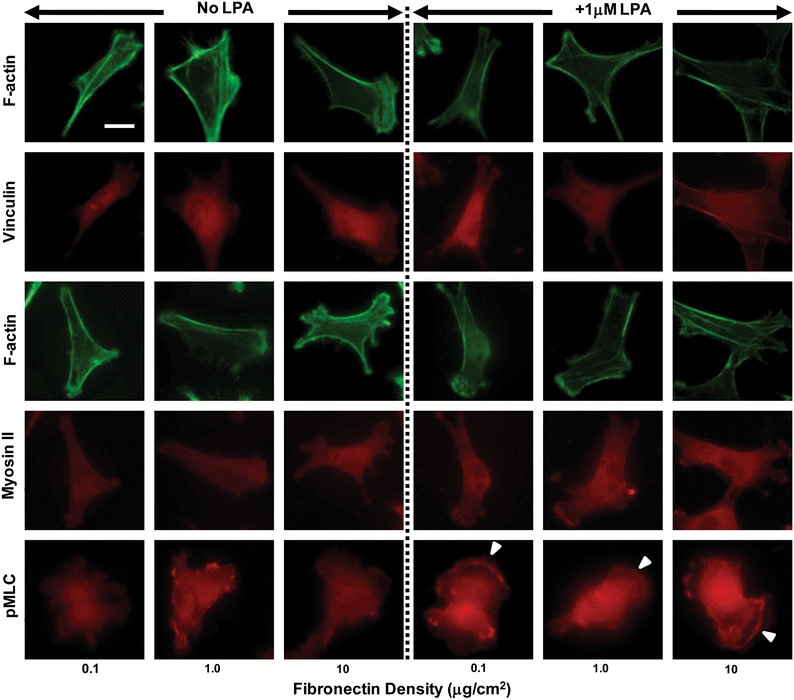
Cells that are enzymatically detached from a solid substrate rapidly round up as the tensile prestress in the cytoskeleton is suddenly unopposed by cell-ECM adhesions. We recently showed that this retraction follows sigmoidal kinetics with time constants that correlate closely with cortical stiffness values. This raises the promising prospect that these de-adhesion measurements may be used for high-throughput screening of cell mechanical properties; however, an important limitation to doing so is the possibility that the retraction kinetics may also be influenced and potentially rate-limited by the time needed to sever matrix adhesions. In this study, we address this open question by separating contributions of contractility and adhesion to cellular de-adhesion and retraction kinetics. We first develop serum-free conditions under which U373 MG glioma cells can be cultured on substrates of fixed fibronectin density without direct matrix contributions from the medium. We show that while spreading area increases with ECM protein density, cortical stiffness and the time constants of retraction do not. Conversely, addition of lysophosphatidic acid (LPA) to stimulate cell contractility strongly speeds retraction, independent of the initial matrix protein density and LPA's contributions to spreading area. All of these trends hold in serum-rich medium commonly used in tissue culture, with the time constants of retraction much more closely tracking cortical stiffness than adhesive ligand density or cell spreading. These results support the use of cellular de-adhesion measurements to track cellular mechanical properties.
从固体基质上酶解分离的细胞会迅速变圆,因为细胞骨架中的拉伸预应力突然不再受到细胞-细胞外基质黏附的抵抗。我们最近表明,这种回缩遵循时间的 S 形动力学,其时间常数与皮质硬度值密切相关。这提出了一个很有前途的前景,即这些去黏附测量可能用于高通量筛选细胞力学特性;然而,这样做的一个重要限制是,回缩动力学也可能受到并潜在地限制于切断基质黏附所需的时间的影响。在这项研究中,我们通过将收缩性和黏附性对细胞去黏附和回缩动力学的贡献分开来解决这个悬而未决的问题。我们首先开发无血清条件,在这种条件下,U373 MG 神经胶质瘤细胞可以在固定纤维连接蛋白密度的基质上培养,而不受培养基中基质的直接贡献。我们表明,虽然扩散面积随 ECM 蛋白密度的增加而增加,但皮质硬度和回缩的时间常数没有增加。相反,添加溶血磷脂酸(LPA)以刺激细胞收缩性会强烈加速回缩,而与初始基质蛋白密度和 LPA 对扩散面积的贡献无关。这些趋势在组织培养中常用的富含血清的培养基中都成立,回缩的时间常数与皮质硬度的相关性远高于黏附配体密度或细胞扩散。这些结果支持使用细胞去黏附测量来跟踪细胞力学特性。