Department of Neurology, Johns Hopkins University, Baltimore, Maryland 21205, USA.
Glia. 2011 Feb;59(2):200-7. doi: 10.1002/glia.21089.
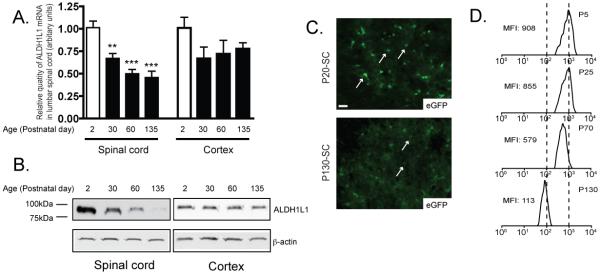
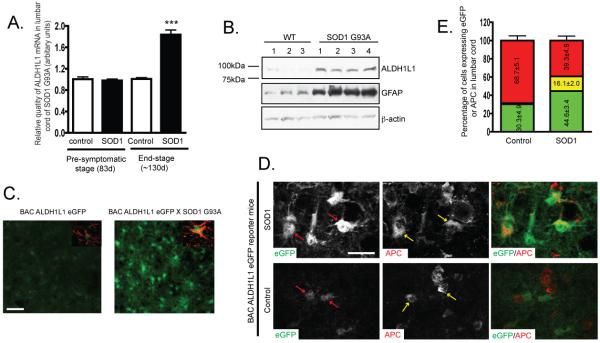
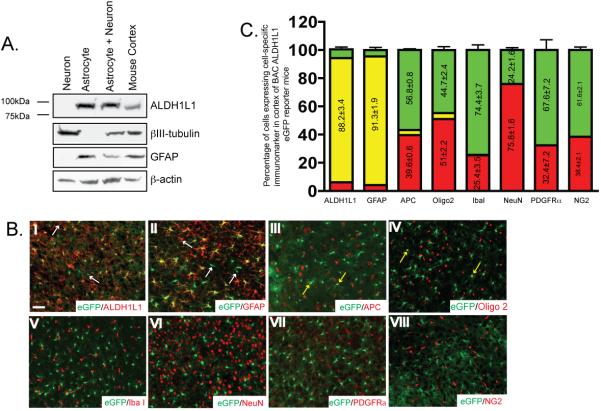
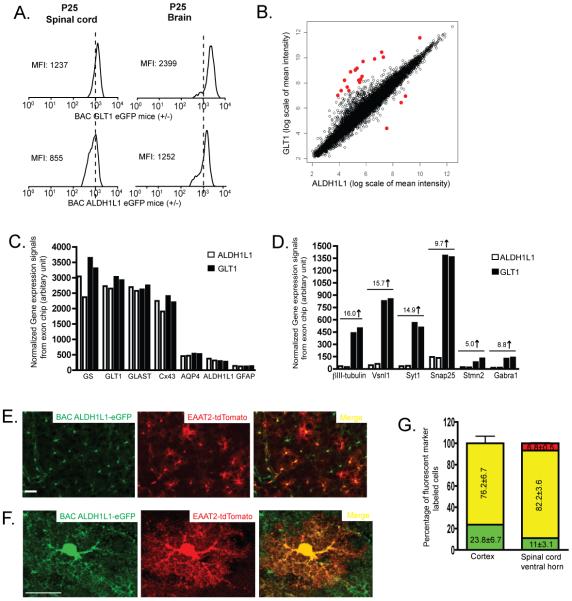
Astrocyte heterogeneity remains largely unknown in the CNS due to lack of specific astroglial markers. In this study, molecular identity of in vivo astrocytes was characterized in BAC ALDH1L1 and BAC GLT1 eGFP promoter reporter transgenic mice. ALDH1L1 promoter is selectively activated in adult cortical and spinal cord astrocytes, indicated by the overlap of eGFP expression with ALDH1L1 and GFAP, but not with NeuN, APC, Olig2, IbaI, PDGFRα immunoreactivity in BAC ALDH1L1 eGFP reporter mice. Interestingly, ALDH1L1 expression levels (protein, mRNA, and promoter activity) in spinal cord were selectively decreased during postnatal maturation. In contrast, its expression was up-regulated in reactive astrocytes in both acute neural injury and chronic neurodegenerative (G93A mutant SOD1) conditions, similar to GFAP, but opposite of GLT1. ALDH1L1(+) and GLT1(+) cells isolated through fluorescence activated cell sorting (FACS) from BAC ALDH1L1 and BAC GLT1 eGFP mice share a highly similar gene expression profile, suggesting ALDH1L1 and GLT1 are co-expressed in the same population of astrocytes. This observation was further supported by overlap of the eGFP driven by the ALDH1L1 genomic promoter and the tdTomato driven by a 8.3kb EAAT2 promoter fragment in astrocytes of BAC ALDH1L1 eGFP X EAAT2-tdTomato mice. These studies support ALDH1L1 as a general CNS astroglial marker and investigated astrocyte heterogeneity in the CNS by comparing the molecular identity of the ALDH1L1(+) and GLT1(+) astrocytes from astroglial reporter mice. These astroglial reporter mice provide useful in vivo tools for the molecular analysis of astrocytes in physiological and pathological conditions.
由于缺乏特异性星形胶质细胞标记物,中枢神经系统(CNS)中的星形胶质细胞异质性在很大程度上仍未知。在这项研究中,使用 BAC ALDH1L1 和 BAC GLT1 eGFP 启动子报告转基因小鼠,对体内星形胶质细胞的分子特征进行了描述。ALDH1L1 启动子在成年皮质和脊髓星形胶质细胞中被选择性激活,这表现在 eGFP 表达与 ALDH1L1 和 GFAP 重叠,而与 NeuN、APC、Olig2、IbaI 和 PDGFRα 免疫反应性不重叠。有趣的是,在出生后成熟过程中,脊髓中的 ALDH1L1 表达水平(蛋白、mRNA 和启动子活性)选择性降低。相反,在急性神经损伤和慢性神经退行性变(G93A 突变 SOD1)条件下的反应性星形胶质细胞中,其表达被上调,与 GFAP 相似,但与 GLT1 相反。通过荧光激活细胞分选(FACS)从 BAC ALDH1L1 和 BAC GLT1 eGFP 小鼠中分离的 ALDH1L1(+)和 GLT1(+)细胞具有高度相似的基因表达谱,提示 ALDH1L1 和 GLT1 在同一星形胶质细胞群体中共同表达。这一观察结果得到了进一步支持,即在 BAC ALDH1L1 eGFP X EAAT2-tdTomato 小鼠的星形胶质细胞中,由 ALDH1L1 基因组启动子驱动的 eGFP 与由 8.3kb EAAT2 启动子片段驱动的 tdTomato 重叠。这些研究支持 ALDH1L1 作为一般的中枢神经系统星形胶质细胞标记物,并通过比较来自星形胶质细胞报告小鼠的 ALDH1L1(+)和 GLT1(+)星形胶质细胞的分子特征,研究了中枢神经系统中的星形胶质细胞异质性。这些星形胶质细胞报告小鼠为生理和病理条件下星形胶质细胞的分子分析提供了有用的体内工具。