Heiman Myriam, Schaefer Anne, Gong Shiaoching, Peterson Jayms D, Day Michelle, Ramsey Keri E, Suárez-Fariñas Mayte, Schwarz Cordelia, Stephan Dietrich A, Surmeier D James, Greengard Paul, Heintz Nathaniel
Laboratory of Molecular and Cellular Neuroscience, The Rockefeller University, New York, NY 10065, USA.
Cell. 2008 Nov 14;135(4):738-48. doi: 10.1016/j.cell.2008.10.028.
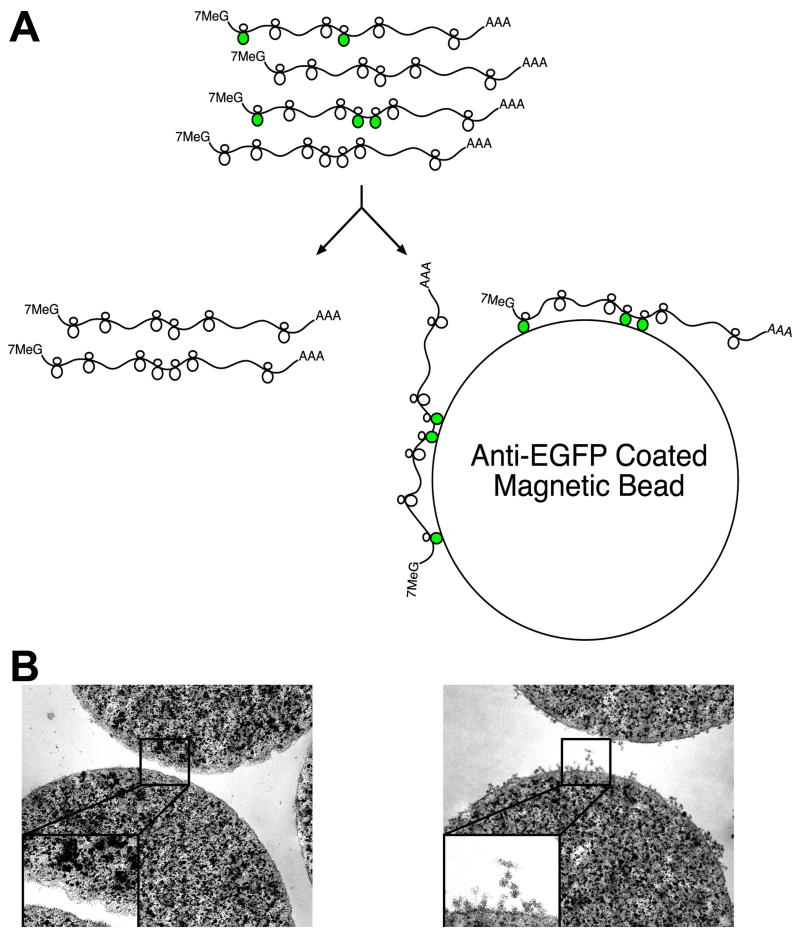
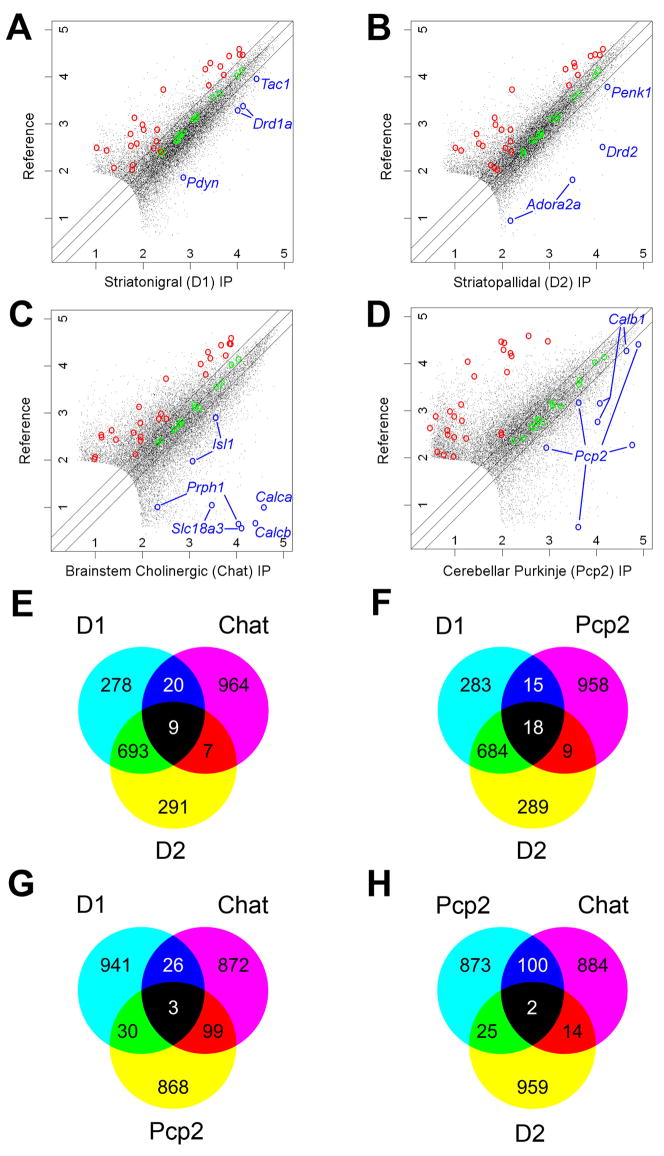
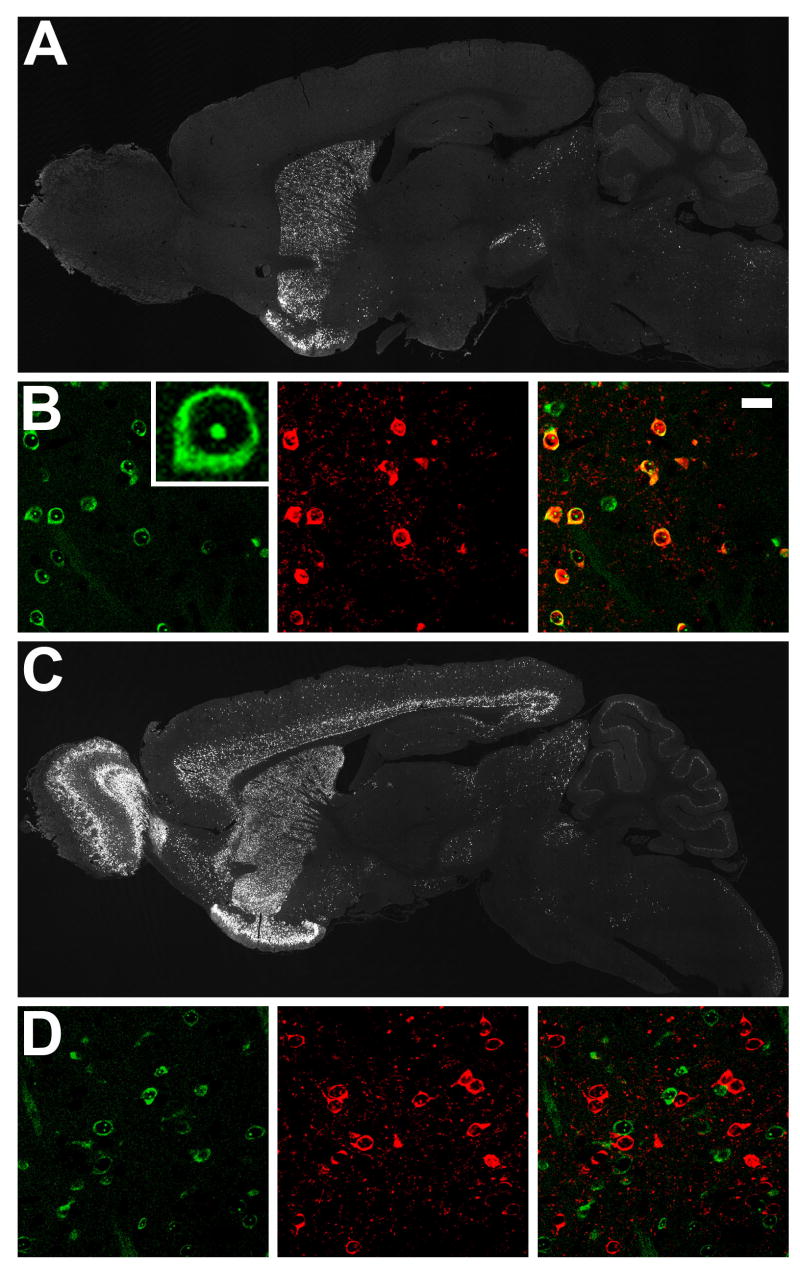
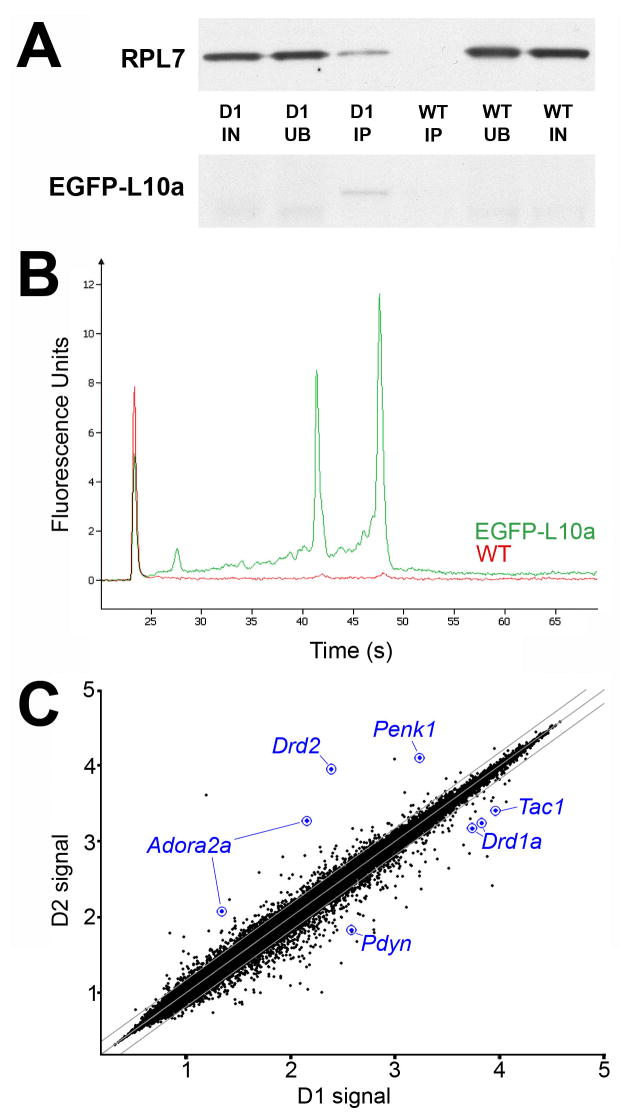
The cellular heterogeneity of the brain confounds efforts to elucidate the biological properties of distinct neuronal populations. Using bacterial artificial chromosome (BAC) transgenic mice that express EGFP-tagged ribosomal protein L10a in defined cell populations, we have developed a methodology for affinity purification of polysomal mRNAs from genetically defined cell populations in the brain. The utility of this approach is illustrated by the comparative analysis of four types of neurons, revealing hundreds of genes that distinguish these four cell populations. We find that even two morphologically indistinguishable, intermixed subclasses of medium spiny neurons display vastly different translational profiles and present examples of the physiological significance of such differences. This genetically targeted translating ribosome affinity purification (TRAP) methodology is a generalizable method useful for the identification of molecular changes in any genetically defined cell type in response to genetic alterations, disease, or pharmacological perturbations.
大脑的细胞异质性给阐明不同神经元群体的生物学特性带来了困难。利用在特定细胞群体中表达EGFP标记的核糖体蛋白L10a的细菌人工染色体(BAC)转基因小鼠,我们开发了一种从大脑中基因定义的细胞群体中亲和纯化多聚体mRNA的方法。对四种神经元类型的比较分析说明了这种方法的实用性,揭示了数百个区分这四个细胞群体的基因。我们发现,即使是中等棘状神经元的两个形态上无法区分、相互混合的亚类,其翻译谱也有很大差异,并给出了这种差异生理意义的实例。这种基因靶向翻译核糖体亲和纯化(TRAP)方法是一种可推广的方法,可用于识别任何基因定义的细胞类型在基因改变、疾病或药物扰动下的分子变化。