Department of Molecular Medicine, Mayo Clinic, Rochester, MN 55905, USA.
Gene Ther. 2011 Mar;18(3):283-93. doi: 10.1038/gt.2010.145. Epub 2010 Nov 4.
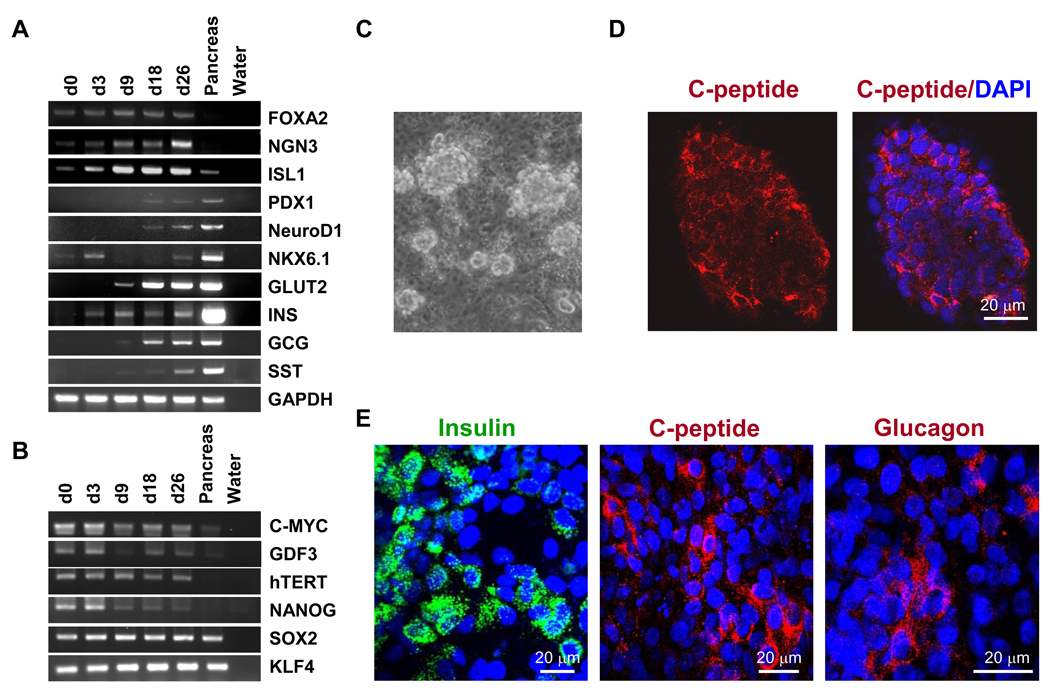
Nuclear reprogramming of somatic tissue enables derivation of induced pluripotent stem (iPS) cells from an autologous, non-embryonic origin. The purpose of this study was to establish efficient protocols for lineage specification of human iPS cells into functional glucose-responsive, insulin-producing progeny. We generated human iPS cells, which were then guided with recombinant growth factors that mimic the essential signaling for pancreatic development. Reprogrammed with four stemness factors, human fibroblasts were here converted into authentic iPS cells. Under feeder-free conditions, fate specification was initiated with activin A and Wnt3a that triggered engagement into definitive endoderm, followed by priming with fibroblast growth factor 10 (FGF10) and KAAD-cyclopamine. Addition of retinoic acid, boosted by the pancreatic endoderm inducer indolactam V (ILV), yielded pancreatic progenitors expressing pancreatic and duodenal homeobox 1 (PDX1), neurogenin 3 (NGN3) and neurogenic differentiation 1 (NEUROD1) markers. Further guidance, under insulin-like growth factor 1 (IGF-1), hepatocyte growth factor (HGF) and N-[N-(3,5-Difluorophenacetyl)-L-alanyl]-S-phenylglycine t-butyl ester (DAPT), was enhanced by glucagon-like peptide-1 (GLP-1) to generate islet-like cells that expressed pancreas-specific markers including insulin and glucagon. Derived progeny demonstrated sustained expression of PDX1, and functional responsiveness to glucose challenge secreting up to 230 pM of C-peptide. A pancreatogenic cocktail enriched with ILV/GLP-1 offers a proficient means to specify human iPS cells into glucose-responsive hormone-producing progeny, refining the development of a personalized platform for islet-like cell generation.
体细胞的核重编程使人们能够从自体、非胚胎来源中获得诱导多能干细胞(iPS 细胞)。本研究的目的是建立高效的方案,将人类 iPS 细胞定向分化为具有功能性、葡萄糖反应性、胰岛素分泌功能的祖细胞。我们生成了人类 iPS 细胞,然后用重组生长因子对其进行定向诱导,这些生长因子模拟了胰腺发育所必需的信号通路。通过将四种干性因子转入人成纤维细胞,我们成功将其转化为真正的 iPS 细胞。在无饲养层条件下,先用激活素 A 和 Wnt3a 启动细胞向确定的内胚层分化,然后用碱性成纤维细胞生长因子 10(FGF10)和 KAAD-环巴胺进行初始诱导。添加视黄酸,并用胰腺内胚层诱导剂吲哚酰胺 V(ILV)增强,得到表达胰腺十二指肠同源盒 1(PDX1)、神经基因 3(NGN3)和神经分化 1(NEUROD1)标志物的胰腺祖细胞。在胰岛素样生长因子 1(IGF-1)、肝细胞生长因子(HGF)和 N-[N-(3,5-二氟苯乙酰基)-L-丙氨酰]-S-苯甘氨酸叔丁酯(DAPT)存在的情况下,通过胰高血糖素样肽 1(GLP-1)进一步诱导,产生胰岛样细胞,这些细胞表达包括胰岛素和胰高血糖素在内的胰腺特异性标志物。衍生的祖细胞持续表达 PDX1,对葡萄糖刺激有功能反应,可分泌高达 230pm 的 C 肽。富含 ILV/GLP-1 的胰发生细胞诱导液为将人类 iPS 细胞定向分化为具有葡萄糖反应性、激素分泌功能的祖细胞提供了一种有效的方法,从而完善了用于胰岛样细胞生成的个体化平台的开发。