Farb Claudia R, Chang William, Ledoux J E
Center for Neural Science, New York University New York, NY, USA.
Front Behav Neurosci. 2010 Oct 13;4:162. doi: 10.3389/fnbeh.2010.00162. eCollection 2010.
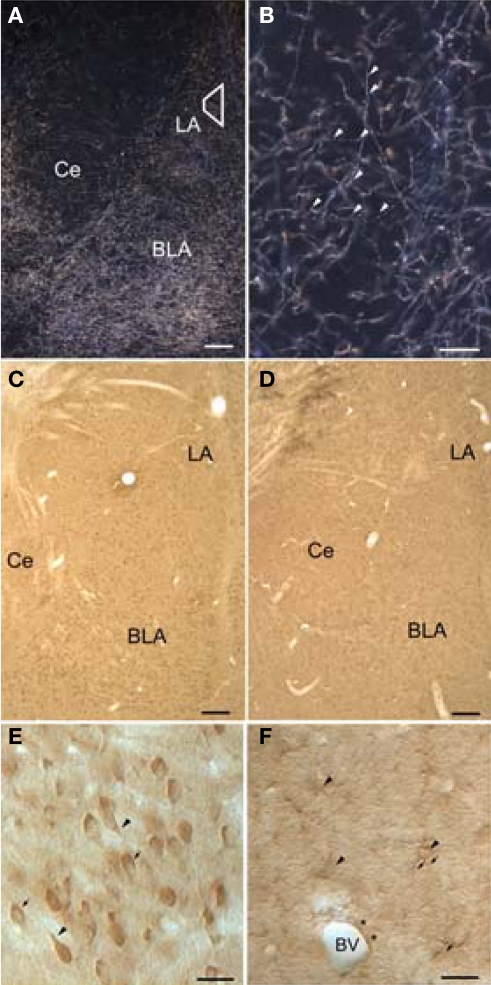
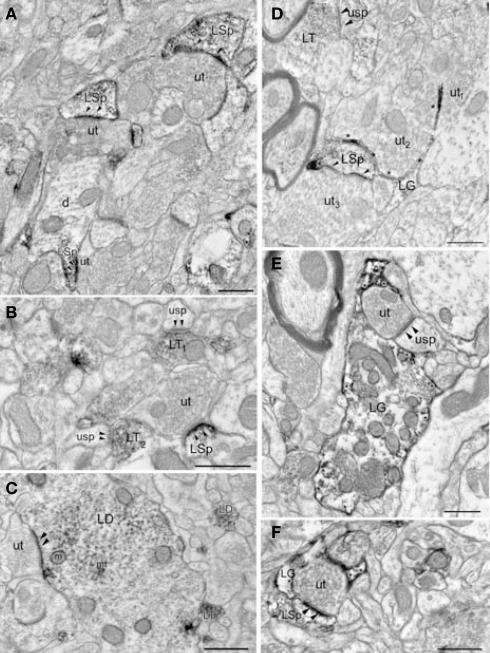
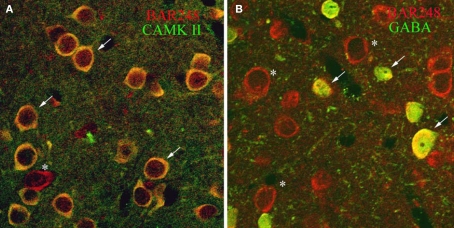
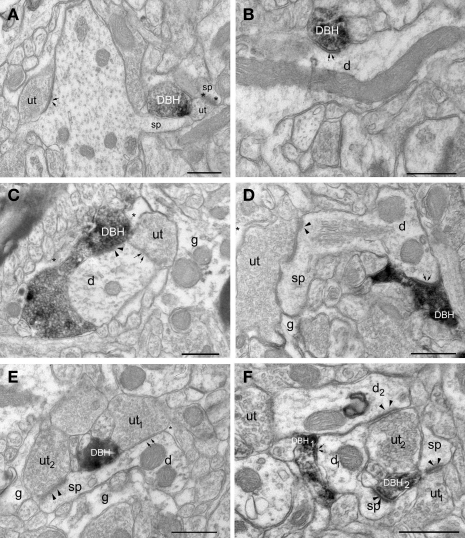
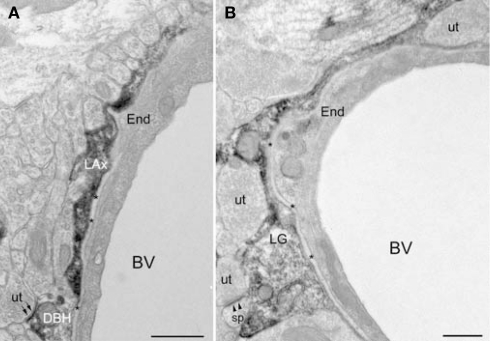
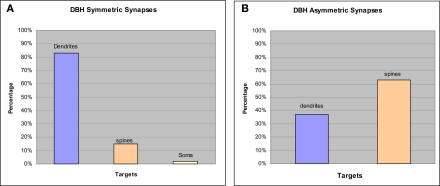
Norepinephrine (NE) is thought to play a key role in fear and anxiety, but its role in amygdala-dependent Pavlovian fear conditioning, a major model for understanding the neural basis of fear, is poorly understood. The lateral nucleus of the amygdala (LA) is a critical brain region for fear learning and regulating the effects of stress on memory. To understand better the cellular mechanisms of NE and its adrenergic receptors in the LA, we used antibodies directed against dopamine beta-hydroxylase (DβH), the synthetic enzyme for NE, or against two different isoforms of the beta-adrenergic receptors (βARs), one that predominately recognizes neurons (βAR 248) and the other astrocytes (βAR 404), to characterize the microenvironments of DβH and βAR. By electron microscopy, most DβH terminals did not make synapses, but when they did, they formed both asymmetric and symmetric synapses. By light microscopy, βARs were present in both neurons and astrocytes. Confocal microscopy revealed that both excitatory and inhibitory neurons express βAR248. By electron microscopy, βAR 248 was present in neuronal cell bodies, dendritic shafts and spines, and some axon terminals and astrocytes. When in dendrites and spines, βAR 248 was frequently concentrated along plasma membranes and at post-synaptic densities of asymmetric (excitatory) synapses. βAR 404 was expressed predominately in astrocytic cell bodies and processes. These astrocytic processes were frequently interposed between unlabeled terminals or ensheathed asymmetric synapses. Our findings provide a morphological basis for understanding ways in which NE may modulate transmission by acting via synaptic or non-synaptic mechanisms in the LA.
去甲肾上腺素(NE)被认为在恐惧和焦虑中起关键作用,但其在杏仁核依赖的巴甫洛夫式恐惧条件反射(这是理解恐惧神经基础的主要模型)中的作用却鲜为人知。杏仁核外侧核(LA)是恐惧学习以及调节应激对记忆影响的关键脑区。为了更好地理解LA中NE及其肾上腺素能受体的细胞机制,我们使用了针对多巴胺β-羟化酶(DβH,NE的合成酶)或两种不同亚型的β-肾上腺素能受体(βARs)的抗体,其中一种主要识别神经元(βAR 248),另一种识别星形胶质细胞(βAR 404),以表征DβH和βAR的微环境。通过电子显微镜观察,大多数DβH终末不形成突触,但当它们形成突触时,会形成不对称和对称突触。通过光学显微镜观察,βARs存在于神经元和星形胶质细胞中。共聚焦显微镜显示,兴奋性和抑制性神经元均表达βAR248。通过电子显微镜观察,βAR 248存在于神经元细胞体、树突干和棘以及一些轴突终末和星形胶质细胞中。当位于树突和棘中时,βAR 248经常集中在质膜以及不对称(兴奋性)突触的突触后致密区。βAR 404主要在星形胶质细胞的细胞体和突起中表达。这些星形胶质细胞突起经常插入未标记的终末之间或包裹不对称突触。我们的研究结果为理解NE可能通过在LA中通过突触或非突触机制发挥作用来调节传递的方式提供了形态学基础。