State Key Laboratory for Diagnosis and Treatment of Infectious Diseases, First Affiliated Hospital of Medical College, Zhejiang University, Hangzhou, China.
PLoS Negl Trop Dis. 2010 Oct 26;4(10):e857. doi: 10.1371/journal.pntd.0000857.
Leptospira interrogans is the major causative agent of leptospirosis. Phagocytosis plays important roles in the innate immune responses to L. interrogans infection, and L. interrogans can evade the killing of phagocytes. However, little is known about the adaptation of L. interrogans during this process.
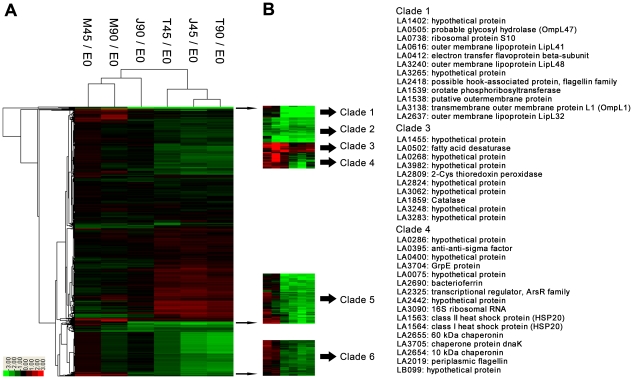
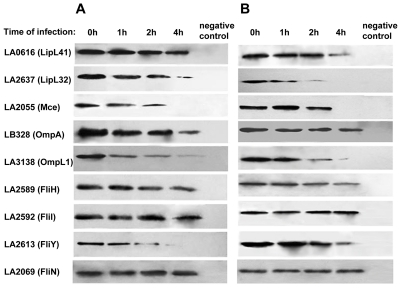
METHODOLOGY/PRINCIPAL FINDINGS: To better understand the interaction of pathogenic Leptospira and innate immunity, we employed microarray and comparative genomics analyzing the responses of L. interrogans to macrophage-derived cells. During this process, L. interrogans altered expressions of many genes involved in carbohydrate and lipid metabolism, energy production, signal transduction, transcription and translation, oxygen tolerance, and outer membrane proteins. Among them, the catalase gene expression was significantly up-regulated, suggesting it may contribute to resisting the oxidative pressure of the macrophages. The expressions of several major outer membrane protein (OMP) genes (e.g., ompL1, lipL32, lipL41, lipL48 and ompL47) were dramatically down-regulated (10-50 folds), consistent with previous observations that the major OMPs are differentially regulated in vivo. The persistent down-regulations of these major OMPs were validated by immunoblotting. Furthermore, to gain initial insight into the gene regulation mechanisms in L. interrogans, we re-defined the transcription factors (TFs) in the genome and identified the major OmpR TF gene (LB333) that is concurrently regulated with the major OMP genes, suggesting a potential role of LB333 in OMPs regulation.
CONCLUSIONS/SIGNIFICANCE: This is the first report on global responses of pathogenic Leptospira to innate immunity, which revealed that the down-regulation of the major OMPs may be an immune evasion strategy of L. interrogans, and a putative TF may be involved in governing these down-regulations. Alterations of the leptospiral OMPs up interaction with host antigen-presenting cells (APCs) provide critical information for selection of vaccine candidates. In addition, genome-wide annotation and comparative analysis of TFs set a foundation for further studying regulatory networks in Leptospira spp.
问号钩端螺旋体是钩端螺旋体病的主要病原体。吞噬作用在先天免疫对问号钩端螺旋体感染的反应中起着重要作用,而问号钩端螺旋体可以逃避吞噬细胞的杀伤。然而,对于问号钩端螺旋体在这个过程中的适应机制知之甚少。
方法/主要发现:为了更好地了解致病性钩端螺旋体与先天免疫的相互作用,我们采用微阵列和比较基因组学分析了问号钩端螺旋体对巨噬细胞来源的细胞的反应。在此过程中,问号钩端螺旋体改变了许多参与碳水化合物和脂质代谢、能量产生、信号转导、转录和翻译、耐氧性以及外膜蛋白的基因的表达。其中,过氧化氢酶基因的表达显著上调,表明它可能有助于抵抗巨噬细胞的氧化压力。几种主要外膜蛋白(OMP)基因(如 ompL1、lipL32、lipL41、lipL48 和 ompL47)的表达显著下调(10-50 倍),与先前观察到的体内主要 OMP 差异调节一致。这些主要 OMP 的持续下调通过免疫印迹得到验证。此外,为了初步了解问号钩端螺旋体的基因调控机制,我们重新定义了基因组中的转录因子(TFs),并鉴定了主要的 OmpR TF 基因(LB333),该基因与主要 OMP 基因同时被调控,表明 LB333 可能在 OMP 调控中起作用。
结论/意义:这是首次报道致病性钩端螺旋体对先天免疫的全面反应,揭示了主要 OMP 的下调可能是问号钩端螺旋体的一种免疫逃避策略,而一个假定的 TF 可能参与了这些下调的调控。这些 OMP 的改变影响了钩端螺旋体与宿主抗原呈递细胞(APCs)的相互作用,为选择疫苗候选物提供了重要信息。此外,TF 的全基因组注释和比较分析为进一步研究钩端螺旋体属的调控网络奠定了基础。