School of Computing Science, Simon Fraser University, Burnaby, Canada.
PLoS One. 2010 Oct 25;5(10):e13348. doi: 10.1371/journal.pone.0013348.
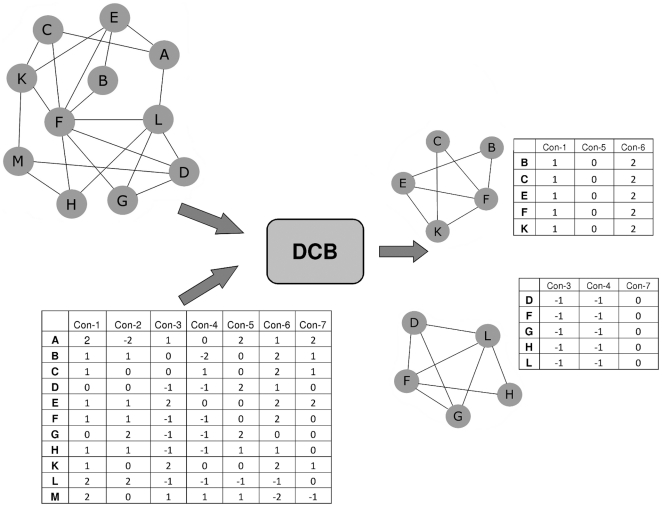
Computational prediction of functionally related groups of genes (functional modules) from large-scale data is an important issue in computational biology. Gene expression experiments and interaction networks are well studied large-scale data sources, available for many not yet exhaustively annotated organisms. It has been well established, when analyzing these two data sources jointly, modules are often reflected by highly interconnected (dense) regions in the interaction networks whose participating genes are co-expressed. However, the tractability of the problem had remained unclear and methods by which to exhaustively search for such constellations had not been presented.
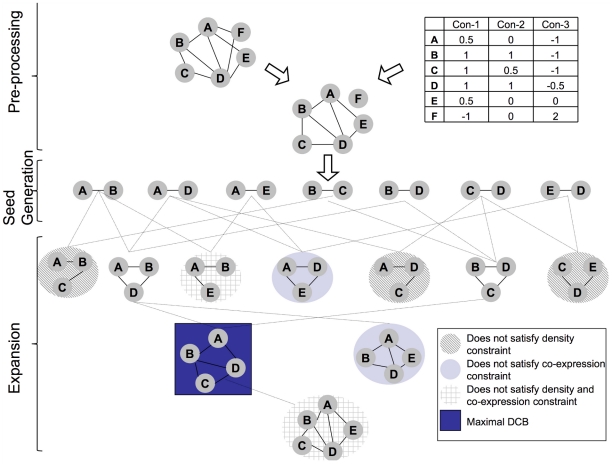
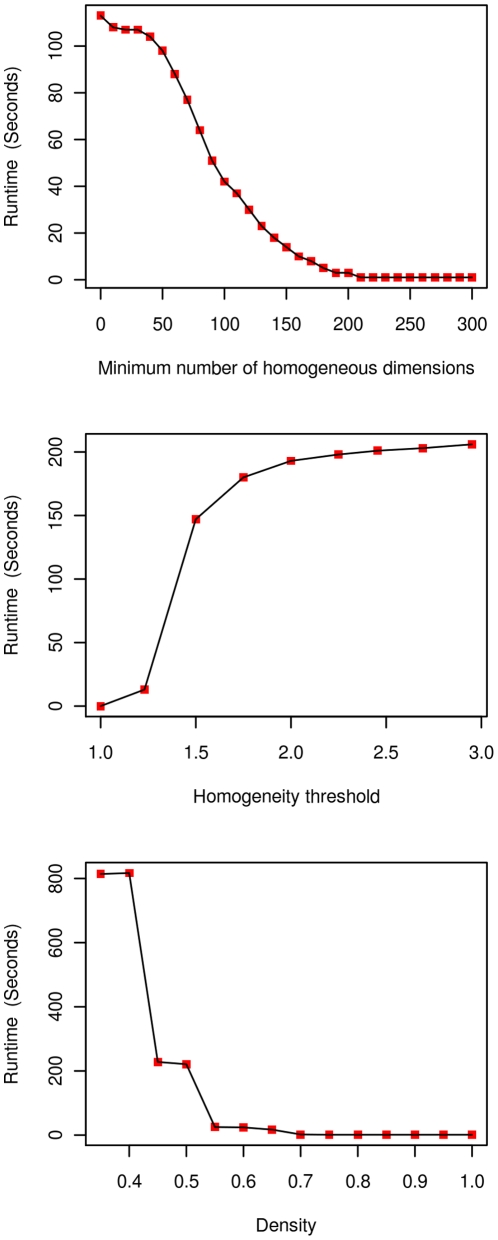
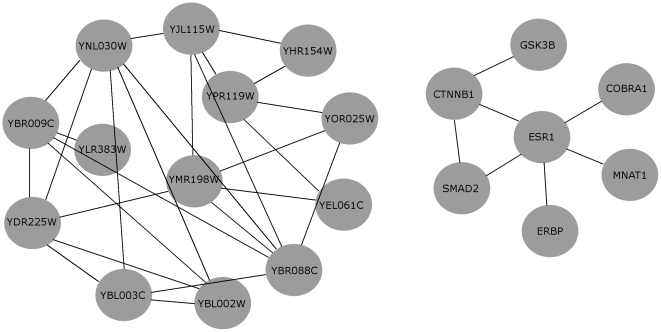
METHODOLOGY/PRINCIPAL FINDINGS: We provide an algorithmic framework, referred to as Densely Connected Biclustering (DECOB), by which the aforementioned search problem becomes tractable. To benchmark the predictive power inherent to the approach, we computed all co-expressed, dense regions in physical protein and genetic interaction networks from human and yeast. An automatized filtering procedure reduces our output which results in smaller collections of modules, comparable to state-of-the-art approaches. Our results performed favorably in a fair benchmarking competition which adheres to standard criteria. We demonstrate the usefulness of an exhaustive module search, by using the unreduced output to more quickly perform GO term related function prediction tasks. We point out the advantages of our exhaustive output by predicting functional relationships using two examples.
CONCLUSION/SIGNIFICANCE: We demonstrate that the computation of all densely connected and co-expressed regions in interaction networks is an approach to module discovery of considerable value. Beyond confirming the well settled hypothesis that such co-expressed, densely connected interaction network regions reflect functional modules, we open up novel computational ways to comprehensively analyze the modular organization of an organism based on prevalent and largely available large-scale datasets.
Software and data sets are available at http://www.sfu.ca/~ester/software/DECOB.zip.
从大规模数据中计算预测功能相关的基因组(功能模块)是计算生物学中的一个重要问题。基因表达实验和相互作用网络是经过充分研究的大规模数据源,可用于许多尚未进行详尽注释的生物体。当联合分析这两个数据源时,已经证实模块通常反映在相互作用网络中高度互联(密集)的区域中,其参与的基因是共表达的。然而,该问题的可处理性一直不清楚,也没有提出用于详尽搜索此类组合的方法。
方法/主要发现:我们提供了一种算法框架,称为密集连接双聚类(DECOB),通过该框架,上述搜索问题变得可行。为了基准该方法固有的预测能力,我们计算了来自人类和酵母的物理蛋白质和遗传相互作用网络中的所有共表达、密集区域。自动过滤过程减少了我们的输出,从而得到更小的模块集合,与最先进的方法相当。我们的结果在遵守标准标准的公平基准测试竞赛中表现出色。我们通过使用未简化的输出更快速地执行 GO 术语相关的功能预测任务,展示了详尽模块搜索的有用性。我们通过使用两个示例预测功能关系,指出了我们详尽输出的优势。
结论/意义:我们证明了在相互作用网络中计算所有密集连接和共表达区域是一种具有相当价值的模块发现方法。除了证实了这种共表达、密集连接的相互作用网络区域反映功能模块的既定假设之外,我们还开辟了新颖的计算方法,可基于普遍存在且广泛可用的大规模数据集全面分析生物体的模块化组织。
软件和数据集可在 http://www.sfu.ca/~ester/software/DECOB.zip 获得。