Wake Forest University, PO Box 7778, Winston-Salem, NC 27109, USA.
J Youth Adolesc. 2011 Jun;40(6):719-29. doi: 10.1007/s10964-010-9597-3. Epub 2010 Oct 30.
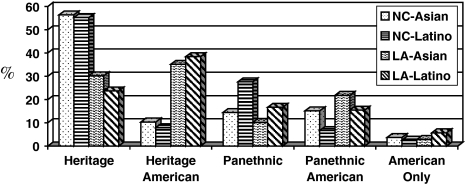
Understanding adolescents' use of ethnic labels is a key developmental issue, particularly given the practical significance of identity and self-definition in adolescents' lives. Ethnic labeling was examined among adolescents in the traditional immigrant receiving area of Los Angeles (Asian n = 258, Latino n = 279) and the non-traditional immigrant receiving area of North Carolina (Asian n = 165, Latino n = 239). Logistic regressions showed that adolescents from different geographic settings use different ethnic labels, with youth from NC preferring heritage and panethnic labels and youth from LA preferring hyphenated American labels. Second generation youth were more likely than first generation youth to use hyphenated American labels, and less likely to use heritage or panethnic labels. Greater ethnic centrality increased the odds of heritage label use, and greater English proficiency increased the odds of heritage-American label use. These associations significantly mediated the initial effects of setting. Further results examine ethnic differences as well as links between labels and self-esteem. The discussion highlights implications of ethnic labeling and context.
理解青少年使用族群标签是一个关键的发展问题,特别是考虑到身份认同和自我定义在青少年生活中的实际意义。本研究在洛杉矶传统移民接收区(亚洲裔 n=258,拉丁裔 n=279)和北卡罗来纳州非传统移民接收区(亚洲裔 n=165,拉丁裔 n=239)的青少年中考察了族群标签的使用情况。逻辑回归显示,来自不同地理环境的青少年使用不同的族群标签,来自北卡罗来纳州的青少年更喜欢传统和泛族群标签,而来自洛杉矶的青少年更喜欢混血美国人标签。与第一代青少年相比,第二代青少年更有可能使用混血美国人标签,而不太可能使用传统或泛族群标签。更高的族群中心度增加了使用传统族群标签的可能性,而更高的英语熟练程度则增加了使用混血美国人标签的可能性。这些关联显著中介了环境的初始影响。进一步的结果考察了族群差异以及标签与自尊之间的联系。讨论强调了族群标签和环境的影响。