Unité de Recherche sur les Maladies Infectieuses et Tropicales Emergentes, UMR CNRS 6236, IRD198, IFR48, Faculté de Médecine, Université de la Méditerranée, Marseille, France.
PLoS One. 2010 Oct 27;5(10):e15405. doi: 10.1371/journal.pone.0015405.
The new field of paleomicrobiology allows past outbreaks to be identified by testing dental pulp of human remains with PCR.
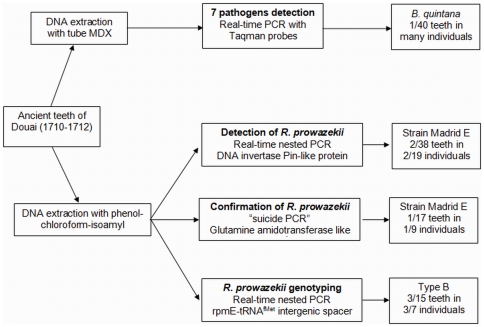
We identified a mass grave in Douai, France dating from the early XVIII(th) century. This city was besieged during the European war of Spanish succession. We tested dental pulp from 1192 teeth (including 40 from Douai) by quantitative PCR (qPCR) for R. prowazekii and B. quintana. We also used ultra-sensitive suicide PCR to detect R. prowazekii and genotyped positive samples.
In the Douai remains, we identified one case of B. quintana infection (by qPCR) and R. prowazekii (by suicide PCR) in 6/21 individuals (29%). The R. prowazekii was genotype B, a genotype previously found in a Spanish isolate obtained in the first part of the XX(th) century.
Louse-borne outbreaks were raging during the XVIII(th) century; our results support the hypothesis that typhus was imported into Europe by Spanish soldiers from America.
古微生物学这一新领域允许通过聚合酶链式反应(PCR)检测人类遗骸的牙髓来识别过去的疫情爆发。
我们在法国杜埃确定了一个可追溯到 18 世纪早期的万人坑。这座城市在西班牙王位继承战争期间被围困。我们对来自 1192 颗牙齿(包括 40 颗来自杜埃的牙齿)的牙髓进行了定量 PCR(qPCR)检测,以确定 R. prowazekii 和 B. quintana。我们还使用超灵敏自杀 PCR 来检测 R. prowazekii 并对阳性样本进行基因分型。
在杜埃的遗骸中,我们在 21 个人中的 6 个人(29%)中发现了一种 B. quintana 感染(通过 qPCR)和一种 R. prowazekii(通过自杀 PCR)。R. prowazekii 为基因型 B,这是一种在 20 世纪初从西班牙分离株中发现的基因型。
18 世纪虱子传播的疫情肆虐;我们的结果支持了这样一种假设,即斑疹伤寒是由西班牙士兵从美洲带入欧洲的。