Aix Marseille Univ, IRD, AP-HM, SSA, VITROME, Marseille, France.
IHU-Méditerranée Infection, Marseille, France.
Parasit Vectors. 2019 Jun 7;12(1):290. doi: 10.1186/s13071-019-3540-6.
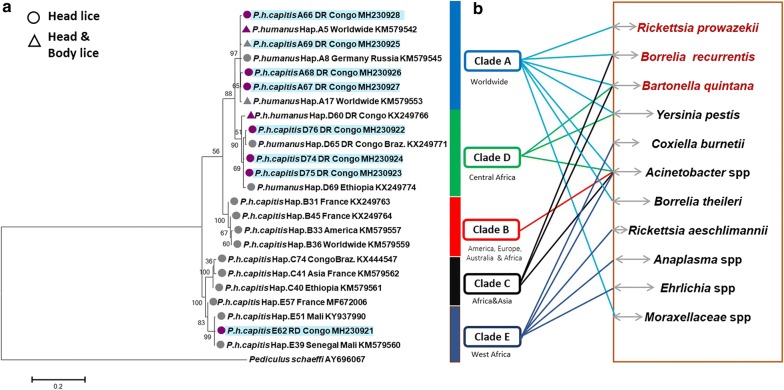
Head louse, Pediculus humanus capitis, is an obligatory blood-sucking ectoparasite, distributed worldwide. Phylogenetically, it occurs in five divergent mitochondrial clades (A-E); each exhibiting a particular geographical distribution. Recent studies suggest that, as in the case of body louse, head louse could be a disease vector. We aimed to study the genetic diversity of head lice collected in the Democratic Republic of the Congo (DR Congo) and to screen for louse-borne pathogens in these lice.
A total of 181 head lice were collected from 27 individuals at the Monkole Hospital Center located in Kinshasa. All head lice were genotyped and screened for the presence of louse-borne bacteria using molecular methods. We searched for Bartonella quintana, Borrelia recurrentis, Rickettsia prowazekii, Anaplasma spp., Yersinia pestis, Coxiella burnetii and Acinetobacter spp.
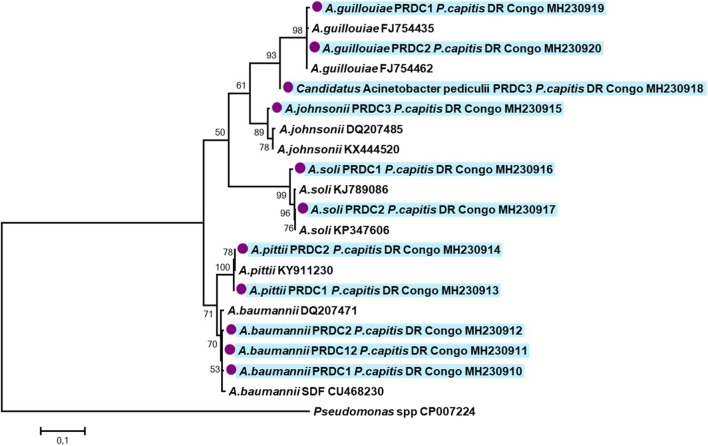
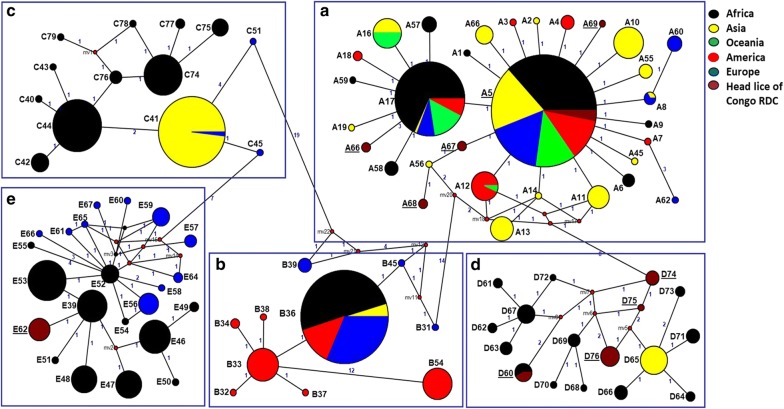
Among these head lice, 67.4% (122/181) belonged to clade A and 24.3% (44/181) belonged to clade D. Additionally, for the first time in this area, we found clade E in 8.3% (15/181) of tested lice, from two infested individuals. Dual infestation with clades A and D was observed for 44.4% individuals. Thirty-three of the 181 head lice were infected only by different bacterial species of the genus Acinetobacter. Overall, 16 out of 27 individuals were infested (59.3%). Six Acinetobacter species were detected including Acinetobacter baumannii (8.3%), Acinetobacter johnsonii (1.7%), Acinetobacter soli (1.7%), Acinetobacter pittii (1.7%), Acinetobacter guillouiae (1.1%), as well as a new potential species named "Candidatus Acinetobacter pediculi".
To our knowledge, this study reports for the first time, the presence of clade E head lice in DR Congo. This study is also the first to report the presence of Acinetobacter species DNAs in human head lice in DR Congo.
人头虱,即 Pediculus humanus capitis,是一种强制性吸血的外寄生虫,分布于世界各地。从进化角度来看,它分为五个不同的线粒体支系(A-E);每个支系都有特定的地理分布。最近的研究表明,就像体虱一样,人头虱也可能是疾病的传播媒介。我们旨在研究在刚果民主共和国(DRC)采集的头虱的遗传多样性,并筛选这些头虱携带的病原体。
总共从位于金沙萨的 Monkole 医院中心的 27 个人身上采集了 181 个头虱。所有头虱均通过分子方法进行基因分型并筛选是否存在虱传细菌。我们寻找了斑疹伤寒立克次体、回归热螺旋体、普氏立克次体、无形体属、鼠疫耶尔森菌、贝纳柯克斯体和不动杆菌属。
在这些头虱中,67.4%(122/181)属于支系 A,24.3%(44/181)属于支系 D。此外,在该地区首次发现,在 8.3%(15/181)的测试头虱中发现了支系 E,来自两个受感染的个体。44.4%的个体同时感染了支系 A 和 D。181 个头虱中有 33 只仅感染了不同的不动杆菌属细菌。总体而言,27 个人中有 16 人(59.3%)受到感染。检测到六种不动杆菌属,包括鲍曼不动杆菌(8.3%)、约翰逊不动杆菌(1.7%)、土壤不动杆菌(1.7%)、皮特不动杆菌(1.7%)、桂氏不动杆菌(1.1%),以及一种新的潜在物种,命名为“Candidatus Acinetobacter pediculi”。
据我们所知,这是首次在刚果民主共和国报告发现支系 E 头虱。这项研究也是首次在刚果民主共和国报告在人类头虱中发现不动杆菌属 DNA。