Department of Orthopedics, Oslo University Hospital, Rikshospitalet, Norway.
Acta Orthop. 2010 Dec;81(6):708-14. doi: 10.3109/17453674.2010.533935. Epub 2010 Nov 11.
The prognosis in Perthes' disease varies considerably according to certain risk factors, but there is no concensus regarding the relative importance of these factors. We assessed the natural history of the disease and defined prognostic factors of value in deciding the proper treatment.
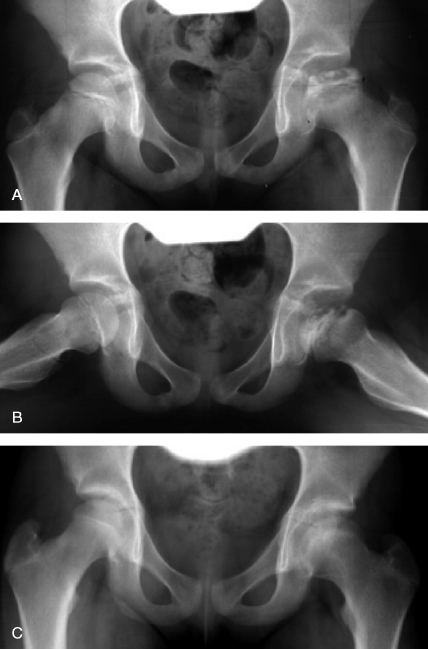
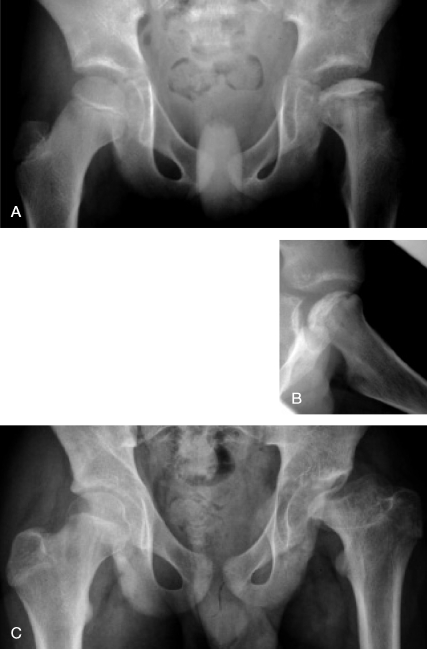
During the 5-year period 1996-2000, a nationwide study on Perthes' disease was performed in Norway. 425 patients were registered. The present study involved the 212 children (mean age 5.1 years, 77% boys) who were affected unilaterally and who had been treated with physiotherapy only (which is considered not to change the natural history). They were followed by taking radiographs at the time of diagnosis and after 1, 3, and 5 years. At the 5-year follow-up, the outcome was evaluated according to a modification of the Stulberg classification: good (spherical femoral head), fair (ovoid femoral head), and poor (flat femoral head).
The 5-year radiographic results were strongly dependent on 4 risk factors: age 6 years or more at diagnosis, total femoral head necrosis, height of the lateral pillar of the epiphysis less than 50% of normal height, and femoral head cover less than 80%. As the number of risk factors increased from 0 to 4, the proportion of patients with good radiographic 5-year outcome decreased from 79% to 0% and the proportion with poor outcome increased from 3% to 91%.
Most children under 6 years of age do not need any special treatment. In older children, no special treatment is indicated if the whole femoral head is not necrotic and the femoral head cover is > 80%. In the most severe forms of the disease (i.e. more than 2 risk factors), surgical containment treatment seems advisable.
佩特氏病的预后因某些危险因素而有很大差异,但这些因素的相对重要性尚无共识。我们评估了疾病的自然史,并确定了在决定适当治疗方法时具有价值的预后因素。
在 1996 年至 2000 年的 5 年期间,挪威进行了一项关于佩特氏病的全国性研究。共登记了 425 例患者。本研究涉及 212 例单侧受累且仅接受物理治疗的儿童(平均年龄为 5.1 岁,77%为男性),这被认为不会改变疾病的自然史。在诊断时以及 1、3 和 5 年后拍摄 X 光片以进行随访。在 5 年随访时,根据 Stulberg 分类的修改对结果进行评估:良好(球形股骨头)、中等(卵圆形股骨头)和差(扁平股骨头)。
5 年的放射学结果强烈取决于 4 个危险因素:诊断时年龄 6 岁或以上、整个股骨头坏死、骨骺外侧柱高度小于正常高度的 50%、股骨头覆盖小于 80%。随着危险因素数从 0 增加到 4,5 年放射学结果良好的患者比例从 79%降至 0%,而结果差的患者比例从 3%增至 91%。
大多数 6 岁以下的儿童不需要任何特殊治疗。对于年龄较大的儿童,如果整个股骨头未坏死且股骨头覆盖>80%,则不需要特殊治疗。在疾病最严重的形式(即超过 2 个危险因素)中,手术限制治疗似乎是合理的。