Division of Biology 216-76, California Institute of Technology, Pasadena, California 91125, USA.
Nature. 2010 Nov 11;468(7321):270-6. doi: 10.1038/nature09553.
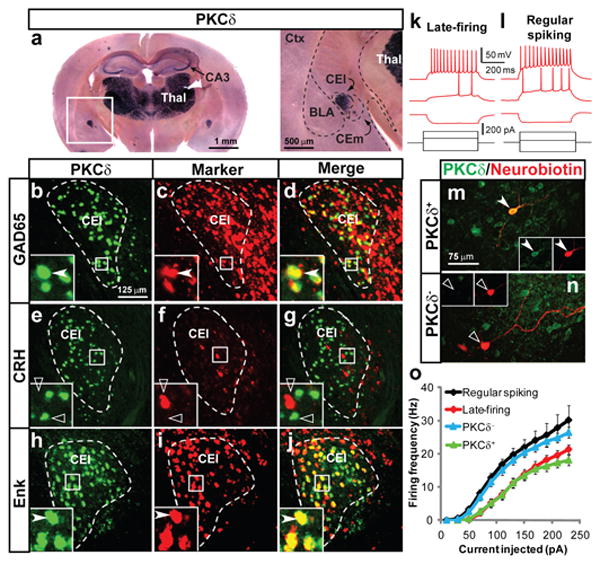
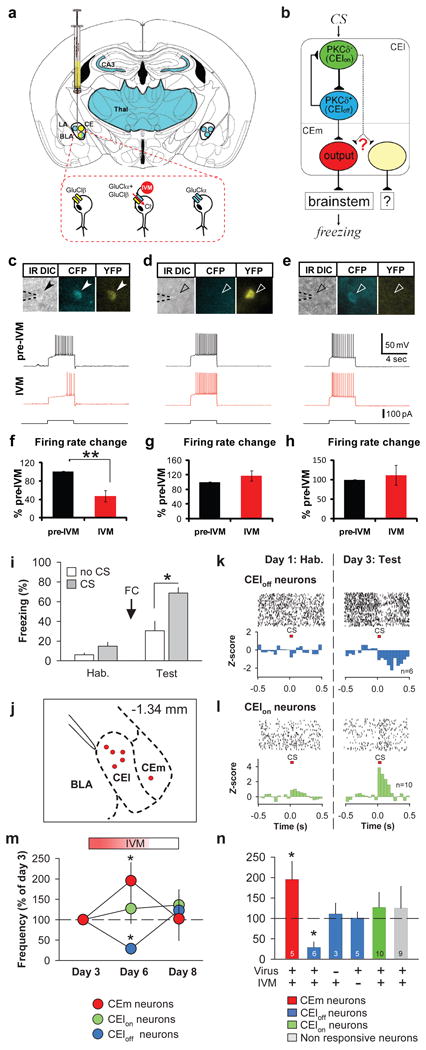
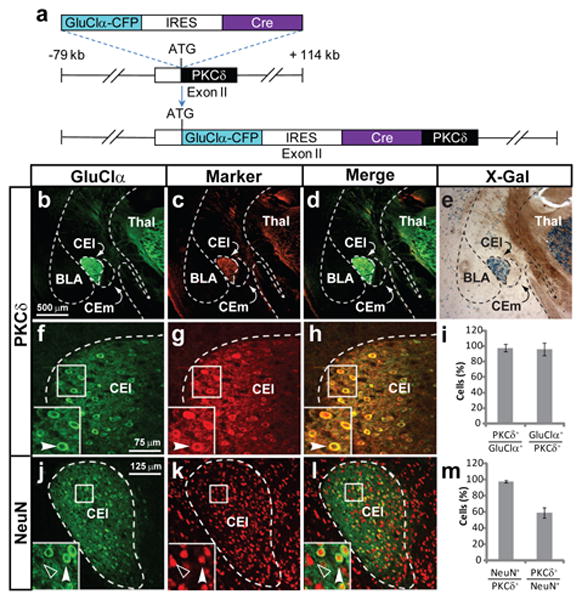
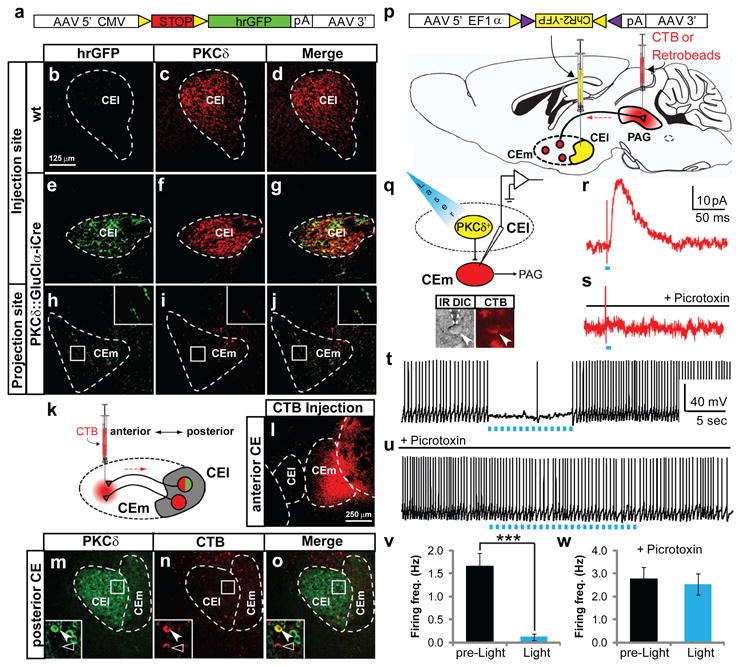
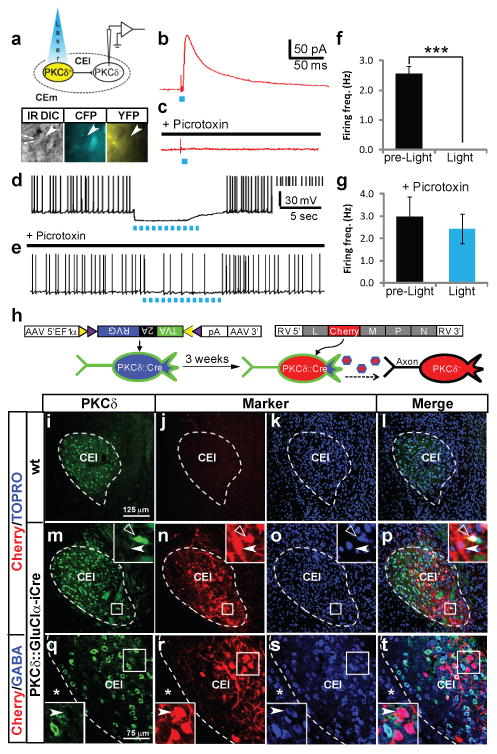
The role of different amygdala nuclei (neuroanatomical subdivisions) in processing Pavlovian conditioned fear has been studied extensively, but the function of the heterogeneous neuronal subtypes within these nuclei remains poorly understood. Here we use molecular genetic approaches to map the functional connectivity of a subpopulation of GABA-containing neurons, located in the lateral subdivision of the central amygdala (CEl), which express protein kinase C-δ (PKC-δ). Channelrhodopsin-2-assisted circuit mapping in amygdala slices and cell-specific viral tracing indicate that PKC-δ(+) neurons inhibit output neurons in the medial central amygdala (CEm), and also make reciprocal inhibitory synapses with PKC-δ(-) neurons in CEl. Electrical silencing of PKC-δ(+) neurons in vivo suggests that they correspond to physiologically identified units that are inhibited by the conditioned stimulus, called CEl(off) units. This correspondence, together with behavioural data, defines an inhibitory microcircuit in CEl that gates CEm output to control the level of conditioned freezing.
不同杏仁核核团(神经解剖学细分)在处理巴甫洛夫条件性恐惧中的作用已被广泛研究,但这些核团内异质神经元亚型的功能仍知之甚少。在这里,我们使用分子遗传学方法来绘制位于杏仁核外侧亚区(CE1)中表达蛋白激酶 C-δ(PKC-δ)的 GABA 能神经元的亚群的功能连接图谱。在杏仁核切片中的通道视紫红质-2辅助电路映射和细胞特异性病毒追踪表明,PKC-δ(+)神经元抑制内侧杏仁核中央区(CEm)中的输出神经元,并且还与 CE1 中的 PKC-δ(-)神经元形成反向抑制性突触。体内电沉默 PKC-δ(+)神经元表明,它们对应于生理上鉴定的被条件刺激抑制的单元,称为 CE1(off)单元。这种对应关系,加上行为数据,定义了 CE1 中的抑制性微电路,该微电路控制 CEm 的输出以控制条件性冻结的水平。