• 文献检索
  • 文档翻译
  • 深度研究
  • 学术资讯
  • Suppr Zotero 插件Zotero 插件
  • 邀请有礼
  • 套餐&价格
  • 历史记录
应用&插件
Suppr Zotero 插件Zotero 插件浏览器插件Mac 客户端Windows 客户端微信小程序
定价
高级版会员购买积分包购买API积分包
服务
文献检索文档翻译深度研究API 文档MCP 服务
关于我们
关于 Suppr公司介绍联系我们用户协议隐私条款
关注我们

Suppr 超能文献

核心技术专利:CN118964589B侵权必究
粤ICP备2023148730 号-1Suppr @ 2026

文献检索

告别复杂PubMed语法,用中文像聊天一样搜索,搜遍4000万医学文献。AI智能推荐,让科研检索更轻松。

立即免费搜索

文件翻译

保留排版,准确专业,支持PDF/Word/PPT等文件格式,支持 12+语言互译。

免费翻译文档

深度研究

AI帮你快速写综述,25分钟生成高质量综述,智能提取关键信息,辅助科研写作。

立即免费体验

NICU 婴儿新生儿听力筛查失败后 I-V 间期延长的发生率及临床价值。

Incidence and clinical value of prolonged I-V interval in NICU infants after failing neonatal hearing screening.

机构信息

Department of Otorhinolaryngology, Sophia Children's Hospital, Erasmus Medical Center, Dr. Molewaterplein 60, SP-1455, 3015 GJ, Rotterdam, The Netherlands.

出版信息

Eur Arch Otorhinolaryngol. 2011 Apr;268(4):501-5. doi: 10.1007/s00405-010-1415-8. Epub 2010 Nov 11.

DOI:10.1007/s00405-010-1415-8
PMID:21069370
原文链接:https://pmc.ncbi.nlm.nih.gov/articles/PMC3052503/
Abstract

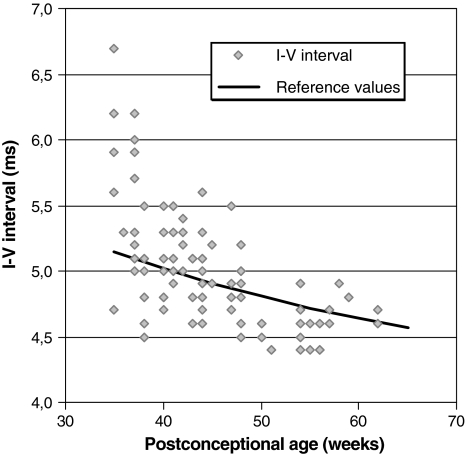
Infants admitted to neonatal intensive care units (NICUs) have a higher incidence of perinatal complications and delayed maturational processes. Parameters of the auditory brainstem response (ABR) were analyzed to study the prevalence of delayed auditory maturation or neural pathology. The prevalence of prolonged I-V interval as a measure of delayed maturation and the correlation with ABR thresholds were investigated. All infants admitted to the NICU Sophia Children's Hospital between 2004 and 2009 who had been referred for ABR measurement after failing neonatal hearing screening with automated auditory brainstem response (AABR) were included. The ABR parameters were retrospectively analyzed. Between 2004 and 2009, 103 infants were included: 46 girls and 57 boys. In 58.3% (60 infants) of our population, the I-V interval was recordable in at least one ear at first diagnostic ABR measurement. In 4.9%, the I-V interval was severely prolonged. The median ABR threshold of infants with a normal or mildly prolonged I-V interval was 50 dB. The median ABR threshold of infants with a severely prolonged I-V interval was 30 dB. In conclusion, in case both peak I and V were measurable, we found only a limited (4.9%) incidence of severely prolonged I-V interval (≥0.8 ms) in this high-risk NICU population. A mild delay in maturation is a more probable explanation than major audiologic or neural pathology, as ABR thresholds were near normal in these infants.

摘要

新生儿重症监护病房(NICU)收治的婴儿围产期并发症和发育延迟的发生率较高。分析听觉脑干反应(ABR)的参数,以研究听觉成熟延迟或神经病理学的患病率。研究了作为成熟延迟指标的 I-V 间隔延长的患病率,以及与 ABR 阈值的相关性。所有 2004 年至 2009 年期间在 Sophia 儿童医院 NICU 住院,并在新生儿自动听觉脑干反应(AABR)听力筛查失败后被转介进行 ABR 测量的婴儿均被纳入研究。对 ABR 参数进行了回顾性分析。2004 年至 2009 年间,共纳入 103 例婴儿:46 例女孩,57 例男孩。在我们的研究人群中,58.3%(60 例)至少有一耳在首次诊断性 ABR 测量时可记录到 I-V 间隔。4.9%的婴儿 I-V 间隔严重延长。I-V 间隔正常或轻度延长的婴儿的 ABR 阈值中位数为 50dB。I-V 间隔严重延长的婴儿的 ABR 阈值中位数为 30dB。总之,在峰 I 和 V 均可测量的情况下,我们发现这种高危 NICU 人群中严重延长的 I-V 间隔(≥0.8ms)发生率仅有限(4.9%)。与主要的听觉或神经病理学相比,成熟的轻度延迟更有可能是解释,因为这些婴儿的 ABR 阈值接近正常。
https://cdn.ncbi.nlm.nih.gov/pmc/blobs/4e58/3052503/40fa4ee01d69/405_2010_1415_Fig1_HTML.jpg

相似文献

1
Incidence and clinical value of prolonged I-V interval in NICU infants after failing neonatal hearing screening.NICU 婴儿新生儿听力筛查失败后 I-V 间期延长的发生率及临床价值。
Eur Arch Otorhinolaryngol. 2011 Apr;268(4):501-5. doi: 10.1007/s00405-010-1415-8. Epub 2010 Nov 11.
2
Newborn hearing screening at the Neonatal Intensive Care Unit and Auditory Brainstem Maturation in preterm infants.新生儿重症监护病房的新生儿听力筛查与早产儿听觉脑干成熟度
Int J Pediatr Otorhinolaryngol. 2019 Aug;123:110-115. doi: 10.1016/j.ijporl.2019.05.004. Epub 2019 May 7.
3
Auditory Brainstem Evoked Response Patterns in the Neonatal Intensive Care Unit.新生儿重症监护病房的听觉脑干诱发电位模式。
Am J Perinatol. 2021 Aug;38(S 01):e231-e238. doi: 10.1055/s-0040-1709467. Epub 2020 Apr 10.
4
Implementation of a nation-wide automated auditory brainstem response hearing screening programme in neonatal intensive care units.在新生儿重症监护病房实施全国性自动听性脑干反应听力筛查计划。
Acta Paediatr. 2003;92(3):332-8.
5
Identification of neonatal hearing impairment: auditory brain stem responses in the perinatal period.新生儿听力障碍的识别:围产期听觉脑干反应
Ear Hear. 2000 Oct;21(5):383-99. doi: 10.1097/00003446-200010000-00006.
6
Auditory brainstem response morphology and analysis in very preterm neonatal intensive care unit infants.早产儿重症监护病房婴儿的听觉脑干反应形态及其分析。
Laryngoscope. 2011 Oct;121(10):2245-9. doi: 10.1002/lary.22140. Epub 2011 Sep 6.
7
Performance of two hearing screening protocols in the NICU.两种听力筛查方案在新生儿重症监护病房的应用效果
B-ENT. 2005;1(1):11-5.
8
Sensitivity of the Automated Auditory Brainstem Response in Neonatal Hearing Screening.新生儿听力筛查中自动听性脑干反应的敏感性。
Pediatrics. 2015 Sep;136(3):e641-7. doi: 10.1542/peds.2014-3784.
9
Sensorineural Hearing Loss in Newborns Hospitalized in Neonatal Intensive Care Unit: An Observational Study.新生儿重症监护病房住院新生儿的感音神经性听力损失:一项观察性研究。
Int Tinnitus J. 2019 Jan 1;23(1):31-36. doi: 10.5935/0946-5448.20190006.
10
Risk Factors and Prognostic Factors of Hearing Impairment in Neonatal Intensive Care Unit-Treated Infants.新生儿重症监护病房治疗的婴儿听力障碍的危险因素和预后因素
Audiol Neurootol. 2019;24(2):84-89. doi: 10.1159/000500316. Epub 2019 May 27.

引用本文的文献

1
Recovery of Abnormal ABR in Neonates and Infants at Risk of Hearing Loss.听力损失风险新生儿和婴儿异常听觉脑干反应的恢复情况
Int J Otolaryngol. 2017;2017:7912127. doi: 10.1155/2017/7912127. Epub 2017 Apr 4.
2
Risk Factors for Sensorineural Hearing Loss Among High-Risk Infants in Golestan Province, Iran in 2010 - 2011.2010 - 2011年伊朗戈勒斯坦省高危婴儿感音神经性听力损失的危险因素
Iran Red Crescent Med J. 2015 Dec 20;17(12):e20419. doi: 10.5812/ircmj.20419. eCollection 2015 Dec.
3
Influence of postconceptional age on universal newborn hearing screening in NICU-babies.

本文引用的文献

1
Fitting model of ABR age dependency in a clinical population of normal hearing children.正常听力儿童临床人群 ABR 年龄相关性拟合模型。
Eur Arch Otorhinolaryngol. 2010 Oct;267(10):1531-7. doi: 10.1007/s00405-010-1291-2. Epub 2010 Jun 8.
2
Permanent bilateral sensory and neural hearing loss of children after neonatal intensive care because of extreme prematurity: a thirty-year study.因极度早产在新生儿重症监护后儿童出现的永久性双侧感觉神经性听力损失:一项三十年的研究。
Pediatrics. 2009 May;123(5):e797-807. doi: 10.1542/peds.2008-2531.
3
Etiologic and audiologic evaluations after universal neonatal hearing screening: analysis of 170 referred neonates.
孕龄对新生儿重症监护病房婴儿普遍新生儿听力筛查的影响。
Audiol Res. 2012 Jan 9;2(1):e1. doi: 10.4081/audiores.2012.e1.
4
Newborn hearing screening and early diagnostic in the NICU.新生儿重症监护病房中的新生儿听力筛查与早期诊断。
Biomed Res Int. 2014;2014:845308. doi: 10.1155/2014/845308. Epub 2014 Jun 9.
普遍新生儿听力筛查后的病因学和听力学评估:170例转诊新生儿分析
Pediatrics. 2008 Jun;121(6):1119-26. doi: 10.1542/peds.2007-1479.
4
Year 2007 position statement: Principles and guidelines for early hearing detection and intervention programs.2007年立场声明:早期听力检测与干预项目的原则和指南
Pediatrics. 2007 Oct;120(4):898-921. doi: 10.1542/peds.2007-2333.
5
Prevalence and independent risk factors for hearing loss in NICU infants.新生儿重症监护病房(NICU)婴儿听力损失的患病率及独立危险因素
Acta Paediatr. 2007 Aug;96(8):1155-8. doi: 10.1111/j.1651-2227.2007.00398.x.
6
Auditory brainstem response in premature and full-term children.早产和足月儿童的听觉脑干反应
Int J Pediatr Otorhinolaryngol. 2007 Sep;71(9):1449-56. doi: 10.1016/j.ijporl.2007.05.029. Epub 2007 Jul 13.
7
Effectiveness of population-based newborn hearing screening in England: ages of interventions and profile of cases.英国基于人群的新生儿听力筛查的有效性:干预年龄及病例概况。
Pediatrics. 2006 May;117(5):e887-93. doi: 10.1542/peds.2005-1064.
8
Brainstem auditory function at term in preterm babies with and without perinatal complications.有或无围产期并发症的早产儿足月时的脑干听觉功能
Pediatr Res. 2005 Dec;58(6):1164-9. doi: 10.1203/01.pdr.0000183783.99717.2b.
9
Hearing impairment in preterm very low birthweight babies detected at term by brainstem auditory evoked responses.通过脑干听觉诱发电位在足月时检测早产极低出生体重儿的听力障碍。
Acta Paediatr. 2001 Dec;90(12):1411-5. doi: 10.1080/08035250152708824.
10
Identification of neonatal hearing impairment: characteristics of infants in the neonatal intensive care unit and well-baby nursery.新生儿听力障碍的识别:新生儿重症监护病房和健康婴儿护理室中婴儿的特征
Ear Hear. 2000 Oct;21(5):373-82. doi: 10.1097/00003446-200010000-00005.