Division of Rheumatology, Northwestern University Feinberg School of Medicine, Chicago, Illinois, United States of America.
PLoS One. 2010 Nov 2;5(11):e13778. doi: 10.1371/journal.pone.0013778.
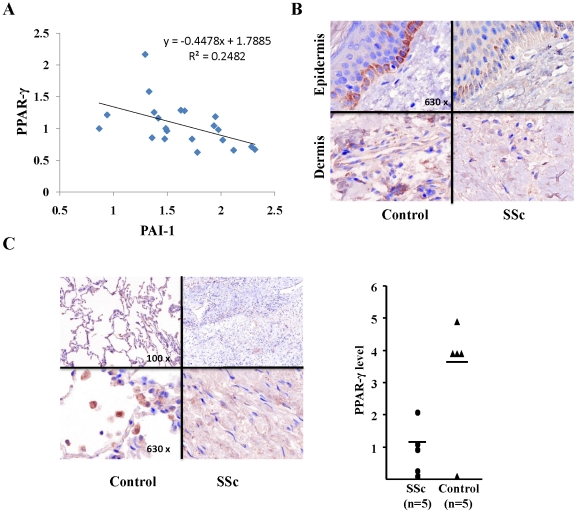
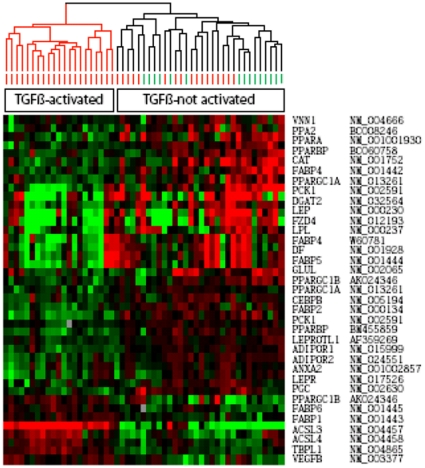
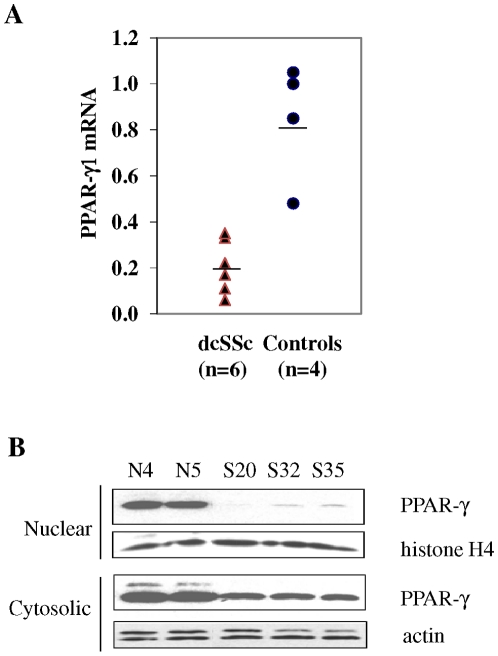
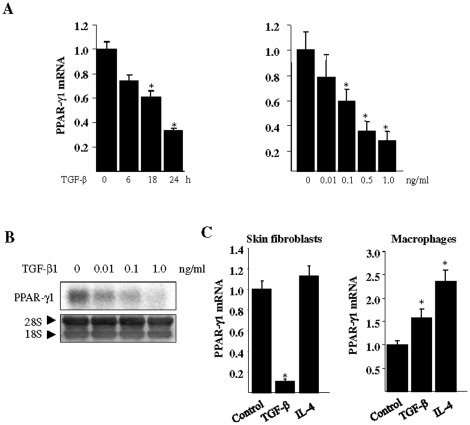
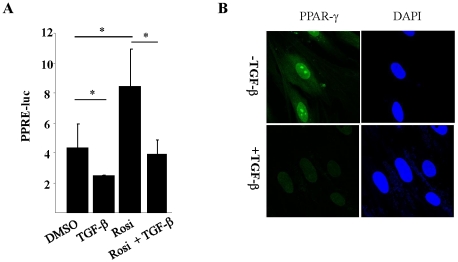
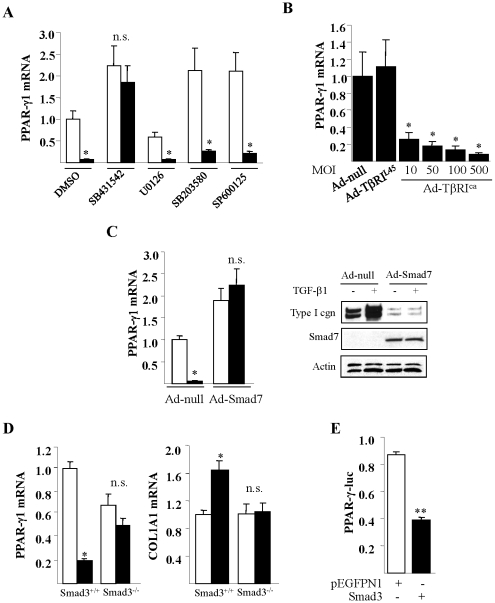
The nuclear orphan receptor peroxisome proliferator-activated receptor-gamma (PPAR-γ) is expressed in multiple cell types in addition to adipocytes. Upon its activation by natural ligands such as fatty acids and eicosanoids, or by synthetic agonists such as rosiglitazone, PPAR-γ regulates adipogenesis, glucose uptake and inflammatory responses. Recent studies establish a novel role for PPAR-γ signaling as an endogenous mechanism for regulating transforming growth factor-ß (TGF-ß)-dependent fibrogenesis. Here, we sought to characterize PPAR-γ function in the prototypic fibrosing disorder systemic sclerosis (SSc), and delineate the factors governing PPAR-γ expression. We report that PPAR-γ levels were markedly diminished in skin and lung biopsies from patients with SSc, and in fibroblasts explanted from the lesional skin. In normal fibroblasts, treatment with TGF-ß resulted in a time- and dose-dependent down-regulation of PPAR-γ expression. Inhibition occurred at the transcriptional level and was mediated via canonical Smad signal transduction. Genome-wide expression profiling of SSc skin biopsies revealed a marked attenuation of PPAR-γ levels and transcriptional activity in a subset of patients with diffuse cutaneous SSc, which was correlated with the presence of a "TGF-ß responsive gene signature" in these biopsies. Together, these results demonstrate that the expression and function of PPAR-γ are impaired in SSc, and reveal the existence of a reciprocal inhibitory cross-talk between TGF-ß activation and PPAR-γ signaling in the context of fibrogenesis. In light of the potent anti-fibrotic effects attributed to PPAR-γ, these observations lead us to propose that excessive TGF-ß activity in SSc accounts for impaired PPAR-γ function, which in turn contributes to unchecked fibroblast activation and progressive fibrosis.
核孤儿受体过氧化物酶体增殖物激活受体-γ(PPAR-γ)除脂肪细胞外,还在多种细胞类型中表达。在其天然配体(如脂肪酸和类二十烷酸)或合成激动剂(如罗格列酮)激活后,PPAR-γ 调节脂肪生成、葡萄糖摄取和炎症反应。最近的研究确立了 PPAR-γ 信号作为调节转化生长因子-β(TGF-β)依赖性纤维化的内源性机制的新作用。在这里,我们试图描述 PPAR-γ 在典型纤维化疾病系统性硬化症(SSc)中的功能,并阐明调节 PPAR-γ 表达的因素。我们报告说,PPAR-γ 水平在 SSc 患者的皮肤和肺活检组织以及从病变皮肤中分离的成纤维细胞中明显降低。在正常成纤维细胞中,TGF-β 处理导致 PPAR-γ 表达的时间和剂量依赖性下调。这种抑制发生在转录水平,并通过经典的 Smad 信号转导介导。对 SSc 皮肤活检组织的全基因组表达谱分析显示,在弥漫性皮肤 SSc 的一部分患者中,PPAR-γ 水平和转录活性明显降低,这与这些活检组织中存在“TGF-β 反应基因特征”相关。总之,这些结果表明 PPAR-γ 的表达和功能在 SSc 中受损,并揭示了 TGF-β 激活和 PPAR-γ 信号之间在纤维化背景下存在相互抑制的交叉对话。鉴于 PPAR-γ 归因于强大的抗纤维化作用,这些观察结果使我们提出 SSc 中 TGF-β 活性过度导致 PPAR-γ 功能受损,这反过来又导致未受控制的成纤维细胞激活和进行性纤维化。