Nematode Research Group, Department of Zoology, The Natural History Museum, Cromwell Road, London SW7 5BD, UK.
BMC Evol Biol. 2010 Nov 12;10:353. doi: 10.1186/1471-2148-10-353.
The subclass Enoplia (Phylum Nematoda) is purported to be the earliest branching clade amongst all nematode taxa, yet the deep phylogeny of this important lineage remains elusive. Free-living marine species within the order Enoplida play prominent roles in marine ecosystems, but previous molecular phylogenies have provided only the briefest evolutionary insights; this study aimed to firmly resolve internal relationships within the hyper-diverse but poorly understood Enoplida. In addition, we revisited the molecular framework of the Nematoda using a rigorous phylogenetic approach in order to investigate patterns of early splits amongst the oldest lineages (Dorylaimia and Enoplia).
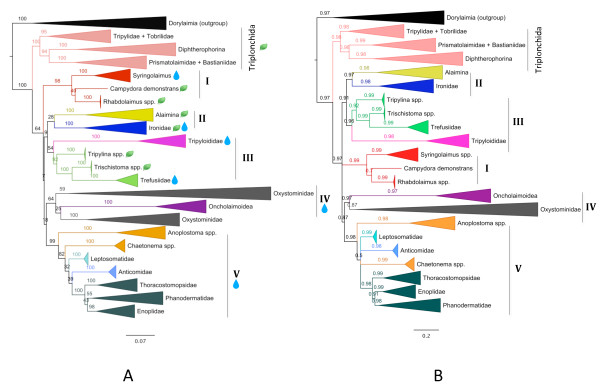
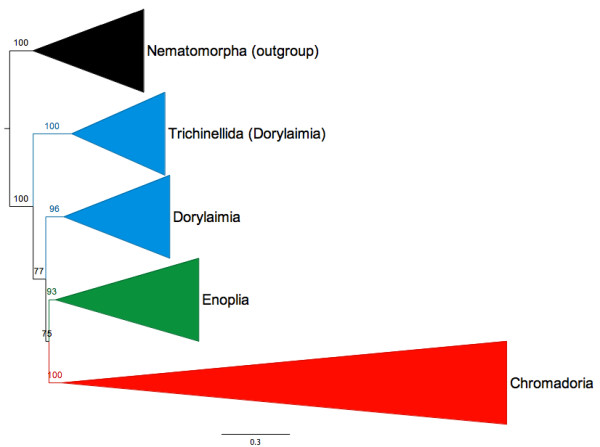
Morphological identifications, nuclear gene sequences (18S and 28S rRNA), and mitochondrial gene sequences (cox1) were obtained from marine Enoplid specimens representing 37 genera. The 18S gene was used to resolve deep splits within the Enoplia and evaluate the branching order of major clades in the nematode tree; multiple phylogenetic methods and rigorous empirical tests were carried out to assess tree topologies under different parameters and combinations of taxa. Significantly increased taxon sampling within the Enoplida resulted in a well-supported, robust phylogenetic topology of this group, although the placement of certain clades was not fully resolved. Our analysis could not unequivocally confirm the earliest splits in the nematode tree, and outgroup choice significantly affected the observed branching order of the Dorylaimia and Enoplia. Both 28S and cox1 were too variable to infer deep phylogeny, but provided additional insight at lower taxonomic levels.
Analysis of internal relationships reveals that the Enoplia is split into two main clades, with groups consisting of terrestrial (Triplonchida) and primarily marine fauna (Enoplida). Five independent lineages were recovered within the Enoplida, containing a mixture of marine and terrestrial species; clade structure suggests that habitat transitions have occurred at least four times within this group. Unfortunately, we were unable to obtain a consistent or well-supported topology amongst early-branching nematode lineages. It appears unlikely that single-gene phylogenies using the conserved 18S gene will be useful for confirming the branching order at the base of the nematode tree-future efforts will require multi-gene analyses or phylogenomic methods.
Enoplia 类群(门:线虫动物门)被认为是所有线虫分类群中最早分支的类群,但这个重要谱系的深层系统发育仍然难以捉摸。自由生活的海洋物种在 Enoplida 目中发挥着重要作用,但以前的分子系统发育仅提供了最简短的进化见解;本研究旨在确定超多样但了解甚少的 Enoplida 目中的内部关系。此外,我们使用严格的系统发育方法重新研究了线虫的分子框架,以调查最古老谱系(Dorylaimia 和 Enoplia)之间早期分支的模式。
从代表 37 个属的海洋 Enoplid 标本中获得了形态鉴定、核基因序列(18S 和 28S rRNA)和线粒体基因序列(cox1)。18S 基因用于解决 Enoplia 中的深部分支,并评估线虫树中主要分支的分支顺序;进行了多种系统发育方法和严格的经验测试,以评估不同参数和分类群组合下的树拓扑结构。Enoplida 内的分类群取样显著增加,导致该组的系统发育拓扑结构得到很好的支持和稳健,尽管某些分支的位置尚未完全解决。我们的分析不能明确确认线虫树中的最早分支,并且外群选择显着影响 Dorylaimia 和 Enoplia 的观察到的分支顺序。28S 和 cox1 变化太大,无法推断深层系统发育,但在较低的分类水平提供了额外的见解。
内部关系的分析表明,Enoplia 分为两个主要分支,其中一组由陆地(Triplonchida)和主要海洋动物组成(Enoplida)。在 Enoplida 中恢复了五个独立的谱系,包含海洋和陆地物种的混合物;分支结构表明,该组至少发生了四次生境转变。不幸的是,我们无法在早期分支的线虫谱系中获得一致或得到很好支持的拓扑结构。似乎使用保守的 18S 基因进行单基因系统发育不太可能有助于确认线虫树基部的分支顺序-未来的工作将需要多基因分析或系统基因组学方法。