Department of Zoology, The Natural History Museum, London, UK.
BMC Evol Biol. 2010 Dec 18;10:389. doi: 10.1186/1471-2148-10-389.
Nematodes represent the most abundant benthic metazoa in one of the largest habitats on earth, the deep sea. Characterizing major patterns of biodiversity within this dominant group is a critical step towards understanding evolutionary patterns across this vast ecosystem. The present study has aimed to place deep-sea nematode species into a phylogenetic framework, investigate relationships between shallow water and deep-sea taxa, and elucidate phylogeographic patterns amongst the deep-sea fauna.
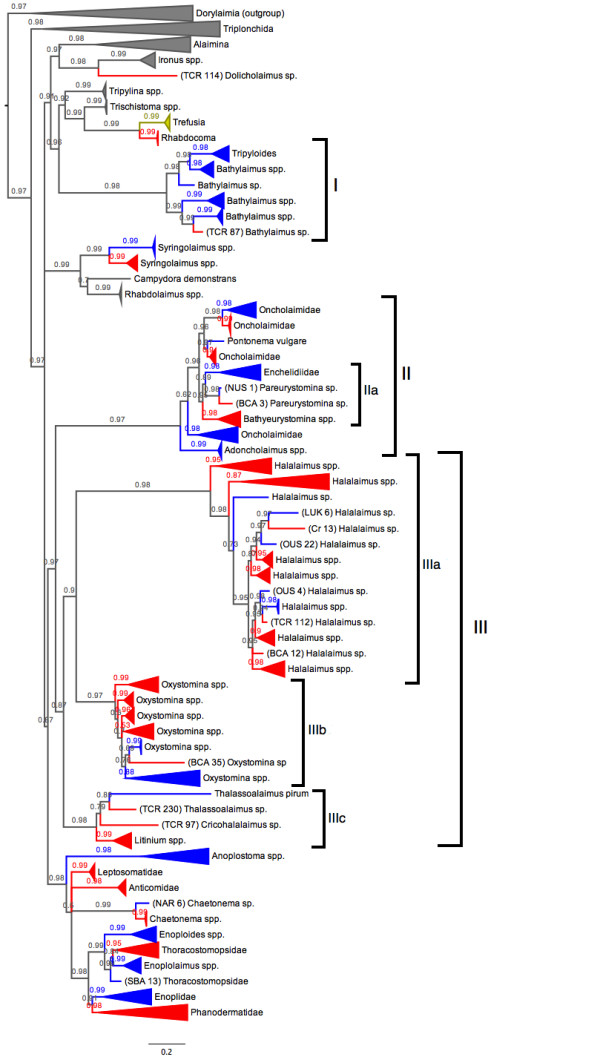
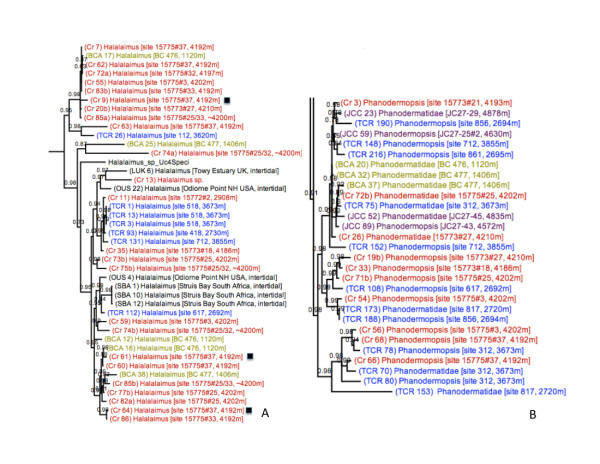
Molecular data (18 S and 28 S rRNA) confirms a high diversity amongst deep-sea Enoplids. There is no evidence for endemic deep-sea lineages in Maximum Likelihood or Bayesian phylogenies, and Enoplids do not cluster according to depth or geographic location. Tree topologies suggest frequent interchanges between deep-sea and shallow water habitats, as well as a mixture of early radiations and more recently derived lineages amongst deep-sea taxa. This study also provides convincing evidence of cosmopolitan marine species, recovering a subset of Oncholaimid nematodes with identical gene sequences (18 S, 28 S and cox1) at trans-Atlantic sample sites.
The complex clade structures recovered within the Enoplida support a high global species richness for marine nematodes, with phylogeographic patterns suggesting the existence of closely related, globally distributed species complexes in the deep sea. True cosmopolitan species may additionally exist within this group, potentially driven by specific life history traits of Enoplids. Although this investigation aimed to intensively sample nematodes from the order Enoplida, specimens were only identified down to genus (at best) and our sampling regime focused on an infinitesimal small fraction of the deep-sea floor. Future nematode studies should incorporate an extended sample set covering a wide depth range (shelf, bathyal, and abyssal sites), utilize additional genetic loci (e.g. mtDNA) that are informative at the species level, and apply high-throughput sequencing methods to fully assay community diversity. Finally, further molecular studies are needed to determine whether phylogeographic patterns observed in Enoplids are common across other ubiquitous marine groups (e.g. Chromadorida, Monhysterida).
线虫是地球上最大的栖息地之一——深海中最丰富的底栖后生动物。对线虫这一主要类群的生物多样性进行特征描述是了解这一广阔生态系统进化模式的关键步骤。本研究旨在将深海线虫物种置于系统发育框架内,调查浅海和深海分类群之间的关系,并阐明深海动物区系的系统地理格局。
分子数据(18S 和 28S rRNA)证实深海曳鳃类线虫具有很高的多样性。最大似然法和贝叶斯系统发育树中没有证据表明存在深海特有谱系,曳鳃类线虫也没有根据深度或地理位置聚类。树拓扑结构表明,深海和浅海生境之间频繁发生交流,以及深海分类群中早期辐射和最近衍生谱系的混合。本研究还提供了确凿的证据,证明海洋物种具有世界性,在跨大西洋采样点回收了一组具有相同基因序列(18S、28S 和 cox1)的 Oncholaimid 线虫。
在曳鳃类中恢复的复杂分支结构支持海洋线虫具有很高的全球物种丰富度,系统地理格局表明深海中存在密切相关的、全球分布的物种复合体。该类群中可能还存在真正的世界性物种,这可能是由曳鳃类的特定生活史特征驱动的。虽然本研究旨在对曳鳃目线虫进行密集采样,但标本只能鉴定到属(最好的情况),而且我们的采样方案只集中在深海海底的一小部分。未来的线虫研究应包括一个扩展的样本集,涵盖广泛的水深范围(大陆架、半深海和深海),利用在种水平上具有信息量的附加遗传基因座(如 mtDNA),并应用高通量测序方法全面评估群落多样性。最后,需要进一步的分子研究来确定在曳鳃目线虫中观察到的系统地理格局是否在其他普遍存在的海洋类群(如 Chromadorida、Monhysterida)中常见。