Lilly Research Laboratories, Eli Lilly Canada, Toronto, ON, Canada.
Int J Clin Pract. 2011 Jan;65(1):73-81. doi: 10.1111/j.1742-1241.2010.02546.x. Epub 2010 Nov 16.
This study was designed to assess clinical and functional outcomes associated with switching to duloxetine treatment in patients with major depressive disorder (MDD) experiencing emotional and painful physical symptoms in their current episode.
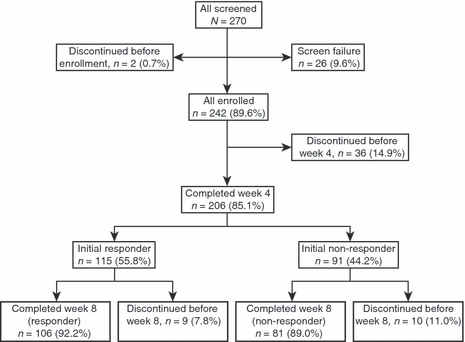
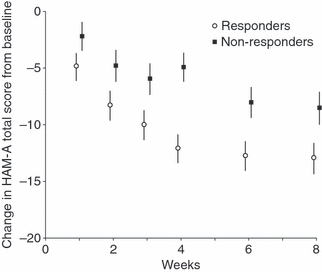
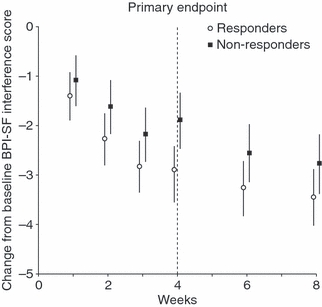
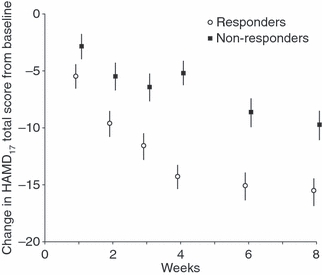
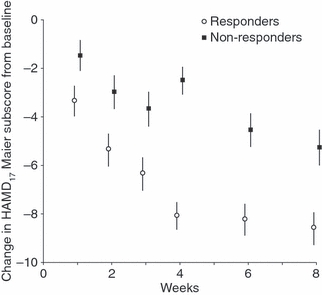
In this 8-week, multinational, multicentre, single-arm, open-label clinical trial, 242 MDD patients were switched to duloxetine 60 mg/day after selective serotonin reuptake inhibitor (SSRI) or serotonin and norepinephrine reuptake inhibitor (SNRI) treatment. The primary analysis compared mean change from baseline in Brief Pain Inventory-Modified Short Form (BPI-SF) interference score between initial responders [≥ 50% reduction from baseline on the 17-item Hamilton Depression Rating Scale (HAMD(17)) Maier subscale] and initial non-responders after 4 weeks. Initial responders continued with duloxetine 60 mg/day. Initial non-responders received duloxetine 120 mg/day for the remaining 4 weeks. Depression, pain, anxiety and functional outcomes were also compared after 8 weeks.
BPI-SF interference decreased from baseline in initial responders (n = 108) and initial non-responders (n = 85) after 4 weeks of duloxetine treatment, with greater reductions in initial responders [BPI-SF mean difference in reduction: 1.01 (95% CI 0.42-1.61); p < 0.001]. Reductions in pain interference favouring initial responders were also apparent after 8 weeks [0.68 (95% CI: 0.03-1.33); p = 0.042]. Depression, pain, anxiety and function improved over 8 weeks across patient groups.
Elements of core mood and pain are important residual symptoms following poor treatment response in MDD. Early improvement in these symptoms after switching to duloxetine indicated an increased chance of functional recovery.
本研究旨在评估伴有当前发作情绪和躯体疼痛症状的重性抑郁障碍(MDD)患者换用度洛西汀治疗的临床和功能结局,这些患者在接受选择性 5-羟色胺再摄取抑制剂(SSRI)或 5-羟色胺-去甲肾上腺素再摄取抑制剂(SNRI)治疗时出现上述症状。
在这项为期 8 周的、多中心、多国、单臂、开放性临床试验中,242 例 MDD 患者在接受 SSRI 或 SNRI 治疗后换用度洛西汀 60mg/日。主要分析比较了最初应答者(汉密尔顿抑郁量表(HAMD)17 项Maier 亚项减分≥50%)与最初无应答者在第 4 周时基线Brief Pain Inventory-Modified Short Form(BPI-SF)干扰评分的平均变化。最初应答者继续接受度洛西汀 60mg/日治疗。最初无应答者在接下来的 4 周内接受度洛西汀 120mg/日治疗。8 周时还比较了抑郁、疼痛、焦虑和功能结局。
在换用度洛西汀治疗 4 周后,最初应答者(n=108)和最初无应答者(n=85)的 BPI-SF 干扰均较基线下降,最初应答者的降幅更大[BPI-SF 差值的降低:1.01(95%CI:0.42-1.61);p<0.001]。8 周时,最初应答者的疼痛干扰也明显减少[0.68(95%CI:0.03-1.33);p=0.042]。8 周时,各患者组的抑郁、疼痛、焦虑和功能均有所改善。
在 MDD 治疗反应不佳的情况下,核心情绪和疼痛的一些症状仍为残留症状。换用度洛西汀后这些症状的早期改善表明功能恢复的机会增加。