Department of Cell Biology, Peking University Health Science Center, Beijing 100191, China.
J Biol Chem. 2011 Jan 28;286(4):3119-28. doi: 10.1074/jbc.M110.157842. Epub 2010 Nov 15.
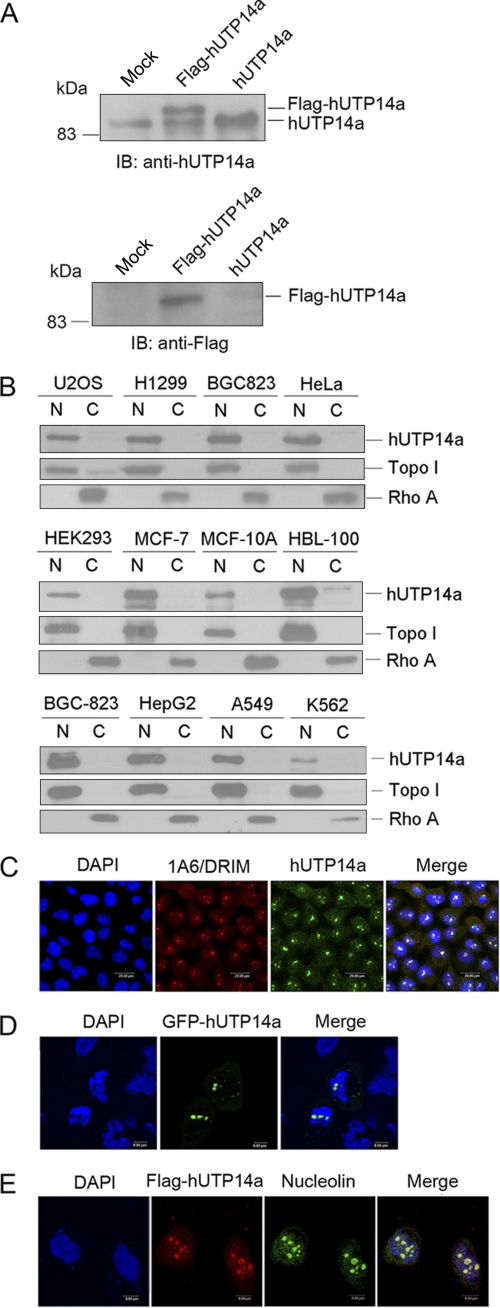
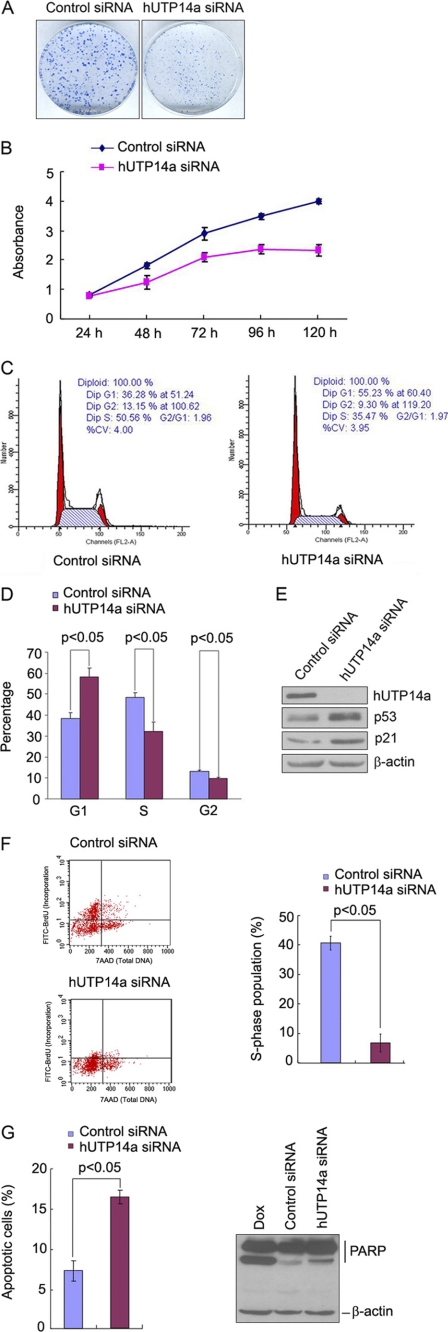
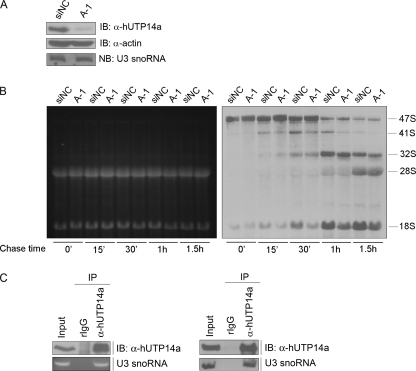
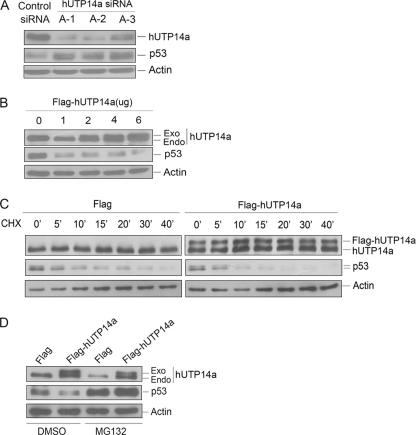
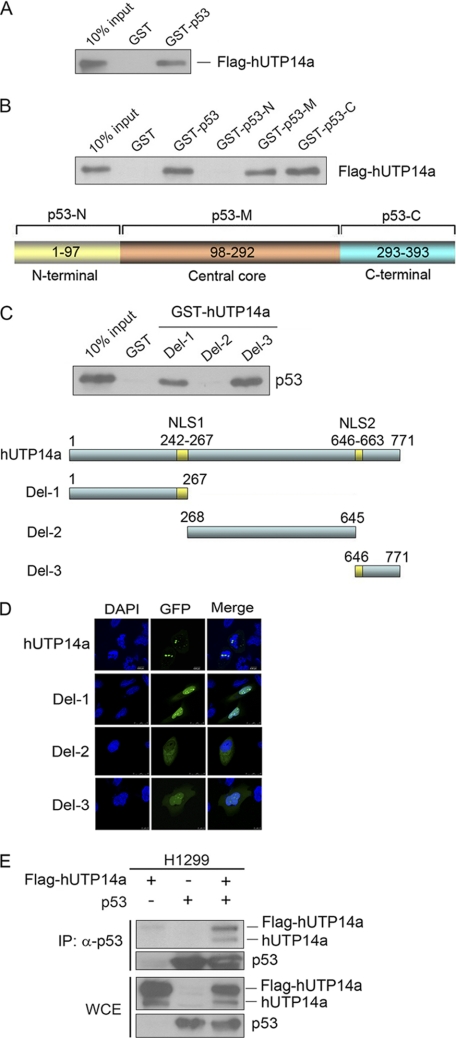
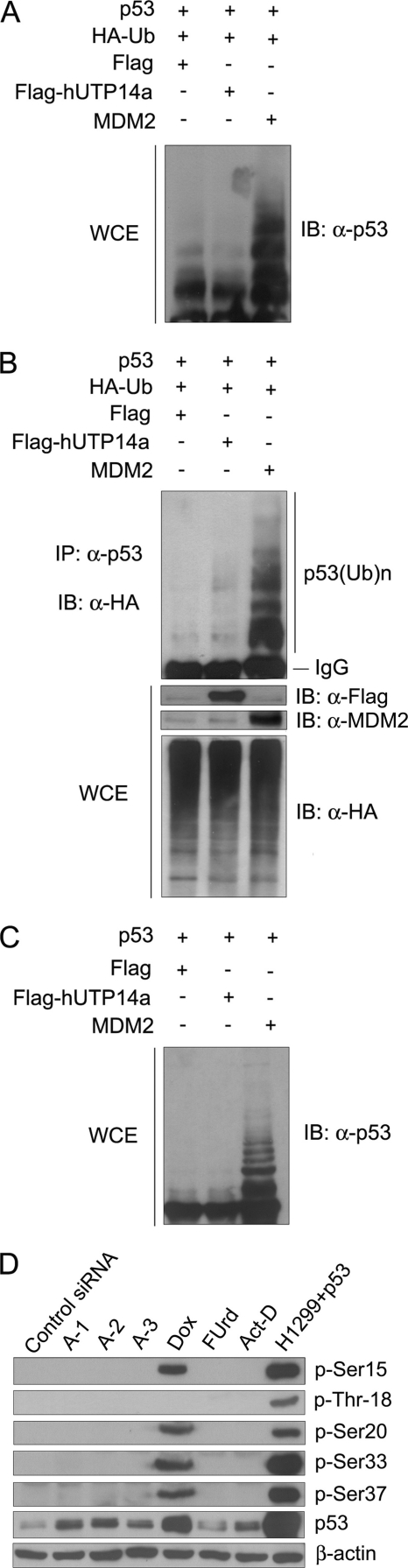
Ribosome biogenesis is required for normal cell function, and aberrant ribosome biogenesis can lead to p53 activation. However, how p53 is activated by defects of ribosome biogenesis remains to be determined. Here, we identified human UTP14a as an SSU processome component by showing that hUTP14a is nucleolar, associated with U3 snoRNA and involved in 18 S rRNA processing. Interestingly, ectopic expression of hUTP14a resulted in a decrease and knockdown of hUTP14a led to an increase of p53 protein levels. We showed that hUTP14a physically interacts with p53 and functionally promotes p53 turn-over, and that hUTP14a promotion of p53 destabilization is sensitive to a proteasome inhibitor but independent of ubiquitination. Significantly, knockdown of hUTP14a led to cell cycle arrest and apoptosis. Our data identified a novel pathway for p53 activation through a defect in rRNA processing and suggest that a ribosome biogenesis factor itself could act as a sensor for nucleolar stress to regulate p53.
核糖体生物发生对于细胞的正常功能是必需的,而核糖体生物发生的异常会导致 p53 的激活。然而,核糖体生物发生缺陷如何激活 p53 仍有待确定。在这里,我们通过显示 hUTP14a 是核仁的、与 U3 snoRNA 相关并参与 18 S rRNA 加工,鉴定了人类 UTP14a 作为一个 SSU 加工体组件。有趣的是,hUTP14a 的异位表达导致 p53 蛋白水平的降低,而 hUTP14a 的敲低则导致 p53 蛋白水平的增加。我们表明 hUTP14a 与 p53 发生物理相互作用,并促进 p53 的周转,而 hUTP14a 促进 p53 不稳定对蛋白酶体抑制剂敏感,但不依赖于泛素化。重要的是,hUTP14a 的敲低导致细胞周期停滞和细胞凋亡。我们的数据确定了通过 rRNA 加工缺陷激活 p53 的新途径,并表明核糖体生物发生因子本身可以作为核仁应激的传感器来调节 p53。