Department of Plant Pathology, University of Kentucky, Lexington, Kentucky, United States of America.
PLoS Pathog. 2010 Nov 4;6(11):e1001175. doi: 10.1371/journal.ppat.1001175.
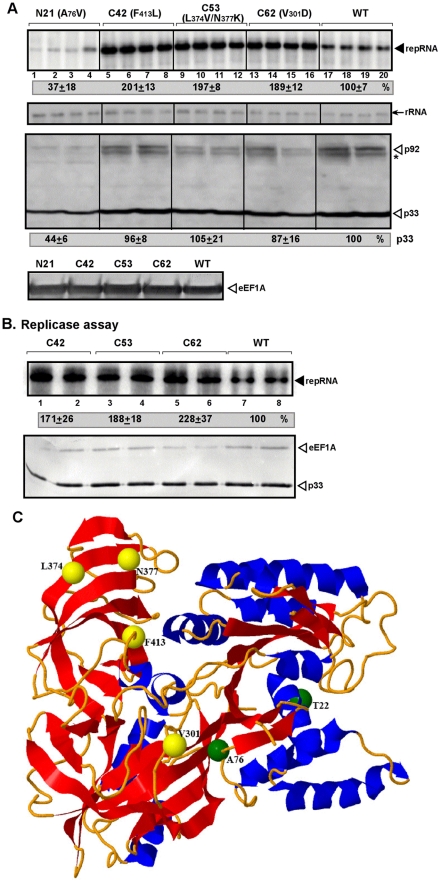
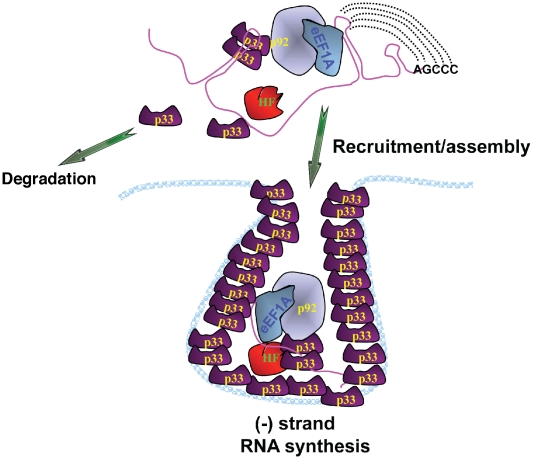
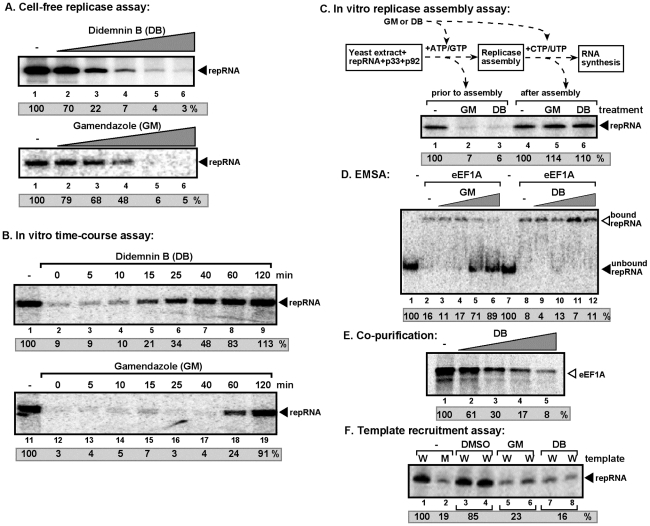
Replication of plus-strand RNA viruses depends on host factors that are recruited into viral replicase complexes. Previous studies showed that eukaryotic translation elongation factor (eEF1A) is one of the resident host proteins in the highly purified tombusvirus replicase complex. Using a random library of eEF1A mutants, we identified one mutant that decreased and three mutants that increased Tomato bushy stunt virus (TBSV) replication in a yeast model host. Additional in vitro assays with whole cell extracts prepared from yeast strains expressing the eEF1A mutants demonstrated several functions for eEF1A in TBSV replication: facilitating the recruitment of the viral RNA template into the replicase complex; the assembly of the viral replicase complex; and enhancement of the minus-strand synthesis by promoting the initiation step. These roles for eEF1A are separate from its canonical role in host and viral protein translation, emphasizing critical functions for this abundant cellular protein during TBSV replication.
正链 RNA 病毒的复制依赖于被招募到病毒复制酶复合物中的宿主因子。先前的研究表明,真核翻译延伸因子 (eEF1A) 是高度纯化的 TBSV 复制酶复合物中固有的宿主蛋白之一。使用 eEF1A 突变体的随机文库,我们鉴定出一个降低 Tomato bushy stunt virus (TBSV) 复制的突变体和三个增加 TBSV 复制的突变体在酵母模型宿主中。用来自表达 eEF1A 突变体的酵母菌株制备的全细胞提取物进行的额外体外测定表明,eEF1A 在 TBSV 复制中具有多种功能:促进病毒 RNA 模板招募到复制酶复合物中;组装病毒复制酶复合物;并通过促进起始步骤增强负链合成。eEF1A 的这些作用与其在宿主和病毒蛋白翻译中的典型作用不同,强调了在 TBSV 复制过程中这种丰富的细胞蛋白的关键作用。