Division of Plant Sciences, Christopher S. Bond Life Sciences Center and Interdisciplinary Plant Group, University of Missouri, Columbia, Missouri, United States of America.
PLoS Pathog. 2010 Nov 4;6(11):e1001172. doi: 10.1371/journal.ppat.1001172.
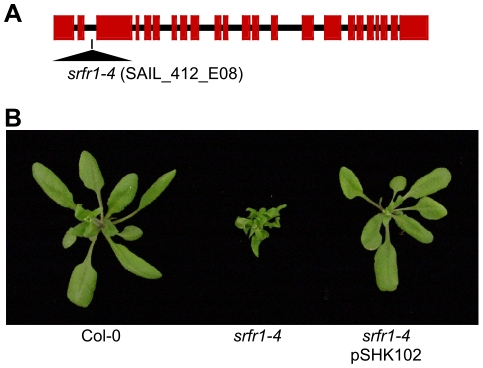
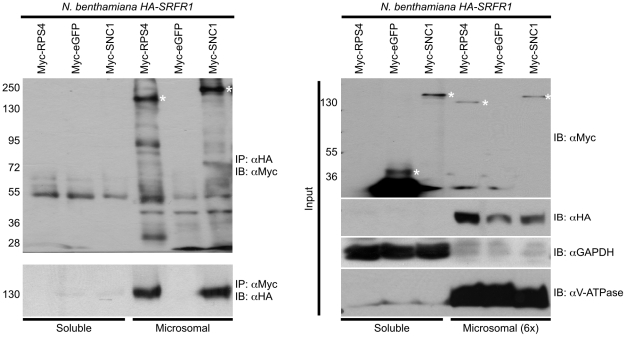
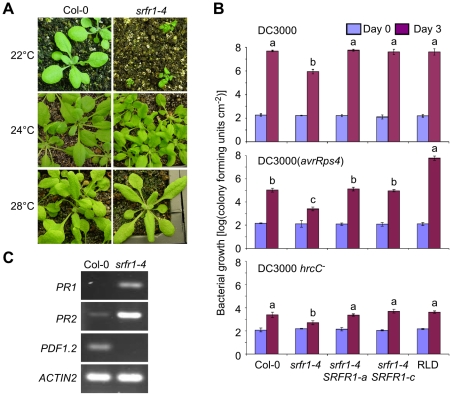
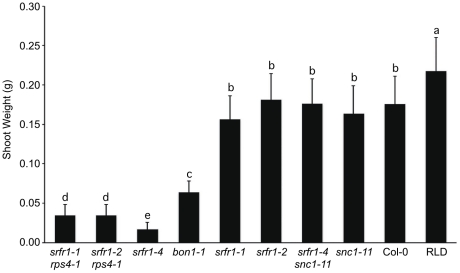
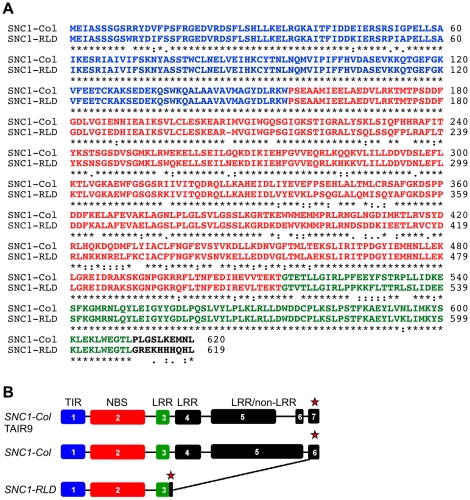
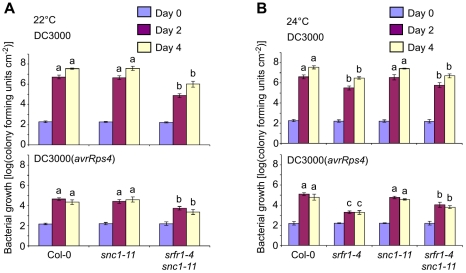
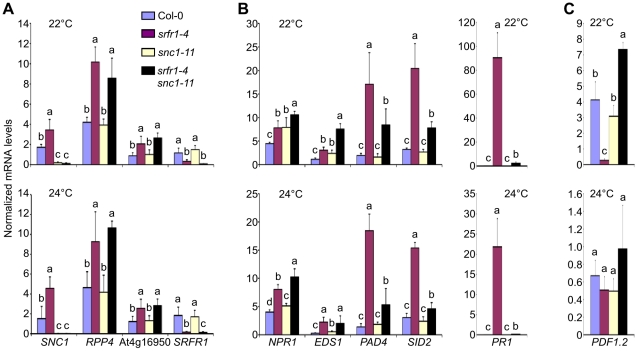
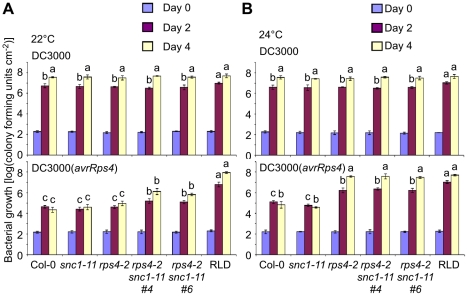
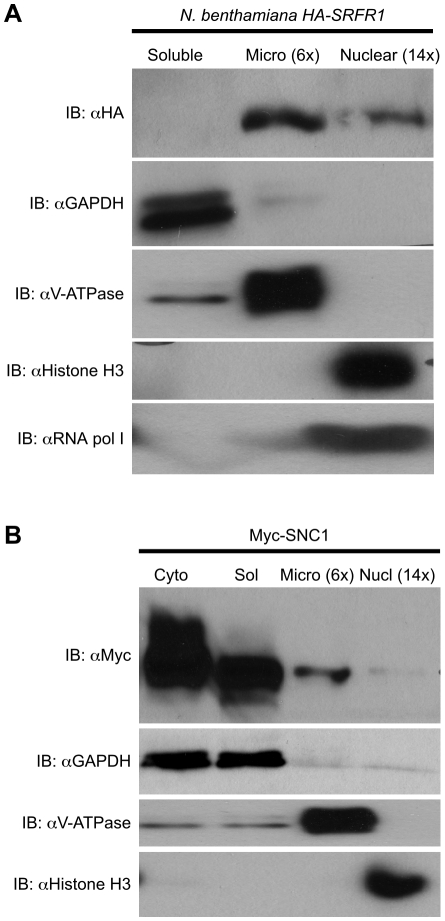
The SUPPRESSOR OF rps4-RLD1 (SRFR1) gene was identified based on enhanced AvrRps4-triggered resistance in the naturally susceptible Arabidopsis accession RLD. No other phenotypic effects were recorded, and the extent of SRFR1 involvement in regulating effector-triggered immunity was unknown. Here we show that mutations in SRFR1 in the accession Columbia-0 (Col-0) lead to severe stunting and constitutive expression of the defense gene PR1. These phenotypes were temperature-dependent. A cross between srfr1-1 (RLD background) and srfr1-4 (Col-0) showed that stunting was caused by a recessive locus in Col-0. Mapping and targeted crosses identified the Col-0-specific resistance gene SNC1 as the locus that causes stunting. SRFR1 was proposed to function as a transcriptional repressor, and SNC1 is indeed overexpressed in srfr1-4. Interestingly, co-regulated genes in the SNC1 cluster are also upregulated in the srfr1-4 snc1-11 double mutant, indicating that the overexpression of SNC1 is not a secondary effect of constitutive defense activation. In addition, a Col-0 RPS4 mutant showed full susceptibility to bacteria expressing avrRps4 at 24°C but not at 22°C, while RLD susceptibility was not temperature-dependent. The rps4-2 snc1-11 double mutant showed increased, but not full, susceptibility at 22°C, indicating that additional cross-talk between resistance pathways may exist. Intriguingly, when transiently expressed in Nicotiana benthamiana, SRFR1, RPS4 and SNC1 are in a common protein complex in a cytoplasmic microsomal compartment. Our results highlight SRFR1 as a convergence point in at least a subset of TIR-NBS-LRR protein-mediated immunity in Arabidopsis. Based on the cross-talk evident from our results, they also suggest that reports of constitutive resistance phenotypes in Col-0 need to consider the possible involvement of SNC1.
基于自然感病的拟南芥品系 RLD 中增强的 AvrRps4 触发抗性,鉴定出了 SUPPRESSOR OF rps4-RLD1(SRFR1)基因。未记录到其他表型效应,并且尚不清楚 SRFR1 在调节效应子触发免疫中的参与程度。在这里,我们显示,在哥伦比亚-0(Col-0)品系中 SRFR1 的突变导致严重的生长迟缓和防御基因 PR1 的组成型表达。这些表型是温度依赖性的。srfr1-1(RLD 背景)和 srfr1-4(Col-0)之间的杂交表明,生长迟缓是由 Col-0 中的隐性基因座引起的。图谱和靶向杂交鉴定出 Col-0 特异性抗性基因 SNC1 是导致生长迟缓的基因座。SRFR1 被提议作为一个转录抑制因子,并且 SNC1 在 srfr1-4 中确实过表达。有趣的是,SNC1 簇中的共调控基因在 srfr1-4 snc1-11 双突变体中也上调,表明 SNC1 的过表达不是组成型防御激活的次生效应。此外,Col-0 RPS4 突变体在 24°C 下表达 avrRps4 的细菌表现出完全易感性,但在 22°C 下则不然,而 RLD 易感性不受温度影响。rps4-2 snc1-11 双突变体在 22°C 下显示出增加的但不是完全的易感性,表明抗性途径之间可能存在额外的串扰。有趣的是,当在本氏烟中瞬时表达时,SRFR1、RPS4 和 SNC1 存在于细胞质微粒体隔室中的一个共同蛋白复合物中。我们的结果强调了 SRFR1 作为拟南芥中至少一部分 TIR-NBS-LRR 蛋白介导的免疫的汇聚点。基于我们的结果显示的串扰,它们还表明,Col-0 中组成型抗性表型的报告需要考虑 SNC1 的可能参与。