Department of Community Medicine, West Virginia University, Morgantown, West Virginia, USA.
BMC Public Health. 2010 Nov 17;10:705. doi: 10.1186/1471-2458-10-705.
Two counter trends in injury mortality have been separately reported in the US in recent times - a declining suicide rate and a rapidly rising unintentional poisoning mortality rate. Poisoning suicides are especially difficult to detect, and injury of undetermined intent is the underlying cause-of-death category most likely to reflect this difficulty. We compare suicide and poisoning mortality trends over two decades in a preliminary assessment of their independence and implications for suicide misclassification.
Description of overall and gender- and age-specific trends using national mortality data from WISQARS, the Web-based Injury Statistics Query and Reporting System, maintained by the Centers for Disease Control and Prevention (CDC). Subjects were the 936,633 residents dying in the 50 states and the District of Columbia between 1987 and 2006 whose underlying cause of death was classified as suicide, unintentional poisoning, or injury mortality of undetermined intent.
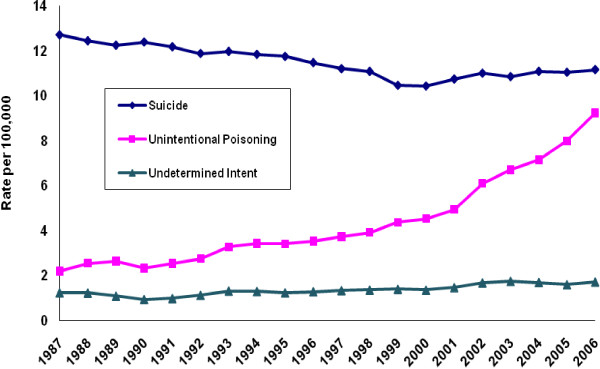
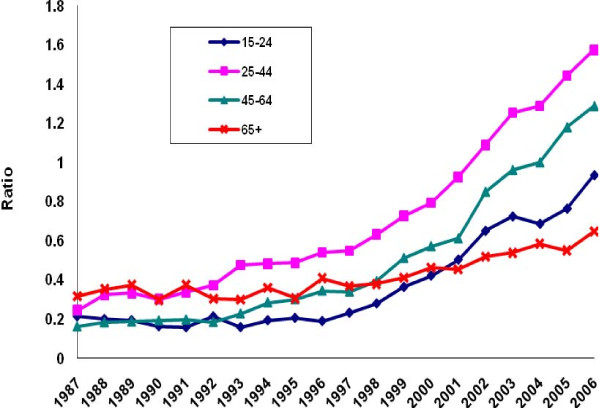
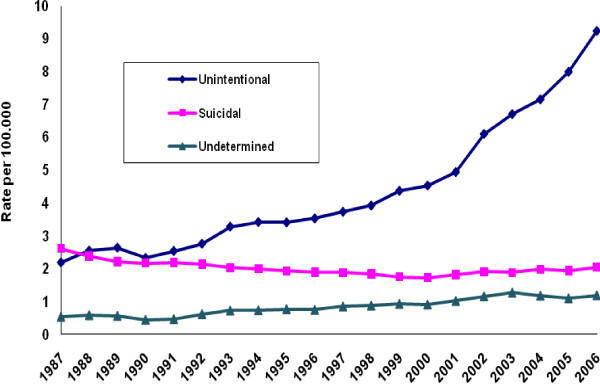
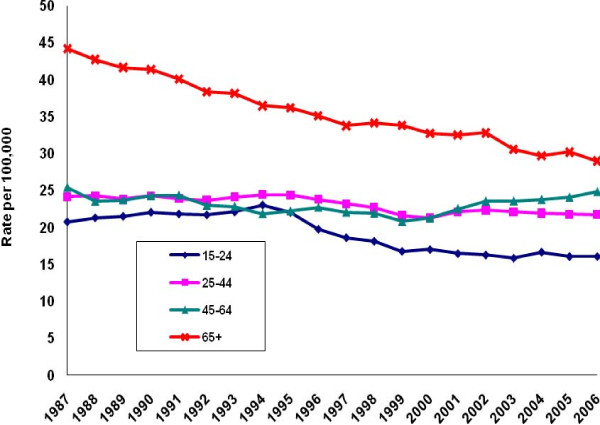
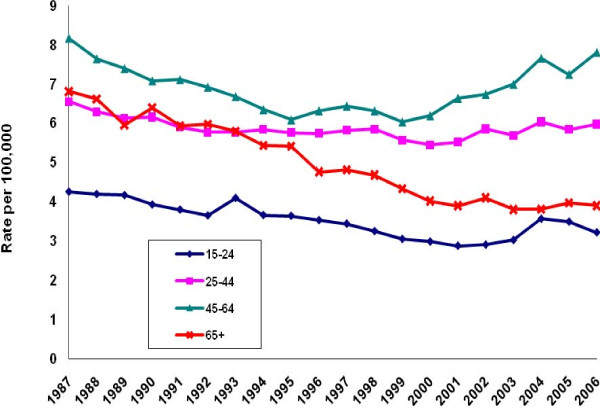
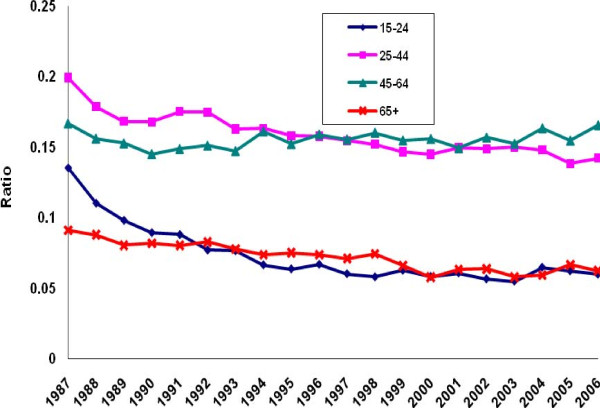
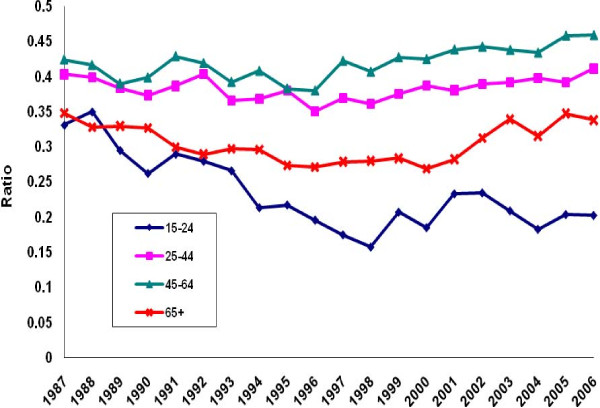
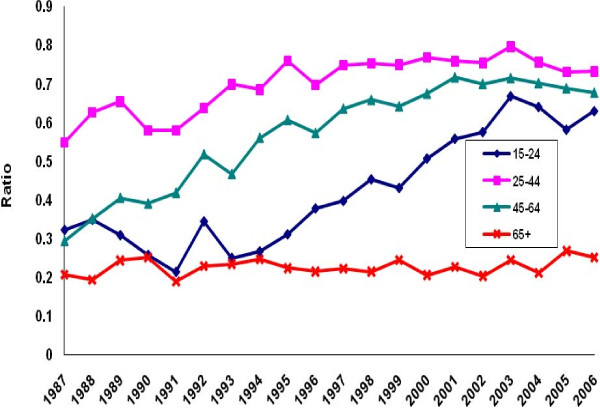
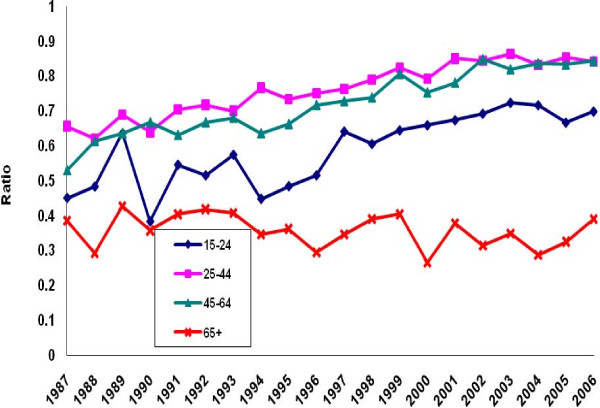
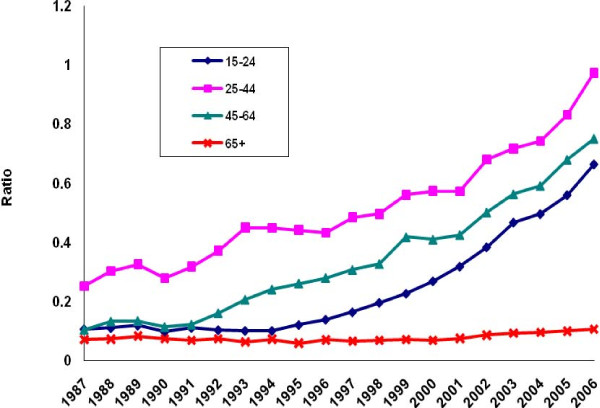
The official US suicide rate declined 18% between 1987 and 2000, from 12.71 to 10.43 deaths per 100,000 population. It then increased to 11.15 deaths per 100,000 by 2006, a 7% rise. By contrast to these much smaller rate changes for suicide, the unintentional poisoning mortality rate rose more than fourfold between 1987 and 2006, from 2.19 to 9.22 deaths per 100,000. Only the population aged 65 years and older showed a sustained decline in the suicide rate over the entire observation period. Consistently highest in gender-age comparisons, the elderly male rate declined by 35%. The elderly female rate declined by 43%. Unlike rate trends for the non-elderly, both declines appeared independent of corresponding mortality trends for unintentional poisoning and poisoning of undetermined intent. The elderly also deviated from younger counterparts by having a smaller proportion of their injury deaths of undetermined intent classified as poisoning. Poisoning manifested as a less common method of suicide for this group than other decedents, except for those aged 15-24 years. Although remaining low, the undetermined poisoning mortality rate increased over the observation period.
The official decline in the suicide rate between 1987 and 2000 may have been a partial artifact of misclassification of non-elderly suicides within unintentional poisoning mortality. We recommend in-depth national, regional, and local population-based research investigations of the poisoning-suicide nexus, and endorse calls for widening the scope of the definition of suicide and evaluation of its risk factors.
最近,美国报告了两种相反的伤害死亡率趋势 - 自杀率下降和意外中毒死亡率迅速上升。中毒自杀尤其难以发现,而意图不明的伤害是最有可能反映这种困难的潜在死因类别。我们通过比较二十年来自杀和中毒死亡率的趋势,初步评估了它们的独立性及其对自杀分类错误的影响。
使用疾病控制与预防中心(CDC)维护的基于网络的伤害统计查询和报告系统(WISQARS)中的国家死亡率数据,对整体和性别及年龄特定趋势进行描述。研究对象为 1987 年至 2006 年间在 50 个州和哥伦比亚特区死亡的 936,633 名居民,其死因被归类为自杀、意外中毒或意图不明的伤害性死亡。
1987 年至 2000 年期间,美国官方自杀率下降了 18%,从每 10 万人 12.71 人降至 10.43 人。然后,到 2006 年,自杀率上升至每 10 万人 11.15 人,上升了 7%。与自杀率的这些较小变化相比,1987 年至 2006 年间意外中毒死亡率上升了四倍多,从每 10 万人 2.19 人增至 9.22 人。在整个观察期间,只有 65 岁及以上人群的自杀率持续下降。在性别年龄比较中,老年人男性的自杀率下降了 35%。老年女性的自杀率下降了 43%。与非老年人的死亡率趋势不同,这两个下降似乎与意外中毒和意图不明的中毒死亡率的相应趋势无关。老年人的情况与年轻人不同,他们的意图不明的伤害性死亡中被归类为中毒的比例较小。除了 15-24 岁的人外,对于该组,中毒并不是比其他死者更常见的自杀方式。尽管仍然很低,但在整个观察期间,意图不明的中毒死亡率有所增加。
1987 年至 2000 年间自杀率的官方下降可能部分是由于将非老年人自杀归类为意外中毒死亡率造成的分类错误。我们建议对中毒-自杀关系进行深入的国家、地区和地方人口研究调查,并支持扩大自杀定义的范围和评估其危险因素的呼吁。