Institut of Sport Science, Friedrich-Alexander-University Erlangen-Nuremberg, Gebbertstrasse 123b, 91058 Erlangen, Germany.
BMC Musculoskelet Disord. 2010 Nov 17;11:266. doi: 10.1186/1471-2474-11-266.
There is strong, internationally confirmed evidence for the short-term effectiveness of multimodal interdisciplinary specific treatment programs for chronic back pain. However, the verification of long-term sustainability of achieved effects is missing so far. For long-term improvement of pain and functional ability high intervention intensity or high volume seems to be necessary (> 100 therapy hours). Especially in chronic back pain rehabilitation, purposefully refined aftercare treatments offer the possibility to intensify positive effects or to increase their sustainability. However, quality assured goal-conscious specific aftercare programs for the rehabilitation of chronic back pain are absent.
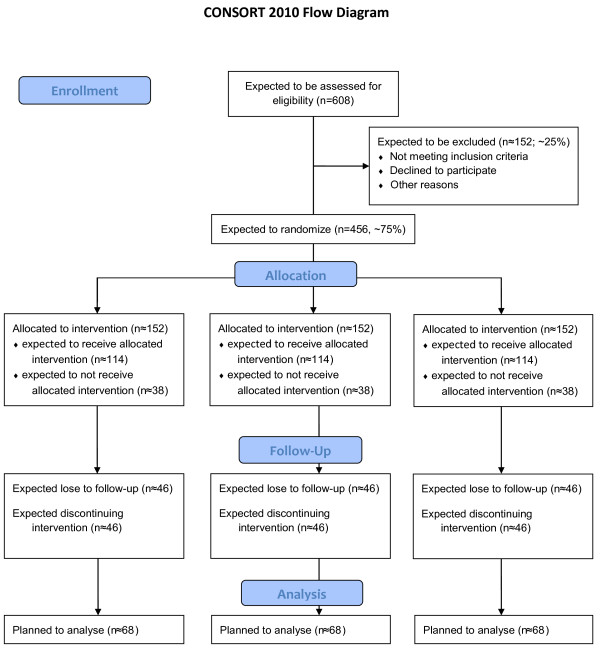
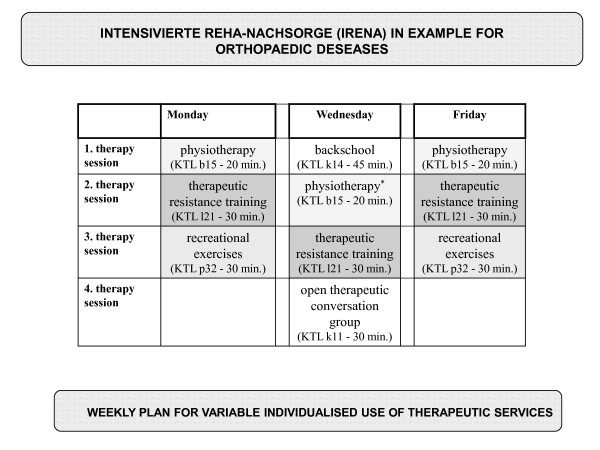
METHODS/DESIGN: This study aims to examine the efficacy of a specially developed bio-psycho-social chronic back pain specific aftercare intervention (RÜCKGEWINN) in comparison to the current usual aftercare (IRENA) and a control group that is given an educational booklet addressing pain-conditioned functional ability and back pain episodes. Overall rehabilitation effects as well as predictors for compliance to the aftercare programs are analysed. Therefore, a multicenter prospective 3-armed randomised controlled trial is conducted. 456 participants will be consecutively enrolled in inpatient and outpatient rehabilitation and assigned to either one of the three study arms. Outcomes are measured before and after rehabilitation. Aftercare programs are assessed at ten month follow up after dismissal form rehabilitation.
Special methodological and logistic challenges are to be mastered in this trial, which accrue from the interconnection of aftercare interventions to their residential district and the fact that the proportion of patients who take part in aftercare programs is low. The usability of the aftercare program is based on the transference into the routine care and is also reinforced by developed manuals with structured contents, media and material for organisation assistance as well as training manuals for therapists in the aftercare.
有强有力的国际证据证实,多模式跨学科特定治疗方案对慢性腰痛的短期疗效。然而,目前还缺乏对已取得的疗效的长期可持续性的验证。为了长期改善疼痛和功能能力,需要高强度或高容量的干预(>100 个治疗小时)。特别是在慢性腰痛康复中,有针对性地进行精细化的康复后治疗,为强化积极效果或提高其可持续性提供了可能。然而,目前缺乏针对慢性腰痛康复的有质量保证、目标明确的特定康复后治疗方案。
方法/设计:本研究旨在比较专门开发的生物心理社会慢性腰痛特定康复后干预(RÜCKGEWINN)与当前常规康复后(IRENA)和对照组的疗效,对照组将获得一本关于疼痛相关功能能力和腰痛发作的教育手册。分析整体康复效果以及对康复后治疗方案的依从性的预测因素。因此,进行了一项多中心前瞻性 3 臂随机对照试验。将连续招募 456 名住院和门诊康复患者,并将其分配到三个研究组中的一个。在康复前后进行测量。在康复后 10 个月随访时评估康复后治疗方案。
该试验需要克服特殊的方法学和后勤挑战,这些挑战源于康复后治疗方案与其居住社区的相互关联,以及参与康复后治疗方案的患者比例较低。康复后治疗方案的可用性基于其向常规护理的转移,并且还通过开发具有结构化内容的手册、组织辅助的媒体和材料以及康复后治疗师的培训手册来得到加强。