Division of Nephrology, Department of Medicine, London Health Sciences Centre, London, ON, Canada.
BMJ. 2010 Nov 17;341:c6020. doi: 10.1136/bmj.c6020.
To evaluate the risk for hypertension, renal impairment, and cardiovascular disease within eight years of gastroenteritis from drinking water contaminated with Escherichia coli O157:H7 and Campylobacter.
A prospective cohort study. Setting Walkerton, Ontario, Canada.
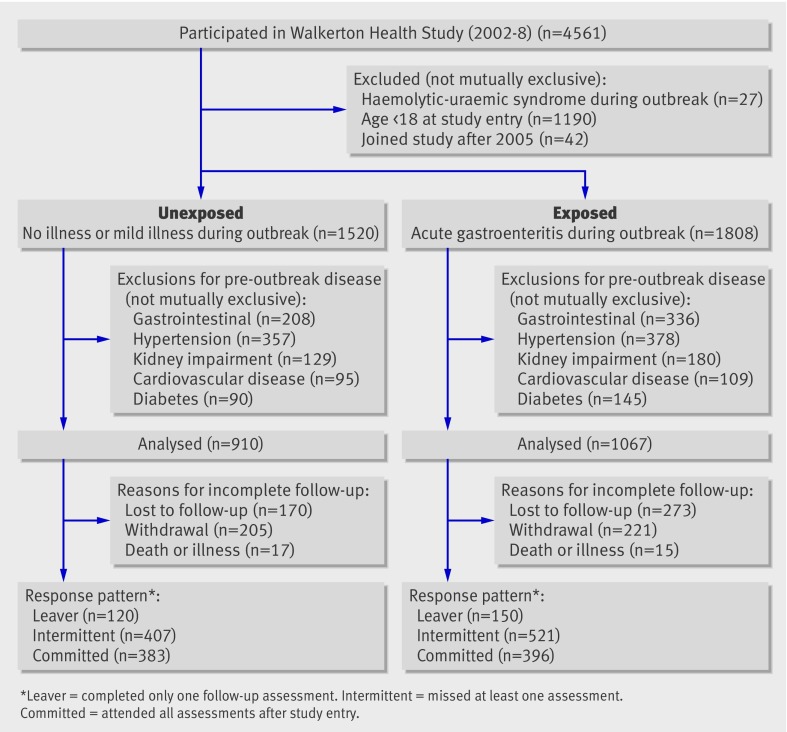
1977 adult participants in the Walkerton Health Study recruited between 2002 and 2005 after an outbreak of gastroenteritis in May 2000, when a municipal water system was contaminated, with no pre-outbreak history of outcome measures.
Information was collected annually via survey, physical examination, and laboratory assessment. Primary measures were acute gastroenteritis (diarrhoeal illness lasting >3 days, bloody diarrhoea, or >3 loose stools/day), hypertension (blood pressure ≥140/90 mm Hg), and renal impairment (microalbuminuria or estimated glomerular filtration rate <60 ml/min/1.73 m(2)). Self reported physician diagnosis of cardiovascular disease (myocardial infarction, stroke, or congestive heart failure) was a secondary outcome.
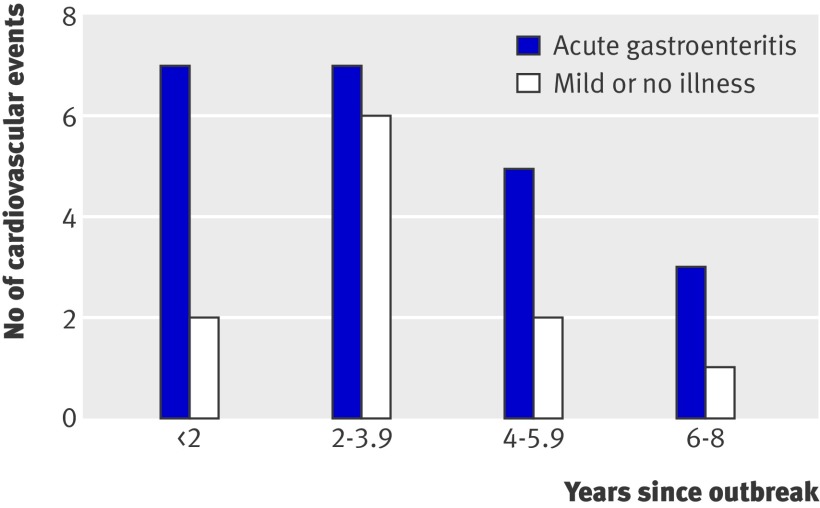
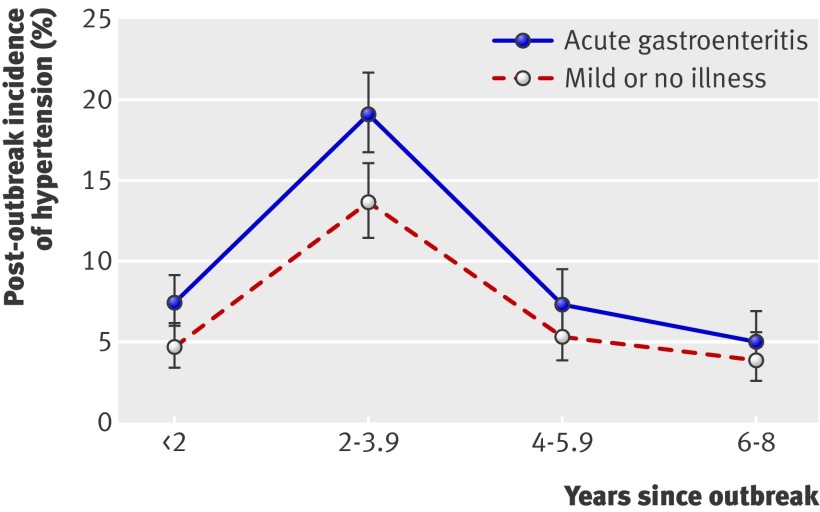
Acute gastroenteritis at the time of the outbreak was reported by 1067 (54%) of participants. Incident hypertension was detected in 697 (35%) (294 (32%) of group not exposed to acute gastroenteritis v 403 (38%) of exposed group). While 572 (29%) had at least one indicator of renal impairment (266 (29%) of unexposed v 306 (29%) of exposed), only 30 (1.5%) had both (8 (0.9%) of unexposed v 22 (2.1%) of exposed). Cardiovascular disease was reported by 33/1749 (1.9%). The adjusted hazard ratios for hypertension and cardiovascular disease after acute gastroenteritis were 1.33 (95% confidence interval 1.14 to 1.54) and 2.13 (1.03 to 4.43) respectively. The adjusted hazard ratio for the presence of either indicator of renal impairment was 1.15 (0.97 to 1.35) and was 3.41 (1.51 to 7.71) for the presence of both.
Gastroenteritis from drinking water contaminated with E coli O157:H7 and Campylobacter was associated with an increased risk for hypertension, renal impairment, and self reported cardiovascular disease. Annual monitoring of blood pressure and periodic monitoring of renal function may be warranted for individuals who experience E coli O157:H7 gastroenteritis.
评估在饮用被大肠杆菌 O157:H7 和弯曲杆菌污染的水后 8 年内患高血压、肾功能损害和心血管疾病的风险。
前瞻性队列研究。地点安大略省沃克顿。
2002 年至 2005 年,在 2000 年 5 月爆发肠胃炎后,招募了 1977 名成年参与者参加沃克顿健康研究,当时市政供水系统受到污染,此前没有发生过结果措施的疫情。
每年通过调查、体检和实验室评估收集信息。主要措施是急性肠胃炎(腹泻持续时间>3 天、血性腹泻或>3 次稀便/天)、高血压(血压≥140/90mmHg)和肾功能损害(微量白蛋白尿或估计肾小球滤过率<60ml/min/1.73m2)。自我报告的心血管疾病(心肌梗死、中风或充血性心力衰竭)的医生诊断为次要结局。
1067 名(54%)参与者报告了疫情期间的急性肠胃炎。在 697 名(35%)参与者中发现了新发高血压(294 名(32%)未暴露于急性肠胃炎组与 403 名(38%)暴露组)。虽然 572 名(29%)至少有一项肾功能损害指标(266 名(29%)未暴露组与 306 名(29%)暴露组),但只有 30 名(1.5%)有两项(8 名(0.9%)未暴露组与 22 名(2.1%)暴露组)。报告了 33/1749 例(1.9%)心血管疾病。急性肠胃炎后高血压和心血管疾病的调整后危险比分别为 1.33(95%置信区间 1.14 至 1.54)和 2.13(1.03 至 4.43)。存在任何一项肾功能损害指标的调整后危险比为 1.15(0.97 至 1.35),同时存在两项指标的危险比为 3.41(1.51 至 7.71)。
饮用被大肠杆菌 O157:H7 和弯曲杆菌污染的水引起的肠胃炎与高血压、肾功能损害和自我报告的心血管疾病风险增加有关。对于患有大肠杆菌 O157:H7 肠胃炎的个体,可能需要每年监测血压并定期监测肾功能。