Department of Neurology, University of Wuerzburg, Wuerzburg, Germany.
PLoS One. 2010 Nov 15;5(11):e15478. doi: 10.1371/journal.pone.0015478.
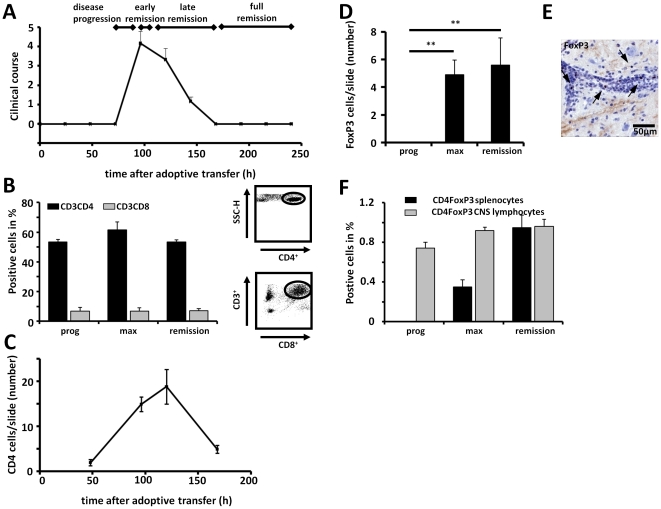
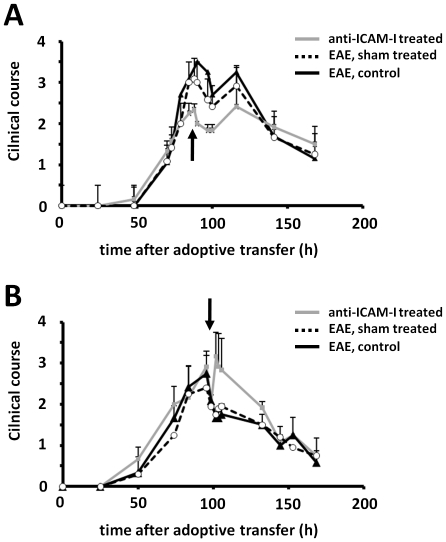
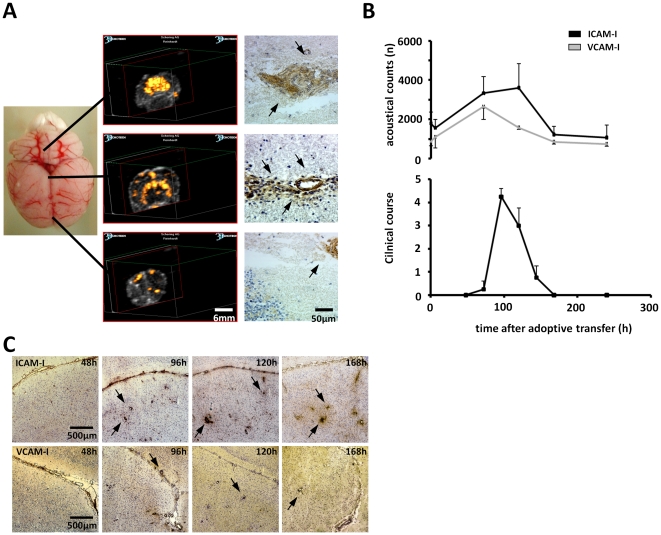
Migration of immune cells to the target organ plays a key role in autoimmune disorders like multiple sclerosis (MS). However, the exact underlying mechanisms of this active process during autoimmune lesion pathogenesis remain elusive. To test if pro-inflammatory and regulatory T cells migrate via a similar molecular mechanism, we analyzed the expression of different adhesion molecules, as well as the composition of infiltrating T cells in an in vivo model of MS, adoptive transfer experimental autoimmune encephalomyelitis in rats. We found that the upregulation of ICAM-I and VCAM-I parallels the development of clinical disease onset, but persists on elevated levels also in the phase of clinical remission. However, the composition of infiltrating T cells found in the developing versus resolving lesion phase changed over time, containing increased numbers of regulatory T cells (FoxP3) only in the phase of clinical remission. In order to test the relevance of the expression of cell adhesion molecules, animals were treated with purified antibodies to ICAM-I and VCAM-I either in the phase of active disease or in early remission. Treatment with a blocking ICAM-I antibody in the phase of disease progression led to a milder disease course. However, administration during early clinical remission aggravates clinical symptoms. Treatment with anti-VCAM-I at different timepoints had no significant effect on the disease course. In summary, our results indicate that adhesion molecules are not only important for capture and migration of pro-inflammatory T cells into the central nervous system, but also permit access of anti-inflammatory cells, such as regulatory T cells. Therefore it is likely to assume that intervention at the blood brain barrier is time dependent and could result in different therapeutic outcomes depending on the phase of CNS lesion development.
免疫细胞向靶器官的迁移在多发性硬化症(MS)等自身免疫性疾病中起着关键作用。然而,自身免疫性病变发病机制中这一主动过程的确切潜在机制仍不清楚。为了测试促炎性和调节性 T 细胞是否通过类似的分子机制迁移,我们分析了不同粘附分子的表达,以及在 MS 的体内模型,即大鼠实验性自身免疫性脑脊髓炎的转导中,浸润 T 细胞的组成。我们发现,ICAM-1 和 VCAM-1 的上调与临床疾病发病的发展平行,但在临床缓解期也持续处于升高水平。然而,在发展与消退病变阶段发现的浸润 T 细胞的组成随时间发生变化,仅在临床缓解期才发现调节性 T 细胞(FoxP3)数量增加。为了测试细胞粘附分子表达的相关性,动物在疾病活跃期或早期缓解期用纯化的 ICAM-1 和 VCAM-1 抗体进行治疗。在疾病进展期用阻断 ICAM-1 的抗体治疗可导致疾病过程较轻。然而,在早期临床缓解期给药会加重临床症状。在不同时间点用抗 VCAM-1 治疗对疾病过程没有显著影响。总之,我们的结果表明,粘附分子不仅对促炎性 T 细胞进入中枢神经系统的捕获和迁移很重要,而且还允许抗炎细胞,如调节性 T 细胞进入。因此,很可能假设血脑屏障的干预是时间依赖性的,并且根据中枢神经系统病变发展的阶段,可能会产生不同的治疗结果。