Division of Clinical Immunology and Rheumatology, Academic Medical Center, University of Amsterdam, Amsterdam, The Netherlands.
PLoS One. 2011 May 12;6(5):e19962. doi: 10.1371/journal.pone.0019962.
Intercellular adhesion molecule-1 (ICAM-1) is involved in migration and co-stimulation of T and B cells. Membrane bound ICAM-1 is over expressed in the salivary glands (SG) of Sjögren's syndrome (SS) patients and has therefore been proposed as a potential therapeutic target. To test the utility of ICAM-1 as a therapeutic target, we used local gene therapy in Non Obese Diabetic (NOD) mice to express soluble (s)ICAM-1 to compete with membrane bound ICAM-1 for binding with its receptor. Therapy was given prior to and just after the influx of immune cells into the SG.
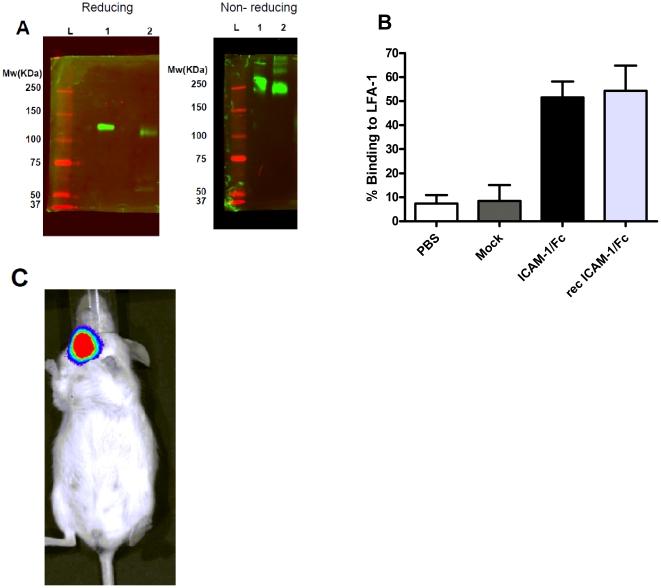
A recombinant serotype 2 adeno associated virus (rAAV2) encoding ICAM-1/Fc was constructed and its efficacy tested in the female NOD mice after retrograde instillation in SG at eight (early treatment) and ten (late treatment) weeks of age. SG inflammation was evaluated by focus score and immunohistochemical quantification of infiltrating cell types. Serum and SG tissue were analyzed for immunoglobulins (Ig).
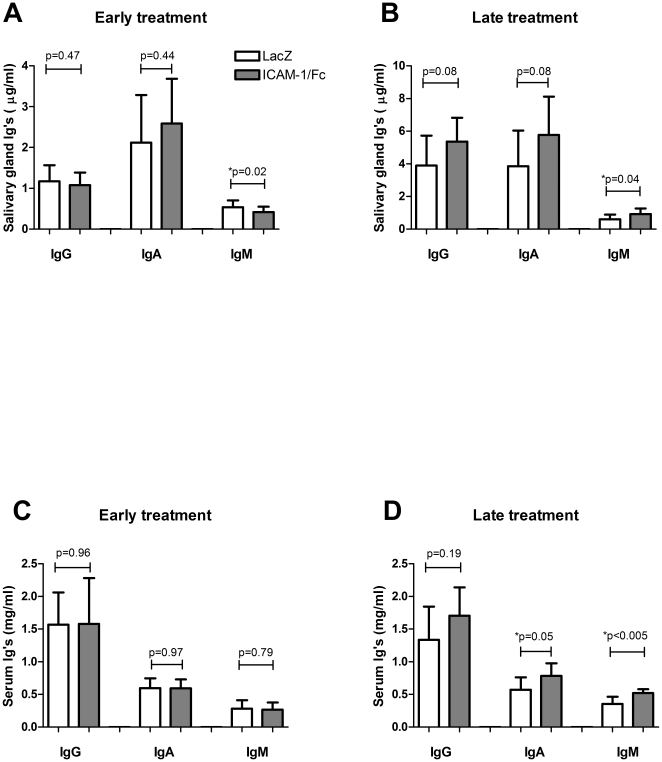
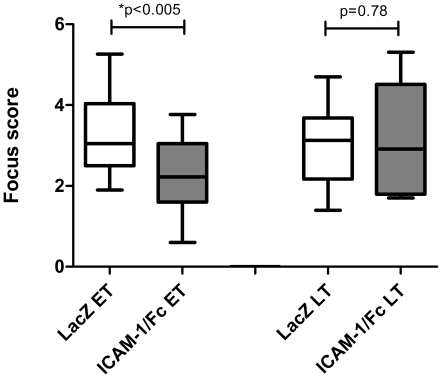
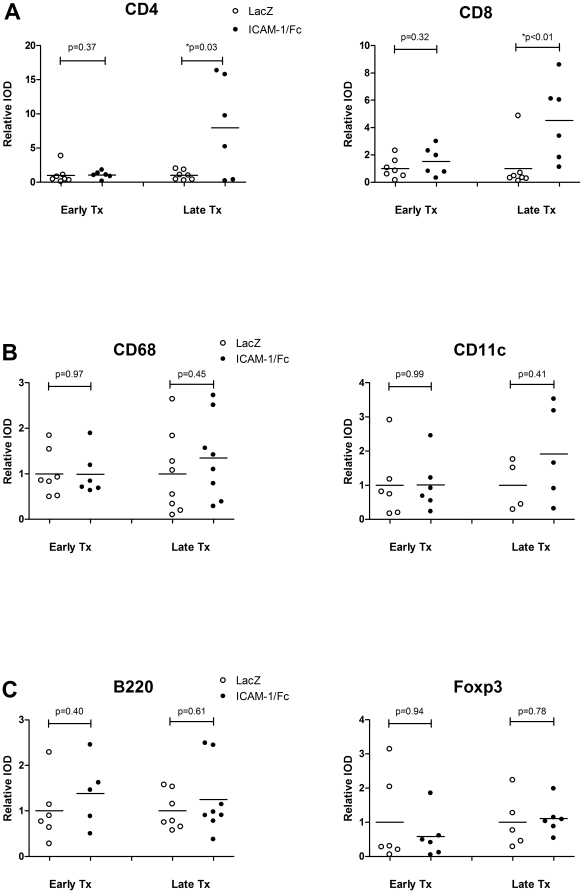
Early treatment with ICAM-1/Fc resulted in decreased average number of inflammatory foci without changes in T and B cell composition. In contrast, late treated mice did not show any change in focus scores, but immunohistochemical staining showed an increase in the overall number of CD4+ and CD8+ T cells. Moreover, early treated mice showed decreased IgM within the SGs, whereas late treated mice had increased IgM levels, and on average higher IgG and IgA.
Blocking the ICAM-1/LFA-1 interaction with sICAM-1/Fc may result in worsening of a SS like phenotype when infiltrates have already formed within the SG. As a treatment for human SS, caution should be taken targeting the ICAM-1 axis since most patients are diagnosed when inflammation is clearly present within the SG.
细胞间黏附分子-1(ICAM-1)参与 T 和 B 细胞的迁移和共刺激。干燥综合征(SS)患者的唾液腺(SG)中过度表达膜结合型 ICAM-1,因此被认为是潜在的治疗靶点。为了测试 ICAM-1 作为治疗靶点的效用,我们使用局部基因治疗在非肥胖糖尿病(NOD)小鼠中表达可溶性(s)ICAM-1,以与膜结合型 ICAM-1 竞争与受体结合。治疗在免疫细胞涌入 SG 之前和之后进行。
构建了编码 ICAM-1/Fc 的重组血清型 2 腺相关病毒(rAAV2),并在 SG 逆行滴注后 8 周(早期治疗)和 10 周(晚期治疗)龄雌性 NOD 小鼠中测试其疗效。通过焦点评分和浸润细胞类型的免疫组织化学定量评估 SG 炎症。分析血清和 SG 组织中的免疫球蛋白(Ig)。
早期用 ICAM-1/Fc 治疗可减少炎症焦点的平均数量,而不改变 T 和 B 细胞组成。相比之下,晚期治疗的小鼠焦点评分没有变化,但免疫组化染色显示 CD4+和 CD8+T 细胞总数增加。此外,早期治疗的小鼠 SG 中的 IgM 减少,而晚期治疗的小鼠 IgM 水平升高,平均 IgG 和 IgA 水平升高。
用 sICAM-1/Fc 阻断 ICAM-1/LFA-1 相互作用可能导致已经在 SG 内形成浸润时,SS 样表型恶化。作为对人类 SS 的治疗,在 SG 内炎症明显存在时,应谨慎靶向 ICAM-1 轴,因为大多数患者在此时被诊断出来。