The Biodiversity Research Centre, University of British Columbia, Vancouver, British Columbia, Canada.
PLoS One. 2010 Nov 15;5(11):e13991. doi: 10.1371/journal.pone.0013991.
Dinoflagellates are an ecologically important group of protists with important functions as primary producers, coral symbionts and in toxic red tides. Although widely studied, the natural diversity of dinoflagellates is not well known. DNA barcoding has been utilized successfully for many protist groups. We used this approach to systematically sample known "species", as a reference to measure the natural diversity in three marine environments.
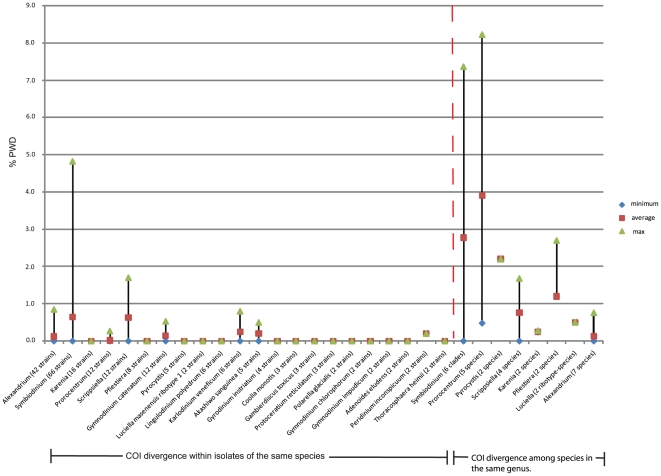
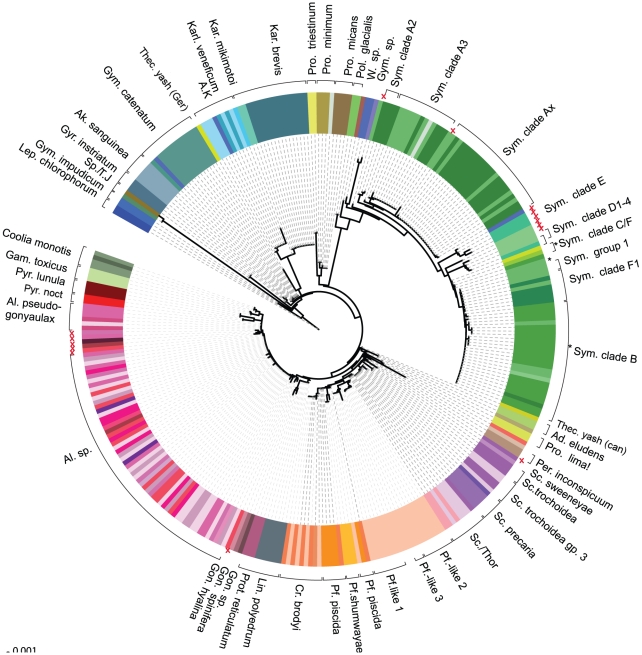
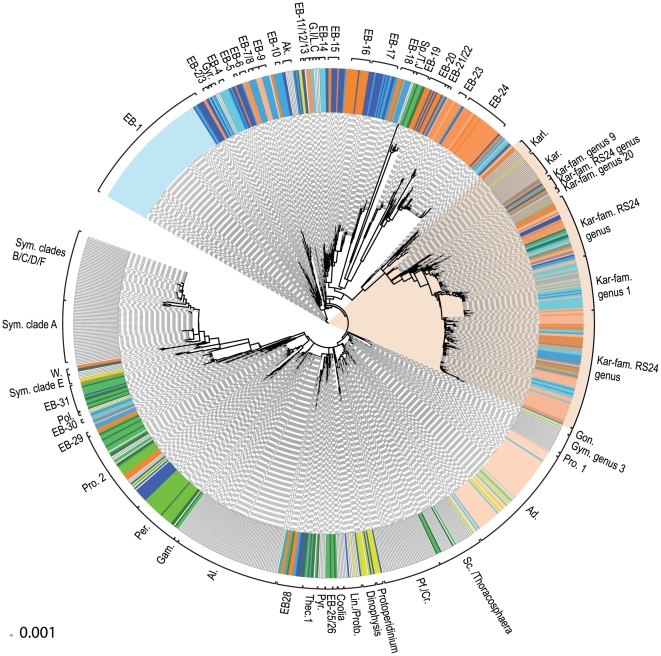
METHODOLOGY/PRINCIPAL FINDINGS: In this study, we assembled a large cytochrome c oxidase 1 (COI) barcode database from 8 public algal culture collections plus 3 private collections worldwide resulting in 336 individual barcodes linked to specific cultures. We demonstrate that COI can identify to the species level in 15 dinoflagellate genera, generally in agreement with existing species names. Exceptions were found in species belonging to genera that were generally already known to be taxonomically challenging, such as Alexandrium or Symbiodinium. Using this barcode database as a baseline for cultured dinoflagellate diversity, we investigated the natural diversity in three diverse marine environments (Northeast Pacific, Northwest Atlantic, and Caribbean), including an evaluation of single-cell barcoding to identify uncultivated groups. From all three environments, the great majority of barcodes were not represented by any known cultured dinoflagellate, and we also observed an explosion in the diversity of genera that previously contained a modest number of known species, belonging to Kareniaceae. In total, 91.5% of non-identical environmental barcodes represent distinct species, but only 51 out of 603 unique environmental barcodes could be linked to cultured species using a conservative cut-off based on distances between cultured species.
CONCLUSIONS/SIGNIFICANCE: COI barcoding was successful in identifying species from 70% of cultured genera. When applied to environmental samples, it revealed a massive amount of natural diversity in dinoflagellates. This highlights the extent to which we underestimate microbial diversity in the environment.
甲藻是一类生态重要的原生生物,具有作为初级生产者、珊瑚共生体和产生有毒赤潮等重要功能。尽管已广泛研究,但甲藻的自然多样性仍不为人知。DNA 条码技术已成功应用于许多原生生物群体。我们采用这种方法系统地采样已知的“物种”,作为衡量三个海洋环境中自然多样性的参考。
方法/主要发现:在这项研究中,我们从全球 8 个公共藻类培养物收藏和 3 个私人收藏中组装了一个大型细胞色素 c 氧化酶 1(COI)条码数据库,共包含 336 个与特定培养物相关的个体条码。我们证明 COI 可在 15 个甲藻属中识别到物种水平,通常与现有的物种名称一致。在属于原本就被认为是分类学上具有挑战性的属的物种中,例如亚历山大藻属或共生藻属,出现了例外。我们利用这个条码数据库作为培养甲藻多样性的基准,研究了三个不同海洋环境(东北太平洋、西北大西洋和加勒比海)中的自然多样性,包括评估单细胞条码以识别未培养的群体。从所有三个环境中,绝大多数条码都没有被任何已知的培养甲藻所代表,而且我们还观察到以前含有少量已知物种的属的多样性呈爆炸式增长,属于 Kareniaceae 科。总的来说,91.5%的非同源环境条码代表了不同的物种,但只有 51 个来自 603 个独特环境条码,可使用基于培养物种之间距离的保守截止值与培养物种联系起来。
结论/意义:COI 条码在识别 70%的培养属物种方面取得了成功。当应用于环境样本时,它揭示了甲藻中大量的自然多样性。这突出表明了我们在多大程度上低估了环境中的微生物多样性。