United States Department of Agriculture-Agricultural Research Service, Plant Genetics Research Unit, Donald Danforth Plant Sciences Center, St. Louis, Missouri, United States of America.
PLoS Genet. 2010 Nov 11;6(11):e1001193. doi: 10.1371/journal.pgen.1001193.
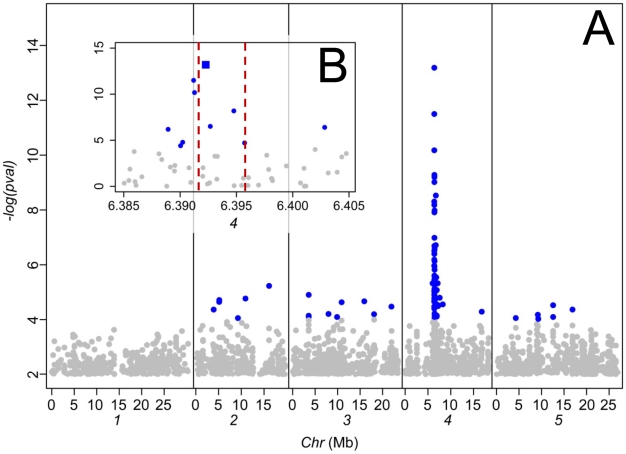
The genetic model plant Arabidopsis thaliana, like many plant species, experiences a range of edaphic conditions across its natural habitat. Such heterogeneity may drive local adaptation, though the molecular genetic basis remains elusive. Here, we describe a study in which we used genome-wide association mapping, genetic complementation, and gene expression studies to identify cis-regulatory expression level polymorphisms at the AtHKT1;1 locus, encoding a known sodium (Na(+)) transporter, as being a major factor controlling natural variation in leaf Na(+) accumulation capacity across the global A. thaliana population. A weak allele of AtHKT1;1 that drives elevated leaf Na(+) in this population has been previously linked to elevated salinity tolerance. Inspection of the geographical distribution of this allele revealed its significant enrichment in populations associated with the coast and saline soils in Europe. The fixation of this weak AtHKT1;1 allele in these populations is genetic evidence supporting local adaptation to these potentially saline impacted environments.
模式植物拟南芥与许多植物物种一样,在其自然栖息地经历了一系列的土壤条件。这种异质性可能会导致局部适应,尽管分子遗传基础仍不清楚。在这里,我们描述了一项研究,我们使用全基因组关联图谱、遗传互补和基因表达研究,在 AtHKT1;1 基因座上鉴定出 cis-regulatory 表达水平多态性,该基因座编码一种已知的钠离子(Na(+))转运蛋白,是控制全球拟南芥群体叶片 Na(+)积累能力自然变异的主要因素。在该群体中,驱动叶片 Na(+)升高的 AtHKT1;1 弱等位基因先前与提高的耐盐性有关。对该等位基因的地理分布的检查表明,它在与欧洲沿海和盐渍土壤相关的种群中显著富集。该弱 AtHKT1;1 等位基因在这些种群中的固定是支持对这些潜在盐渍化环境进行局部适应的遗传证据。