Shenzhen Institutes of Advanced Technology, Chinese Academy of Sciences, Shenzhen, PR China.
Biomed Eng Online. 2010 Nov 19;9:75. doi: 10.1186/1475-925X-9-75.
The effective geometric modeling of vascular structures is crucial for diagnosis, therapy planning and medical education. These applications require good balance with respect to surface smoothness, surface accuracy, triangle quality and surface size.
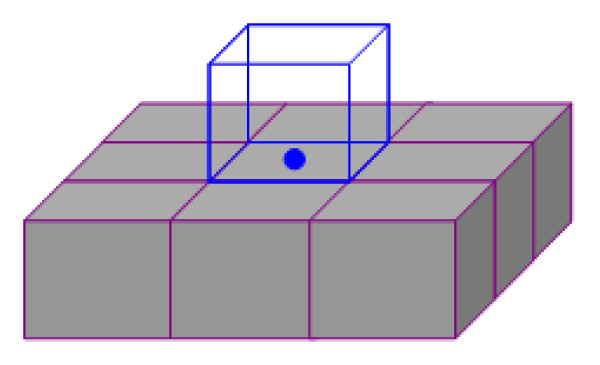
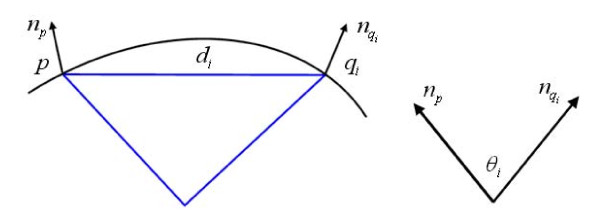
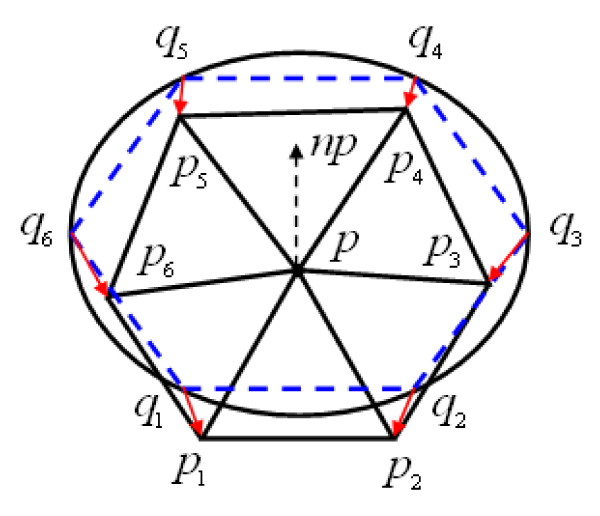
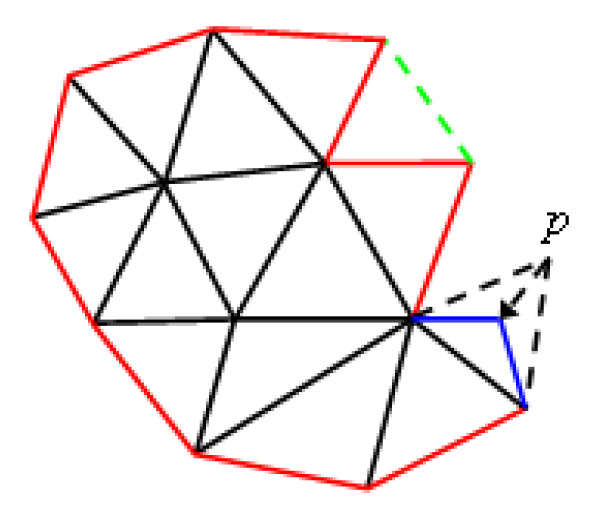
Our method first extracts the vascular boundary voxels from the segmentation result, and utilizes these voxels to build a three-dimensional (3D) point cloud whose normal vectors are estimated via covariance analysis. Then a 3D implicit indicator function is computed from the oriented 3D point cloud by solving a Poisson equation. Finally the vessel surface is generated by a proposed adaptive polygonization algorithm for explicit 3D visualization.
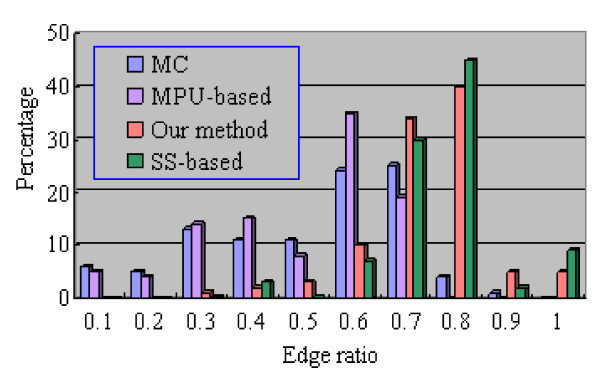
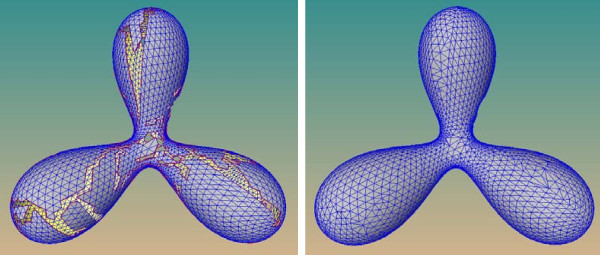
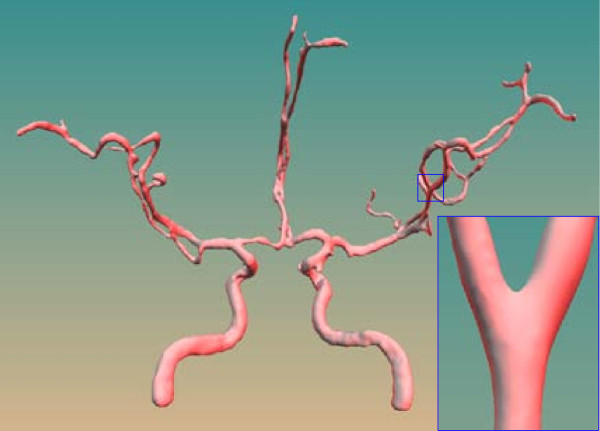
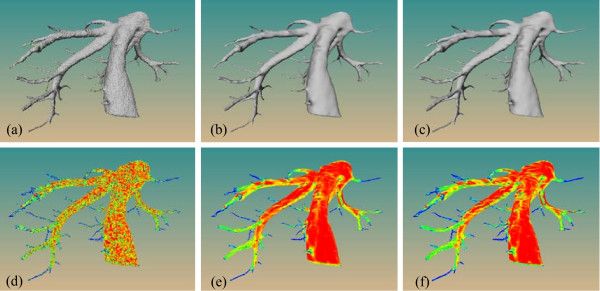
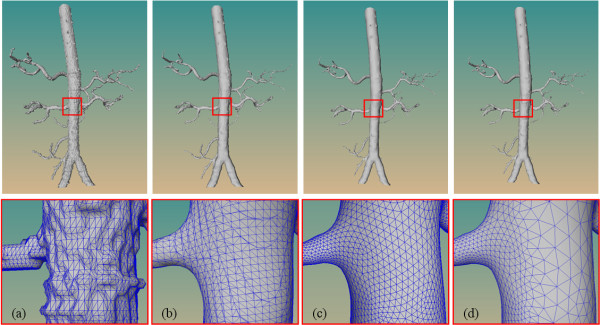
Experiments carried out on several typical vascular structures demonstrate that the presented method yields both a smooth morphologically correct and a topologically preserved two-manifold surface, which is scale-adaptive to the local curvature of the surface. Furthermore, the presented method produces fewer and better-shaped triangles with satisfactory surface quality and accuracy.
Compared to other state-of-the-art approaches, our method reaches good balance in terms of smoothness, accuracy, triangle quality and surface size. The vessel surfaces produced by our method are suitable for applications such as computational fluid dynamics simulations and real-time virtual interventional surgery.
血管结构的有效几何建模对于诊断、治疗计划和医学教育至关重要。这些应用需要在表面光滑度、表面精度、三角形质量和表面大小方面取得良好的平衡。
我们的方法首先从分割结果中提取血管边界体素,并利用这些体素来构建一个三维(3D)点云,其法向量通过协方差分析来估计。然后,通过求解泊松方程从定向 3D 点云中计算出 3D 隐式指示函数。最后,通过提出的自适应多边形化算法生成用于显式 3D 可视化的血管表面。
在几个典型的血管结构上进行的实验表明,所提出的方法生成了既光滑又形态正确且拓扑上保持不变的双连通曲面,并且该曲面能够适应表面的局部曲率进行尺度自适应。此外,该方法生成的三角形数量更少,形状更好,具有令人满意的表面质量和精度。
与其他最先进的方法相比,我们的方法在光滑度、精度、三角形质量和表面大小方面达到了良好的平衡。我们的方法生成的血管表面适用于计算流体动力学模拟和实时虚拟介入手术等应用。