Division of General Internal Medicine, Stanford University, Stanford, CA 94305, USA.
BMJ. 2010 Nov 18;341:c6218. doi: 10.1136/bmj.c6218.
To determine the association of reductions in price of antiretroviral drugs and foreign assistance for HIV with coverage of antiretroviral treatment.
Retrospective study.
Africa.
13 African countries, 2003-8.
A price index of first line antiretroviral therapy with data on foreign assistance for HIV was used to estimate the associations of prices and foreign assistance with antiretroviral coverage (percentage of people with advanced HIV infection receiving antiretroviral therapy), controlling for national public health spending, HIV prevalence, governance, and fixed effects for countries and years.
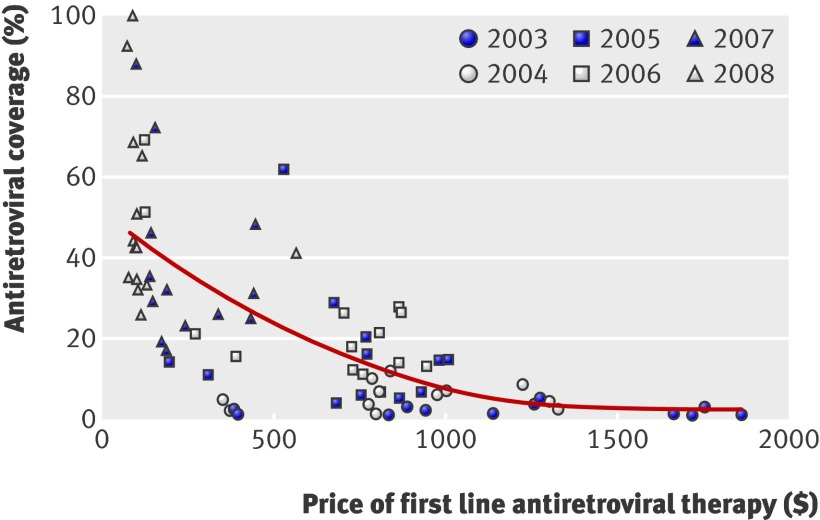
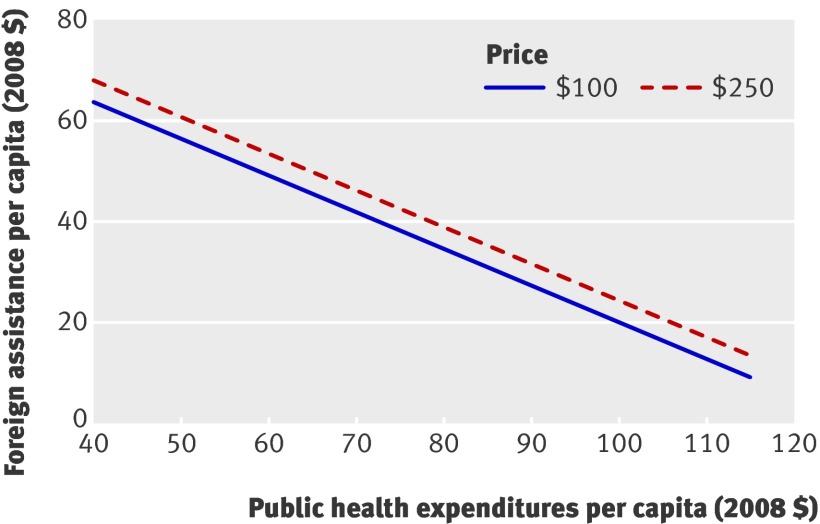
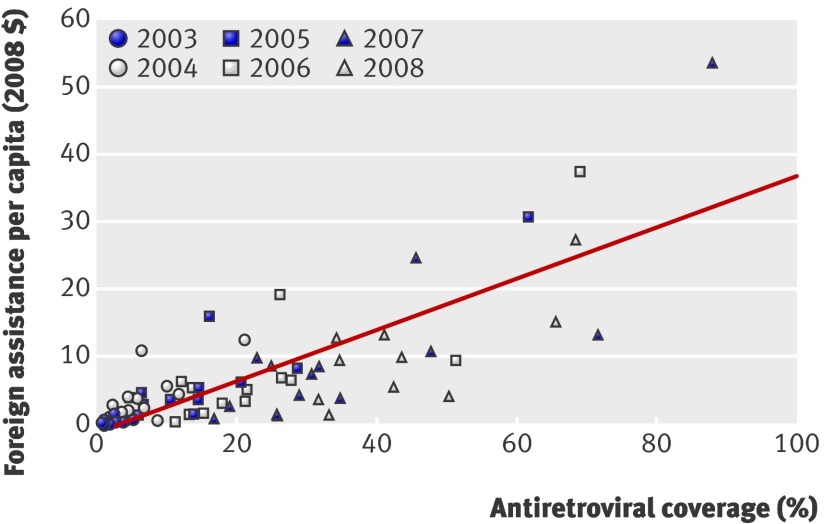
Between 2003 and 2008 the annual price of first line antiretroviral therapy decreased from $1177 (£733; €844) to $96 and foreign assistance for HIV per capita increased from $0.4 to $13.8. At an annual price of $100, a $10 decrease was associated with a 0.16% adjusted increase in coverage (95% confidence interval 0.11% to 0.20%; 0.19% unadjusted, 0.14% to 0.24%). Each additional $1 per capita in foreign assistance for HIV was associated with a 1.0% adjusted increase in coverage (0.7% to 1.2%; 1.4% unadjusted, 1.1% to 1.6%). If the annual price of antiretroviral therapy stayed at $100, foreign assistance would need to quadruple to $64 per capita to be associated with universal coverage. Government effectiveness and national public health expenditures were also positively associated with increasing coverage.
Reductions in price of antiretroviral drugs were important in broadening coverage of HIV treatment in Africa from 2003 to 2008, but their future role may be limited. Foreign assistance and national public health expenditures for HIV seem more important in expanding future coverage.
确定抗逆转录病毒药物价格下降和艾滋病毒外援与抗逆转录病毒治疗覆盖率之间的关联。
回顾性研究。
非洲。
2003-2008 年期间的 13 个非洲国家。
采用一线抗逆转录病毒治疗的价格指数以及艾滋病毒外援的数据,用以评估价格和外援与抗逆转录病毒覆盖率(即患有晚期艾滋病毒感染的人群接受抗逆转录病毒治疗的比例)之间的关联,同时控制国家公共卫生支出、艾滋病毒流行率、治理和国家及年份的固定效应。
2003 年至 2008 年间,一线抗逆转录病毒治疗的年度价格从 1177 美元(733 英镑;844 欧元)降至 96 美元,人均艾滋病毒外援从 0.4 美元增至 13.8 美元。价格每年降低 10 美元,调整后覆盖率相应增加 0.16%(95%置信区间为 0.11%至 0.20%;未调整的增加率为 0.19%,0.14%至 0.24%)。人均艾滋病毒外援每增加 1 美元,调整后覆盖率相应增加 1.0%(0.7%至 1.2%;未调整的增加率为 1.4%,1.1%至 1.6%)。如果抗逆转录病毒治疗的年度价格保持在 100 美元,那么外援需要增加 3 倍,达到人均 64 美元,才能实现普及治疗。政府效能和国家公共卫生支出也与覆盖率的提高呈正相关。
2003 年至 2008 年,抗逆转录病毒药物价格的降低对扩大非洲艾滋病毒治疗的覆盖率起到了重要作用,但未来的作用可能有限。艾滋病毒外援和国家公共卫生支出在扩大未来的覆盖范围方面似乎更为重要。