Department of Psychology, Northern Illinois University, DeKalb, IL 60115, USA.
Psychosom Med. 2011 Jan;73(1):59-66. doi: 10.1097/PSY.0b013e31820019e4. Epub 2010 Nov 19.
To investigate the hypothesis that long-term social isolation in an animal model would produce depression-relevant behaviors and disruptions in the 24-hour autonomic and activity parameters, and to further demonstrate the utility and validity of an animal model for the study of social environment, behavior, and autonomic function. Converging evidence from both experimental and epidemiological studies indicates that there is a bidirectional association between depression and cardiovascular disease; however, the precise neurobiological mechanisms underlying this relationship are not well understood. Disruptions in the social environment may influence this relationship.
Depression-relevant behaviors and ambulatory electrocardiographic and activity data were measured in 12 adult, socially monogamous prairie voles (rodents) during a period of chronic social isolation or social pairing (control conditions).
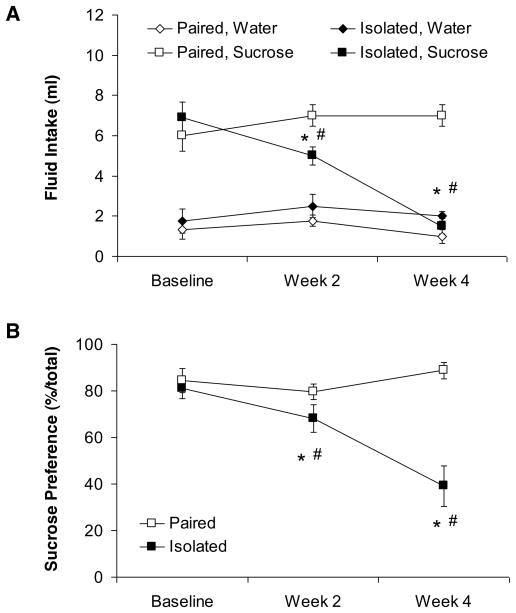
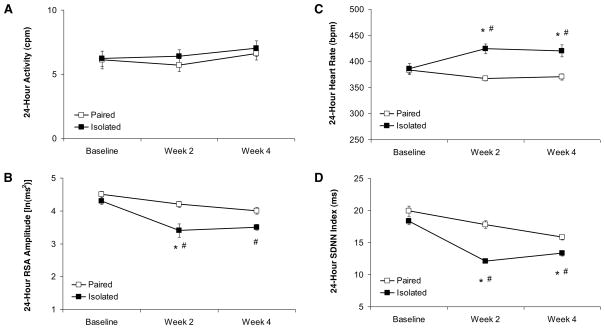
Prairie voles exposed to 4 weeks of social isolation versus control conditions (social pairing) exhibited anhedonia, increased 24-hour heart rate, reduced 24-hour heart rate variability, and predictable correlations between the behavioral measure (anhedonia) and the autonomic measures.
Social isolation is associated with depressive behaviors, 24-hour autonomic dysfunction, and predictable interrelationships between these variables in prairie voles but does not seem to be associated with rhythmicity changes in activity level or autonomic function. These findings have implications for understanding the role of the social environment in mediating the association of mood and cardiovascular disorders in humans.
研究假设,即在动物模型中长期的社会隔离会产生与抑郁相关的行为,并破坏 24 小时自主和活动参数,并进一步证明动物模型在研究社会环境、行为和自主功能方面的实用性和有效性。来自实验和流行病学研究的一致证据表明,抑郁和心血管疾病之间存在双向关联;然而,这种关系背后的确切神经生物学机制尚不清楚。社会环境的破坏可能会影响这种关系。
在慢性社会隔离或社会配对(对照条件)期间,测量了 12 只成年、社会一夫一妻制的草原田鼠(啮齿动物)的与抑郁相关的行为和动态心电图及活动数据。
与对照条件(社会配对)相比,暴露于 4 周社会隔离的草原田鼠表现出快感缺失、24 小时心率增加、24 小时心率变异性降低,以及行为测量(快感缺失)与自主测量之间可预测的相关性。
社会隔离与草原田鼠的抑郁行为、24 小时自主功能障碍以及这些变量之间可预测的相互关系有关,但似乎与活动水平或自主功能的节律变化无关。这些发现对于理解社会环境在介导人类情绪和心血管疾病之间关联中的作用具有重要意义。