Department of Epidemiology, Graduate School of Public Health, University of Pittsburgh, Pittsburgh, PA, USA.
Osteoporos Int. 2011 Sep;22(9):2475-85. doi: 10.1007/s00198-010-1481-1. Epub 2010 Nov 23.
We examined the association of serum 25-hydroxyvitamin D [25(OH)D] with indices of bone quality in older men. Positive associations for 25(OH)D and bone mineral density, content, cortical thickness, and axial and polar strength strain indices were observed among Caucasians; however, among men of African descent findings were either null or negative.
There are limited data on serum 25(OH)D and bone measures in men of African ancestry. To better understand racial differences in vitamin D status and bone health, a cross-sectional study among 446 Caucasian men in the US and 496 men of African ancestry in Tobago (age ≥ 65 years) was conducted.
Serum 25(OH)D (liquid chromatography and tandem mass spectrometry) was measured, and peripheral quantitative computed tomography scans were administered. Bone measures estimated included trabecular and cortical volumetric bone mineral density (vBMD), bone mineral content (BMC), bone geometry (cross-sectional area and cortical thickness), and polar and axial strength strain indices (SSIp and SSIx).
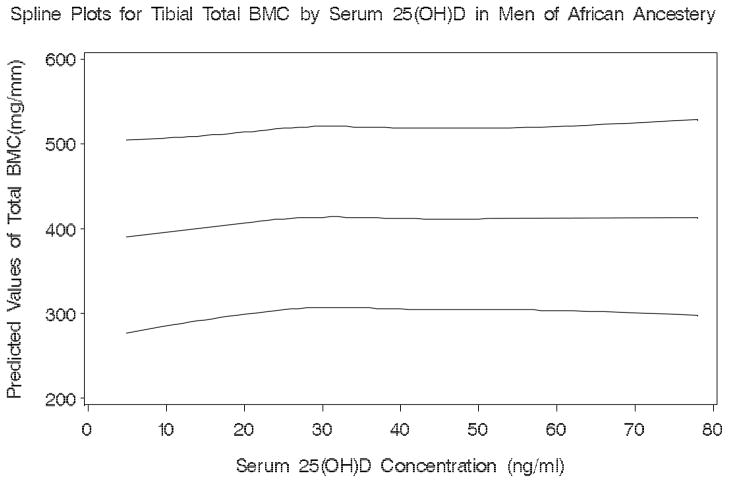
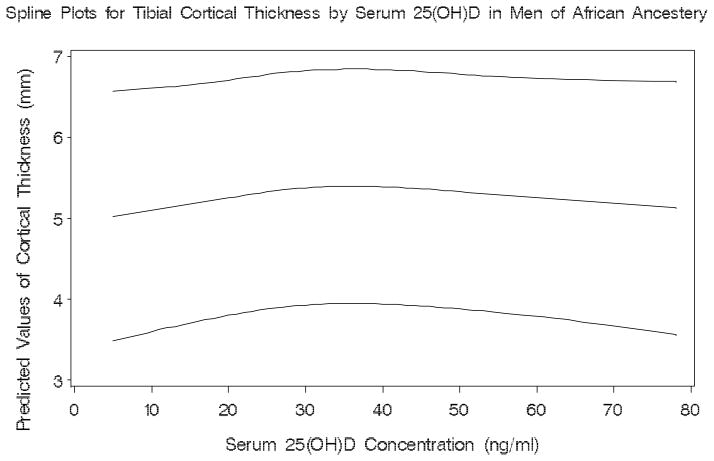
Men of African ancestry had higher 25(OH)D than Caucasians (34.7 vs. 27.6 ng/ml, p < 0.01). Among Caucasians, 25(OH)D was positively (p trend < 0.05) associated with cortical vBMD, total BMC, cortical thickness, SSIp, and SSIx at the distal radius after adjustment for potential confounders. Similar patterns were observed at the distal tibia. In contrast, in men of African ancestry, there was an inverse association (p trend < 0.05) between 25(OH)D and the cross-sectional area, and SSIx. Race modified (p for interaction < 0.05) the association between 25(OH)D and total BMC, cross-sectional area, SSIp, SSIx, and trabecular vBMD of the radius. In men of African ancestry, there was evidence of a threshold effect (at approximately 18 ng/ml) for 25(OH)D on tibial total BMC and cortical thickness.
More studies are needed to better comprehend these race differences for 25(OH)D and bone density, geometry, and indices of bone strength.
我们研究了血清 25-羟维生素 D [25(OH)D]与老年男性骨质量指标的关系。在白种人群中,25(OH)D 与骨密度、骨含量、皮质厚度以及轴向和极轴强度应变指数呈正相关;然而,在非裔美国人群中,研究结果要么为零,要么为负。
关于非裔美国人的血清 25(OH)D 和骨量数据有限。为了更好地了解维生素 D 状态和骨骼健康方面的种族差异,在美国对 446 名白种男性和特立尼达多巴哥的 496 名非裔男性(年龄≥65 岁)进行了一项横断面研究。
采用液相色谱-串联质谱法测量血清 25(OH)D,并进行外周定量计算机断层扫描。估计的骨量指标包括小梁和皮质体积骨密度(vBMD)、骨矿物质含量(BMC)、骨几何形状(横截面积和皮质厚度)以及极轴和轴向强度应变指数(SSIp 和 SSIx)。
非裔美国男性的 25(OH)D 高于白种人(34.7 与 27.6ng/ml,p<0.01)。在白种人群中,25(OH)D 与桡骨远端皮质 vBMD、总 BMC、皮质厚度、SSIp 和 SSIx 呈正相关(p 趋势<0.05),调整了潜在混杂因素后。在胫骨远端也观察到类似的模式。相比之下,在非裔美国男性中,25(OH)D 与横截面积和 SSIx 呈负相关(p 趋势<0.05)。种族(p 交互<0.05)改变了 25(OH)D 与总 BMC、横截面积、SSIp、SSIx 和桡骨小梁 vBMD 之间的关系。在非裔美国男性中,25(OH)D 对胫骨总 BMC 和皮质厚度的影响存在阈值效应(约 18ng/ml)。
需要更多的研究来更好地理解 25(OH)D 和骨密度、几何形状以及骨强度指标方面的这些种族差异。