Department of Gastroenterology and Internal Medicine, Medical University of Lodz, 90-647, Lodz, Poland.
Mol Biol Rep. 2011 Aug;38(6):3679-88. doi: 10.1007/s11033-010-0482-7. Epub 2010 Nov 24.
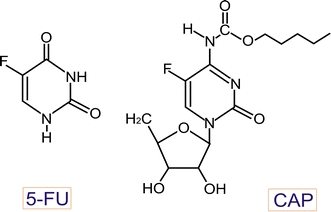
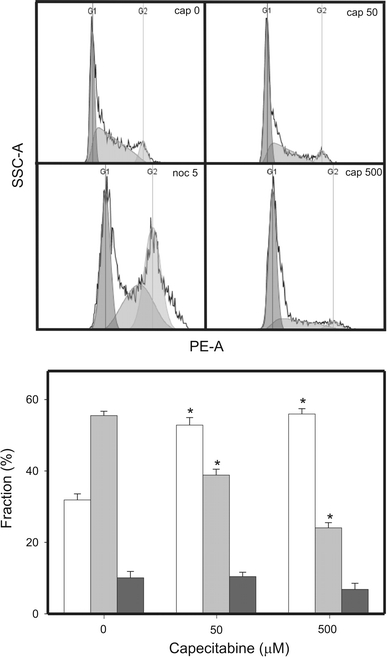
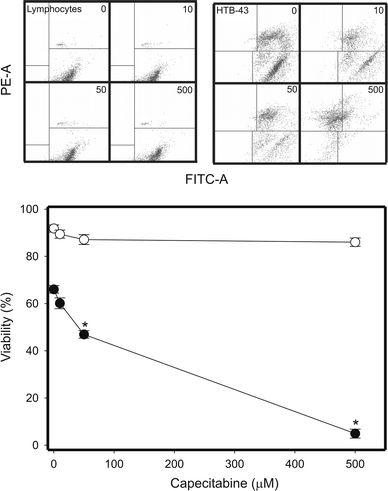
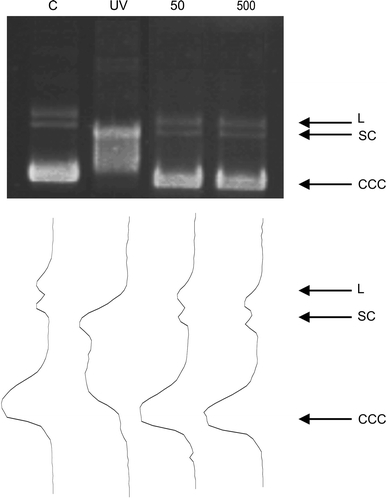
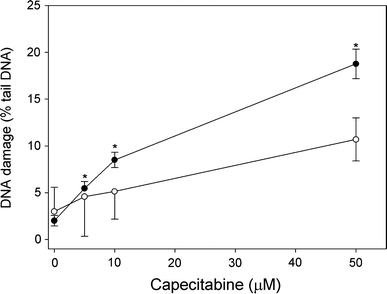
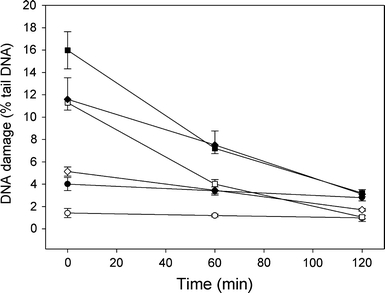
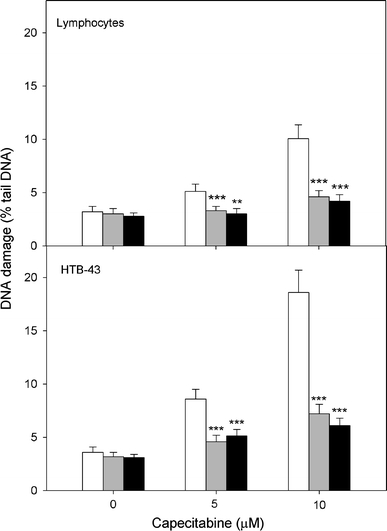
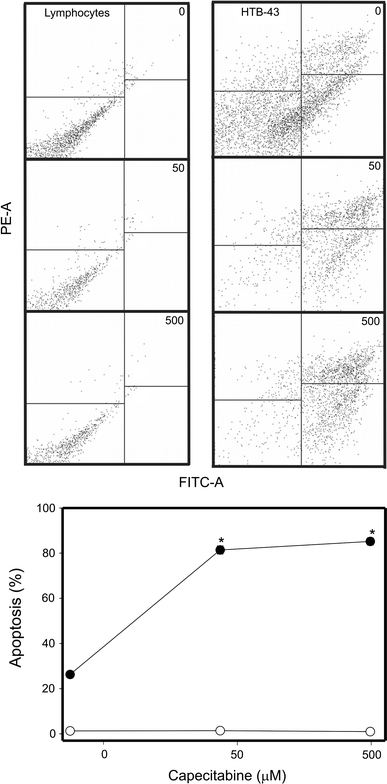
The interaction between a chemical and a cell may strongly depend on whether this cell is normal or pathological. Side effects of anticancer drugs may sometimes overcome their benefit action, so it is important to investigate their effect in both the target and normal cells. Capecitabine (Xeloda, CAP), a prodrug of 5-fluorouracil, is mainly used in colon cancer, but little is known about its action in head and neck cancer. We compared the cyto- and genotoxicity of CAP in head and neck HTB-43 cells and normal human lymphocytes by comet assay and flow cytometry. CAP at concentration up to 50 μM significantly decreased the viability of the cancer cells, whereas it did not affect normal lymphocytes. The drug did not interact with isolated plasmid DNA, but it damaged DNA in both cancer and normal cells. However, the extent of the damage in the former was much higher than in the latter. CAP induced apoptosis in the cancer cells, but not in normal lymphocytes. Pre-treatment of the cells with the nitrone spin traps α-(4-pyridil-1-oxide)-N-tert-butylnitrone and N-tert-butyl-α-phenylnitrone decreased the extent of CAP induced DNA damage, suggesting that free radicals may be involved in the formation of DNA lesions induced by CAP. The drug evoked an increase in the G0/G1 cell population accompanied by a decrease in the S cell population. CAP may evoke a pronounced cyto- and genotoxic effects in head and neck cancer cells, whereas it may or may not induce such effects in normal cells to far lesser extent.
化学物质与细胞的相互作用可能强烈依赖于该细胞是正常的还是病态的。抗癌药物的副作用有时可能超过其治疗作用,因此研究它们在靶细胞和正常细胞中的作用非常重要。卡培他滨(Xeloda,CAP)是氟尿嘧啶的前体药物,主要用于结肠癌,但对其在头颈部癌症中的作用知之甚少。我们通过彗星试验和流式细胞术比较了 CAP 在头颈部 HTB-43 细胞和正常人类淋巴细胞中的细胞毒性和遗传毒性。浓度高达 50 μM 的 CAP 显著降低了癌细胞的活力,而对正常淋巴细胞没有影响。该药物不与分离的质粒 DNA 相互作用,但会损伤癌细胞和正常细胞的 DNA。然而,前者的损伤程度远高于后者。CAP 诱导癌细胞凋亡,但不诱导正常淋巴细胞凋亡。细胞用氮自由基捕获剂 α-(4-吡啶基-1-氧化物)-N-叔丁基氮自由基和 N-叔丁基-α-苯基氮自由基预处理可降低 CAP 诱导的 DNA 损伤程度,表明自由基可能参与 CAP 诱导的 DNA 损伤的形成。该药物引起 G0/G1 细胞群增加,同时 S 细胞群减少。CAP 可能对头颈部癌细胞产生明显的细胞毒性和遗传毒性作用,而对正常细胞可能产生或不产生这种作用,程度要小得多。