
根据接受保乳手术的乳腺癌患者的雌激素受体状态,复发和死亡率。同侧乳房肿瘤复发的动态变化为残留乳房内的肿瘤生物学提供了线索。
Recurrence and mortality according to estrogen receptor status for breast cancer patients undergoing conservative surgery. Ipsilateral breast tumour recurrence dynamics provides clues for tumour biology within the residual breast.
机构信息
Scientific Direction, Fondazione IRCCS Istituto Nazionale Tumori, Milano, Italy.
出版信息
BMC Cancer. 2010 Nov 30;10:656. doi: 10.1186/1471-2407-10-656.
BACKGROUND
The study was designed to determine how tumour hormone receptor status affects the subsequent pattern over time (dynamics) of breast cancer recurrence and death following conservative primary breast cancer resection.
METHODS
Time span from primary resection until both first recurrence and death were considered among 2825 patients undergoing conservative surgery with or without breast radiotherapy. The hazard rates for ipsilateral breast tumour recurrence (IBTR), distant metastasis (DM) and mortality throughout 10 years of follow-up were assessed.
RESULTS
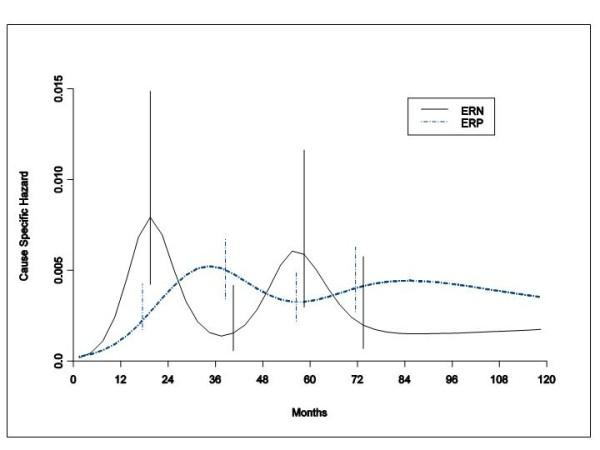
DM dynamics displays the same bimodal pattern (first early peak at about 24 months, second late peak at the sixth-seventh year) for both estrogen receptor (ER) positive (P) and negative (N) tumours and for all local treatments and metastatic sites. The hazard rates for IBTR maintain the bimodal pattern for ERP and ERN tumours; however, each IBTR recurrence peak for ERP tumours is delayed in comparison to the corresponding timing of recurrence peaks for ERN tumours. Mortality dynamics is markedly different for ERP and ERN tumours with more early deaths among patients with ERN than among patients with ERP primary tumours.
CONCLUSION
DM dynamics is not influenced by the extent of conservative primary tumour resection and is similar for both ER phenotypes across different metastatic sites, suggesting similar mechanisms for tumour development at distant sites despite apparently different microenvironments. The IBTR risk peak delay observed in ERP tumours is an exception to the common recurrence risk rhythm. This suggests that the microenvironment within the residual breast tissue may enforce more stringent constraints upon ERP breast tumour cell growth than other tissues, prolonging the latency of IBTR. This local environment is, however, apparently less constraining to ERN cells, as IBTR dynamics is similar to the corresponding recurrence dynamics among other distant tissues.
背景
本研究旨在确定肿瘤激素受体状态如何影响乳腺癌保守性原发乳房肿瘤切除术后复发和死亡的后续模式(动态)。
方法
在 2825 例接受保守性乳房肿瘤切除术(包括或不包括乳房放疗)的患者中,考虑了从原发性切除术到同侧乳房肿瘤复发(IBTR)、远处转移(DM)和死亡的时间跨度。评估了在 10 年随访期间同侧乳房肿瘤复发(IBTR)、远处转移(DM)和死亡率的危险率。
结果
DM 动态对雌激素受体(ER)阳性(P)和阴性(N)肿瘤以及所有局部治疗和转移部位均显示出相同的双峰模式(第一个早期高峰约在 24 个月,第二个晚期高峰在第六至第七年)。IBTR 的危险率保持了 ERP 和 ERN 肿瘤的双峰模式;然而,每个 ERP 肿瘤的 IBTR 复发高峰都比 ERN 肿瘤的相应复发高峰延迟。ERP 和 ERN 肿瘤的死亡率动态明显不同,ERN 肿瘤的早期死亡患者比 ERP 原发性肿瘤的患者多。
结论
DM 动态不受保守性原发肿瘤切除术范围的影响,在不同的转移部位,ERP 和 ERN 肿瘤的 ER 表型相似,提示尽管远处部位的微环境不同,但肿瘤在远处部位的发展具有相似的机制。在 ERP 肿瘤中观察到的 IBTR 风险高峰延迟是常见复发风险节律的例外。这表明残留乳腺组织内的微环境可能对 ERP 乳腺肿瘤细胞的生长施加了比其他组织更严格的限制,从而延长了 IBTR 的潜伏期。然而,这种局部环境对 ERN 细胞的限制显然较小,因为 IBTR 动态与其他远处组织的相应复发动态相似。


 Zotero 插件